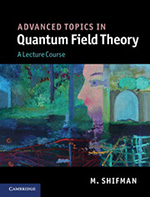
M. Shifman
CAMBRIDGE UNIVERSITY PRESS 2012, 640 PAGES
PRICE £46.00 (HARDBACK) ISBN 978-0-521-19084-8
 There are essentially three to four stages of studying the subject of Quantum Field Theory (QFT), as covered in American universities. In the first two of these stages there are usually a standard set of topics. In brief, these are: QFT 1 – Relativistic Quantum Mechanics, spinors, Dirac’s Equation, Hamiltonian QFT, Canonical Quantization, etc., and QFT II – Path Integral formalism, Perturbation Theory beyond tree level, Renormalization is thoroughly discussed, QCD, etc. These are covered in the first and second years of post-graduate study.
In books which deal with the third/fourth stage each lecturer chooses their own particular favourite set of topics. This book by M. Shifman, Advanced Topics in Quantum Field Theory, covers Shifman’s preferred options at the third/fourth stage. The book is organised into two major sections: Before Supersymmetry and Introduction to Supersymmetry. It is therefore aimed at students in their final year of study towards a PhD in the subject and leads into original research by those readers.
The first part of the book is split into nine chapters and coverage includes the following: Phases of Gauge Theories, Vortices and Strings, Monopoles and Skyrmions, Instantons and Chiral Anomaly. These are mostly, but not all, chapter titles.
A brief description of some of the chapters follows.
Chapter 1 looks into spontaneous symmetry breaking in general terms, then in terms of gauge symmetries, phases of Yang-Mills theories, chiral symmetry breaking.
Chapter 3 introduces strings and considers string-induced gravity.
Chapter 4 describes magnetic monopoles and skyrmions.
Chapter 5 provides quite a lot of detail about instantons including tunneling in non-Abelian Yang-Mills theory, the Euclidean formulation of QCD, BPST instantons, instantons at high energy and other ideas relating to baryon number violation.
Chapter 9 examines confinement in 4D gauge theories and models in lower dimensions.
The second part of the book consists of two chapters covering the Basics of Supersymmetry and Supersymmetric Solitons.
The book would be very useful to advanced readers in QFT attending American universities at the PhD level or beyond, and may be of use to other students as a supplementary text.