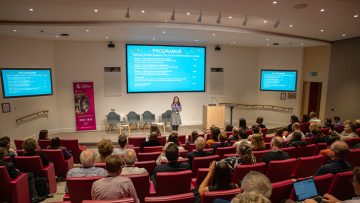
IMA National Celebration of the Best Maths Project 2024, featuring talks by Will Barnfield (University of Liverpool) and Maria Esteban Casadevall (Heriot-Watt University).
For those who were unable to attend this event, a recording has now been added to the IMA YouTube Channel here.
To celebrate the 60th anniversary of the IMA, the IMA ran a national competition where universities across the country were given the opportunity to put forward their top BSc student. The top scoring student from each university was invited to take part in the competition, sharing a topic from Maths/Stats or OR.
Will Barnfield and Maria Esteban Casadevall were awarded first and second place respectively, and will deliver talks based on their respective projects.
Abstracts
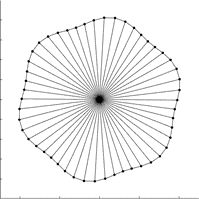
Vibrations of an N-gon mass-spring system and further geometry
Have you ever wondered why when an object vibrates it has a specific frequency? Take a tuning fork, for example—why does it have that pitch? This is due to a concept called vibrational modes, and this project is an exploration of them. I will first look at a simple symmetric mass-spring system, to introduce modes, then build on this model by extending the structure and discovering that some quite beautiful patterns emerge. Gyroscopes will then be introduced, and these will be used to model rotating bodies, altering the dynamics of the system. Finally, I will discuss a three-dimensional structure, constructed with platonic polyhedra, that I’m currently studying for its potential geophysical applications.
Ollivier Ricci curvature and (non-)convergence of the Ollivier Ricci flow
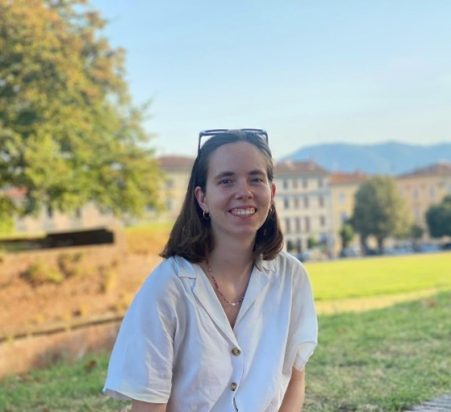 In this talk we will explore the Olliver Ricci curvature, a discrete notion of edge curvature based on the Wasserstein distance between probability distributions around neighbouring nodes. We will begin with a definition and description of such notion, together with a justification of its connection to the Ricci curvature in manifolds. We will then discuss the Ollivier Ricci Flow, an iterative process that tries to make the curvature of the graph constant, while modifying the edge weights. This algorithm can be applied to detect communities within a graph, and we will see a simulation of this phenomenon in a real-world dataset. The talk will close with the main result of the project, which focuses on the convergence of this Ollivier Ricci Flow algorithm. We present a graph for which a simplified version of the algorithm doesn’t converge and explain experimentally and theoretically the reason why.
Registration
This talk will be given remotely, via Zoom. If you wish to register for attendance at this talk, please register here. A joining link will be sent 24 hours before the event.
If you are an IMA Member or you have previously registered for an IMA conference, then you are already on our database. Please “request a new password” using the email address previously used, to log in.
No charge is made to attend this event. Non-IMA members are welcome.
Images courtesy of Will Barnfield and Maria Esteban Casadevall.