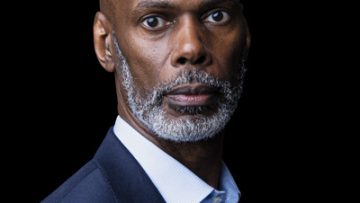
Sipping a fresh cup of tea and digesting Peter Rowlett’s editorial from the June 2022 issue of Mathematics Today (MT), I recall my attempts to define what is meant by ‘maths communication’. Peter Rowlett CMath FIMA was my predecessor in the role of Vice President, Communications for the IMA, and he continues to influence maths communication with great enthusiasm across the UK. From his content creation and media appearances to the networks of mathematicians he facilitates, Peter is what I would call a ‘maths communicator’ – out there communicating maths to the public, a key part of the IMA’s mission.
I don’t feel I can claim the same about myself! Whilst I have, through the IMA, contributed to a number of STEM events and conferences, my talents do not lie in public speaking, blogging or podcasting. It was to my pleasant surprise, then, that I was chosen to succeed Peter in his role at the IMA. As my term as VP began in 2024, I wondered what I might bring to the role.
As a fan of country music, I found inspiration in a quote from Dolly Parton:
Find out who you are and do it on purpose.
I set out to do just that, and drew up a decisive direction to find my feet! Taking inspiration from the five-year IMA Strategy [1], the Communications Committee established a number of key priorities in 2024, namely:
- Provide communications support to the IMA 60th anniversary celebrations.
- Support the branding and MT Refresh projects.
- Create the requisite governance documentation for the IMA Communications Committee.
Reflecting on these goals in 2025, the Communications Committee, IMA staff and other volunteers can be proud of their efforts. The 60th anniversary celebration in 2024 was an enormous success, and credit goes to all the staff and volunteers for marking the IMA’s 60th year with such a brilliant event. Videos from the day are available on the IMAmaths YouTube channel.
The MT Refresh project is underway, and excellent progress has already been made by the supporting task group. Readers have the opportunity to contribute their feedback via a survey – your input to the future of the magazine would be greatly appreciated.
A refresh of the IMA Equity, Diversity and Inclusion (EDI) web pages has also been undertaken; a timely update with the launch of the IMA EDI Strategy [2], prepared by our EDI Champion Howard Haughton CMath FIMA. I encourage the reader to review this strategy, which concisely outlines the benefits of promoting EDI in the mathematical sciences, and aligns these with the IMA’s strategic objectives (see Howard’s article on a recent inclusivity event).
The final priority, to update the governance documentation for the IMA Communications Committee, may not immediately grab everyone’s interest. However, it is fundamental to the IMA’s strategic priority to secure a sustainable future. Recent updates to Charity Commission guidance necessitate some of this change, however I also believe it’s a great opportunity to ensure robust foundations for IMA operations.
This brings me back to Dolly’s quote – I have discovered my greatest contributions to the VP role are to the inner workings of the organisation and the governance that supports it. The staff, members and volunteers that collaborate on these aspects of the IMA may not always take centre stage, but they are crucial to the running of our professional and learned society.
As part of these governance updates, an IMA Social Media Policy has been prepared, which establishes the rules of engagement and best practice for operating social media channels, for the IMA as a charity. Furthermore, this has offered the Communications Committee and IMA Council the opportunity to reflect on our strategic use of social media platforms. Given the present volatility of the social media landscape, I hope you’ll find comfort in the IMA’s adoption of a policy to ensure intentional and ethical engagement via social media.
Despite serving the IMA Council since 2017, I continue to discover initiatives that the IMA is involved in, and I am in awe of the diversity of activities. In what follows I’ll share some of the highlights from the past year and, in doing so, I want to encourage some reflection on the breadth of the IMA’s services, both for our members and the general public.
In spring 2024, the IMA launched IMA Exponential, an amazing new member benefit. IMA Exponential is a mentoring platform available to all IMA members. It connects more experienced members (mentors) with more junior members (mentees) to offer both members support for professional and skills development.
In addition to the platform itself, the IMA is creating resources to support members in their professional development journey. These vary from articles on mentoring concepts [3] to interviews with experienced members that are available on the IMAmaths YouTube channel. In the latest interview, I was joined by Jenny May Roberts (then IMA Membership Development Executive), Daniel Tilley CMath FIMA and his mentee Adrian Bell MIMA (then AMIMA) to explore their mentoring journey. This was an effective way to reflect on both the mentoring process and the value of IMA Exponential for mentoring.
Looking ahead, I’m excited to make use of IMA Exponential to support IMA Early Career Mathematicians in their professional development, as well as to help bolster the pipeline of mathematicians and, hopefully, maths communicators! I’m also delighted to introduce you to the new IMA Career Development Platform.
Additionally, the IMA supported Chartered Week 2025; it was exciting to juxtapose Chartered Mathematician (CMath) status with other equivalent professional registrations, and for chartered members to reflect on what chartership means to them. Moreover, the awareness week offers the opportunity for members to advocate the value of chartership and encourage Early Career Mathematicians to take the next step in their professional registration journey.
The IMA has recently expanded its catalogue of large STEM events, hosting a stand at the Royal International Air Tattoo (RIAT) for the first time in 2024. The IMA exhibited in the Techno Zone at the RAF Fairford air show and the large outreach kit was on show to educate visitors on the mathematics of aerodynamics, while aircraft roared overhead.
Increasing the number of events at which the IMA exhibits broadens public engagement and is a great opportunity for STEM volunteers to develop their skills. In 2025 the IMA will once again support the RAF Museum’s Forces in STEM that provides fascinating hands-on activities for 10–11 year olds (in London on 2 April and in the Midlands on 24 September). We also look forward to demonstrating soap films, binomial distributions and aerodynamics using the large outreach kit at the Big Bang Fair (NEC, Birmingham on 17–19 June).
If you would like to support future events as a volunteer, please contact the IMA Education mailbox.
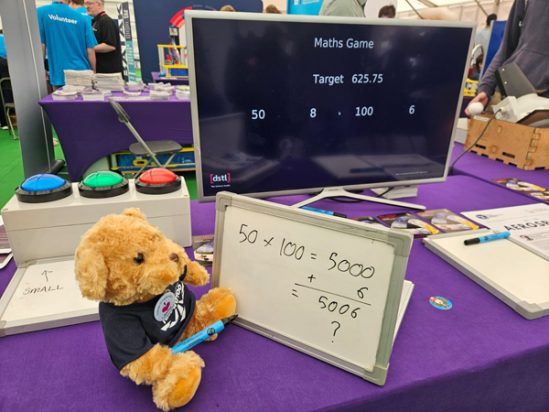
RIAT also saw the debut for a numeracy-based STEM game, curated by apprentices from Dstl. The game tested young people and their parents alike to combine four numbers using standard arithmetic operations to reach a target figure – see James the teddy trying it out in the image! I recall a comment from one parent, after handing them a white board and pen to participate alongside their children:
Oh I’m rubbish at maths, I won’t be able to do it.
Many readers will no doubt have come across this response to mathematical challenges. Whilst the underlying reasons for this sort of reaction are the subject of entire conferences, including the IMA’s series on maths anxiety, I believe it’s helpful to have a simple concept to help people who downplay their own mathematical ability. Kit Yates AMIMA (a member of the IMA Communications Committee) aptly summarises the pervasive, but false, dichotomy about mathematical ability [4, p. 174]:
Those who believe they can do maths and those who think they can’t.
Instead, as Kit suggests, we should describe mathematical ability more accurately using a spectrum. I propose we could go further and strike an analogy with physical fitness. In secondary school physical education, I recall the following definition of fitness:
The ability to meet the demands of one’s environment.
This definition allows us to consider unique environments and tasks, rather than solely a person’s physical and mental capabilities. For example, a professional shot putter might not be able to run a half marathon, but they are capable of throwing a 4 kg mass around 20 metres.
In the ‘mathematical fitness’ analogy, we should consider also what level of mathematical competence is demanded by someone’s environment: their job, lifestyle and interests. This is not to say that we shouldn’t encourage a better mathematical foundation for all, but that as a mathematics community we should help to understand the required level of competence for the populace and communicate using language everyone understands to improve the broad appreciation of mathematics.
Nathan Turner CMath FIMA
IMA VP Communications and QinetiQ
References
- IMA (2023) IMA Strategy 2023–2028
- IMA (2025) Launch of the IMA’s EDI Strategy 2024–2029
- IMA (2025) Unlocking Success: ONSIDE Mentoring for Early Career Mathematicians
- Yates, K. (2021) The Maths of Life and Death, Simon and Schuster.
Reproduced from Mathematics Today, June 2025
Download the article, IMA Communications: EDI, Development and Outreach (pdf)