David Reimer
PRINCETON UNIVERSITY PRESS 2014, 256 PAGES
PRICE (HARDBACK) £19.95 ISBN 978-0-69116-012-2
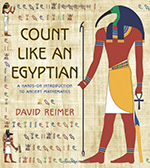 Asserting the shortcomings of existing writings on ancient Egyptian mathematics (at least for the popular audience), David Reimer has produced this step-by-step guide, from which the principles of Egyptian arithmetic may be learnt in a hands-on manner through their application to specific problems. The target audience is quite wide – the book is, I believe, accessible to secondary-school pupils, and yet contains much that will be of interest to people with a broader mathematical background. Count like an Egyptian is a beautifully glossy and colourful book; the presentation of hieroglyphs is particularly well done, and fully integrated into the surrounding text.
The lessons on Egyptian arithmetic begin, as one might expect, with basic operations on integers, where we learn, for example, that Egyptian multiplication was based upon addition and the repeated doubling of numbers (thus, for example, to compute 15 x 7, we note that 2 x 7 = 14, 4 x 7 = 28 and 8 x 7 = 56; since 15 = 1 + 2 + 4 + 8, we have 15 x 7 = (1 x 7) + (2 x 7) + (4 x 7) + (8 x 7) = 7 + 14 + 28 + 56 = 105). The author introduces here an assertion that he returns to throughout the book: that ancient Egyptian arithmetic is inherently easier to learn than our own system, since it involves only the simple application of methods such as that illustrated above, and does not require the memorisation of extensive times tables.
The complexity of the arithmetic increases with the progression of the chapters, as we learn, for example, how to manipulate Egyptian fractions. All of the methods set out are motivated by suitably Egyptian problems: the division of grain amongst workers, the scaling of figures in temple paintings, the construction of pyramids, and so on.
Large parts of the book are concerned not merely with what the Egyptians did, but also with why they did it that way. Where more than one method, or more than one form of the final answer, was available, the author endeavours to explain why ancient Egyptian scribes opted for a particular path. The breaking down of ancient Egyptian methods serves also to throw new light on our own arithmetical procedures.
The book is peppered throughout with (often light-hearted) historical anecdotes and explanations which serve to add context to the mathematics – or, as the author puts it: ‘to work a little color and humor into a book that might otherwise consist of a few dry mathematical procedures’ (pp. 144). The contextual elements that I particularly liked were the stories from ancient Egyptian mythology.
As mentioned above, the author’s contention, which he argues quite convincingly, is that Egyptian methods are in many ways superior to our own. In particular, he challenges the popular view that positional number systems are vastly superior to older non-positional systems, such as that of the Egyptians. In order to drive this point home, he calculates the product 5,784 x 12,497 first using a Babylonian positional system, and then with Egyptian methods; the former takes about two pages, whilst the latter needs just ten lines. The author does acknowledge, however, that whilst Egyptian procedures may provide a more efficient arithmetic, they do not necessarily lend themselves to the development of higher mathematics in the same way that our current methods do.
The book concludes with a slightly more serious message: that the use of Egyptian procedures requires and engenders a deeper knowledge of the under-lying arithmetic, whereas ‘[t]he procedural methods of modern calculation turn our children into mathematical automatons, memorizing without understanding’ (pp. 207). I am not sure how fair a comment this is, but I do feel that, in exposing me to an arithmetical system that is quite different from the one that I am used to, this book has given me a new perspective on day-to-day arithmetic.
Christopher Hollings MIMA
Book review published directly onto IMA website (April 2015)