A Report on the IMA’s First Meeting on Mathematics for Climate, Environment and Sustainability
De Morgan House hosted the inaugural IMA meeting on Mathematics for Climate, Environment and Sustainability (CES), marking the official launch of the lnstitute’s new Special Interest Group (SIG) dedicated to this vital field. The meeting brought together over 70 participants – a room of more than 40 attending in-person and around 30 joining online – from across academia, industry, policy, and the early-career community.
The Climate, Environment and Sustainability (CES) SIG has been established to provide a forum, and a focus, for IMA members interested in climate, environment and sustainability matters – engaging the mathematical sciences community, especially IMA members, in these critical areas. The CES SIG Steering Group is responsible for organising conferences, providing expert advice, and supporting the IMA on related issues. It also aims to encourage, support, disseminate, and celebrate excellent mathematical research in climate, environment and sustainability, as well as conveying the results of this research to policy makers and beyond.
The event opened with welcoming remarks from CES SIG member Dr Dawn Geatches, followed by a thought-provoking address from IMA Executive Director Rosalind Azouzi, which formally inaugurated the SIG’s activities.
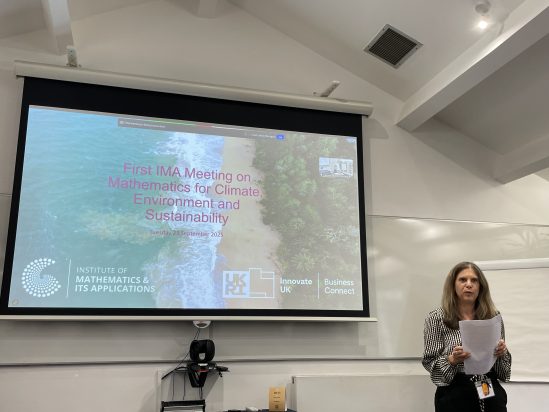
IMA’s Executive Director Rosalind Azouzi welcomes the meeting attendees with an opening speech.
The scientific programme reflected the wide-ranging relevance of mathematical research, with talks exploring topics such as climate tipping points, energy efficiency in data centres, and the mathematics of ecological systems.
The morning programme featured three compelling keynote talks that underscored the critical intersections between mathematics, climate science, sustainable computing, and ecology. First, IPCC AR7 Lead Author and Professor of Applied Mathematics Valerio Lucarini (University of Leicester) explored the multistability of the Earth’s system, emphasising the role of mathematics in understanding complex climate dynamics such as the Atlantic Meridional Overturning Circulation (AMOC), ice-albedo feedback mechanisms, and transient chaos.
Next, sustainability consultant Alex Bardell (SDAdvocate) examined the convergence of mathematics, energy systems, and computer science, highlighting the mathematical challenges inherent in managing a decarbonised energy grid amidst growing demands from Al and data centres. Finally, Dr Lindesay Scott-Hayward (University of St Andrews), who is the Head of St Andrews’ Centre for Research into Ecological and Environmental Modelling (CREEM) offered an overview of CREEM’s two-decade impact on ecological modelling and marine conservation, demonstrating the importance of statistical approaches in environmental assessment, and reinforcing the value of cross-disciplinary collaboration in these fields.
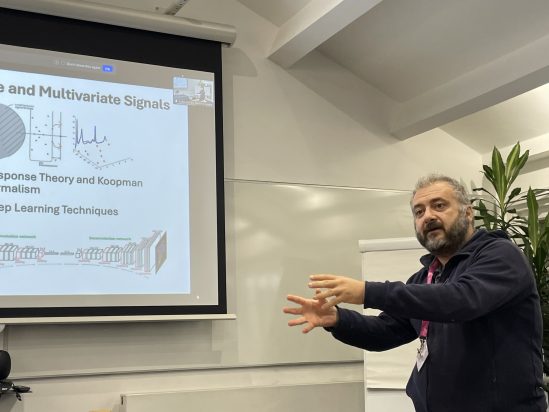
Prof Valerio Lucarini explains the use of linear response theory in understanding climate tipping points.
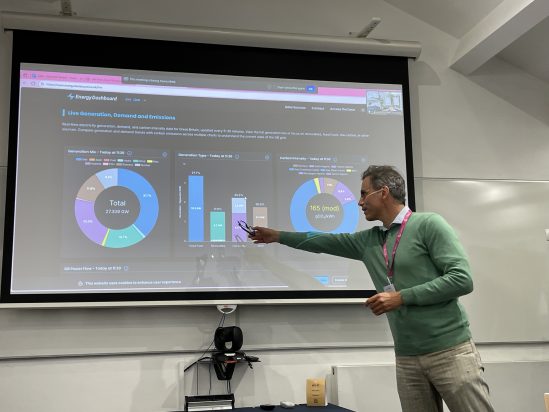
Alex Bardell shows the breakdown of energy demand, generation and consumption in the UK.
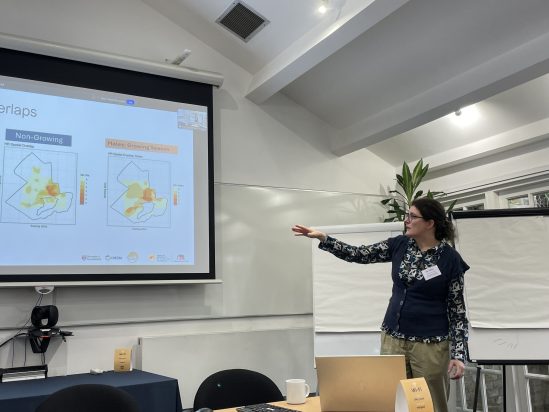
Dr Lindesay Scott-Hayward shows how she used statistical modelling to support conservation and management decisions in Namibia.
The afternoon featured structured breakout discussions, offering both in-person and online participants the opportunity to share their perspectives on how the SIG might best support the wider community. In the first round, participants were grouped by domain of interest – climate, environment, or sustainability – while the second round focused on sector-specific discussions across academia, industry, and policy. Each session concluded with a report-back, where group leads presented key insights to the wider audience. The feedback gathered from these discussions has been carefully collated and will inform the SIG’s future activities and strategic direction in consultation with IMA Council.
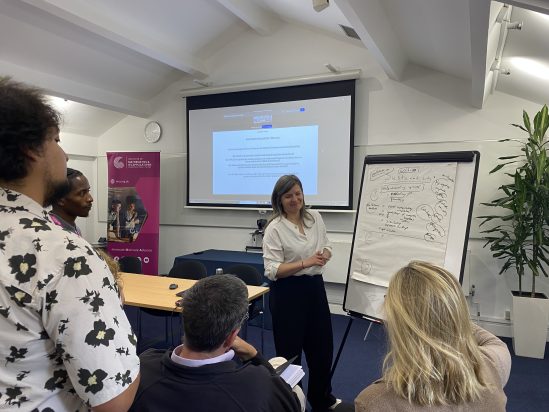
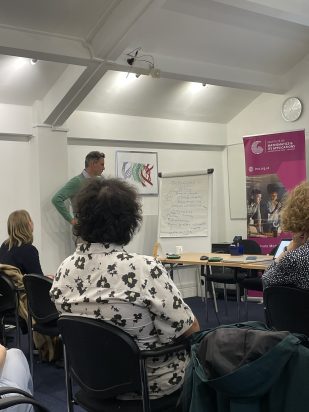
Breakdown discussions led by Dr Karolina Rucinska (left) and Alex Bardell (right).
The day concluded with a panel discussion chaired by Dr Francisco de Melo Virissimo (LSE), featuring leading figures from industry and policy: Professor Veronica Bowman OBE (Paebbl), Dr Karolina Rucinska (Innovate UK Business Connect), Angela Mathis (ThinkTank Maths Limited), and Dr Thomas Hodgson (CreditNature).
Three of the panellists, all mathematicians and statisticians, shared how mathematical thinking has directly shaped their work in developing innovations such as carbon removal and storage, sustainable aviation fuel, satellite pollution, and mechanisms for financing nature-positive projects. Their reflections highlighted the central and often under-recognised role of mathematics in driving practical, scalable solutions to environmental challenges. The panel also benefited from the perspective of a non-mathematician, who spoke to the importance of interdisciplinary collaboration in enabling these advances. The discussion was followed by a networking reception, allowing participants to continue the exchange of ideas.
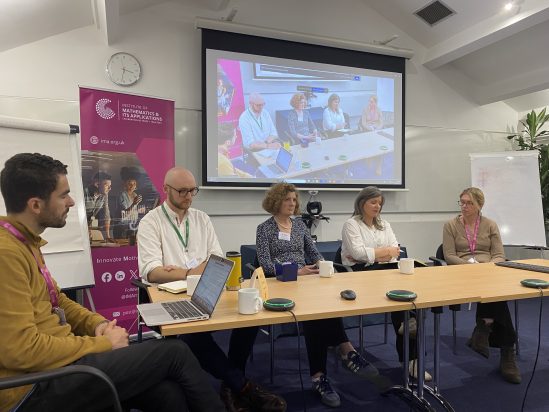
Panel discussion with experts on the role of mathematics for CES in industry and decision-making.
The Steering Committee extends its sincere gratitude to all speakers, panellists, and attendees, as well as to the IMA Secretariat for their continued support and the staff of DMH. Special thanks are also due to Innovate UK Business Connect for their generous sponsorship, which made the event possible.
For further information, including the full list of speakers, presentation titles, and recording of the day, please visit the event website. Additionally, CES SIG warmly welcomes your interest and input. If you would like to get in touch, please send an email to sigs@ima.org.uk
The full programme, including abstracts, is available on the event webpage. https://ima.org.uk/27086/
Full recordings of the day, including talks and panel discussion, are avaialble on IMA’s YouTube channel https://www.youtube.com/playlist?list=PLX2zO2SdlWteFzCBnbEe0rntdUBIuSXd7
Dr Francisco de Melo Virissimo (London School of Economics)
Dr Dawn Geatches (Innovate UK Business Connect)
Prof Chris Budd OBE (University of Bath)
Natacha Johnson (Heathrow Airport)
Dr Tiffany Vlaar (University of Glasgow)
The content, views and opinions expressed herein are those of the authors and do not necessarily reflect those of Heathrow Airport.
Photo credits: Dr Francisco de Melo Virissimo, Dr Tiffany Vlaar and Dr Dawn Geatches.