Béatrice Rivière
SIAM 2008, 190 PAGES
PRICE $57.00 (PAPERBACK) ISBN 978-0-898-71656-6
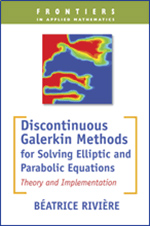 This book is part of the series of books ‘Frontiers in Applied Mathematics’. It is aimed mostly at Mathematicians working on solving various Partial Differential Equations numerically. The first chapter is accessible to undergraduates but the rest is at a much higher level.
The book is organised into three sections: Elliptic Problems (Chapters 1–2), Parabolic equations (Chapter 3) and Applications (Chapters 4–8).
Chapter One introduces the Discontinuous Galerkin (DG) method using a single dimension elliptic equation to present the ideas as simply as possible. It is made very clear from early in the chapter that knowledge of the Lebesgue measure and basics of Sobolev spaces are assumed. The following classes of DG methods are defined, based on the values of various parameters: Symmetric Interior Penalty Galerkin (SIPG); Non-Symmetric Interior Penalty Galerkin (NIPG) and the Incomplete Interior Penalty Galerkin (IIPG). The remainder of the chapter considers the detailed analysis and calculations of a simpler case of DG.
Chapter Two uses an elliptic equation in two and three dimensions as an example. Vector methods and aspects of Sobolev space are introduced and the DG methods are studied in some detail, including software implementation details. The Local Discontinuous Galerkin (LDG) method is introduced. At the end of the chapter the DG methods are compared to the Finite Element method so that the advantages of each can be appreciated.
Chapter Three demonstrates the approach when the equation is a pure parabolic type where first space and then time variables have to be discretised. Chapter Four considers parabolic equations that include convection. Chapters Five to Eight consider various applications of these ideas: Linear elasticity, Stokes flow, Navier-Stokes flow and Flow in Porous Media.
At various points in the book the author points out areas of the theory where there are existing opportunities for research in the subject due to gaps in the theory at the time of writing.
This book is clearly aimed at postgraduate and research mathematicians who are interested in recent advances in numeric methods of solving PDE using discontinuous Galerkin methods. I would recommend it for such an audience.
John Bartlett CMath MIMA
Book review published directly onto IMA website (February 2013)