I have been reflecting on my recent appointment in July 2025 as Editor of Mathematics Today, taking over from Rob Ashmore CMath CSci FIMA who had been in post since just before the pandemic in 2019. (My thanks for doing an excellent job, Rob; I’m very glad you are sticking around!) I realised that I was certainly not the first incumbent in this role who did not study mathematics as an undergraduate. Indeed, both the much missed David Broomhead and Edward Stansfield, two of the editorial board chairs under whom I served, initially studied chemistry and electrical engineering, respectively, before focusing on applied mathematics. So when I took up this role, having served the board continuously since late 2008, I did not feel particularly out-of-place, in fact the board has always welcomed quite a diverse crowd.
In terms of my own journey here, I grew up in West Yorkshire in a town called Ossett, directly between Wakefield and Dewsbury, but I ventured to London in the early 1990s for university and spent my days as an undergraduate and taught masters student at Imperial College London, studying civil and structural engineering, respectively.
Subsequently, however, my formative years in research were spent in the mid to late 1990s at the University of Bath, under the brilliant and inspirational supervision of Giles Hunt CMath FIMA, whose 80th birthday workshop was discussed in some depth in the April 2025 issue’s Westward Ho! piece by my excellent friend, Alan Champneys CMath FIMA [1]. As a supervisor, Giles instilled a passion for the field of nonlinear structural mechanics, including instabilities, bifurcations and dynamical systems. More significantly, working with Giles gave me the following principles for a career in research science and engineering, which I subsequently pursued back at Imperial:
- Do the curiosity-driven work that you find interesting.
- Do let the science drive and guide you.
- Do try to inspire the next generation.
- Don’t be afraid of being hands-on, or ‘getting your hands dirty’, while supervising research.
- Don’t let your ego get in the way of awkward facts.
- Don’t feel that you need to follow the crowd.
This may all seem self-evidently very easy to follow, but with the way that scientific and engineering research is conducted and funded, at times with external pressures to publish more or to secure more funding, it is not always straightforward to remain true to these values.
Another individual who has been a great influence particularly during my time in Bath is the inimitable Chris Budd OBE CMath FIMA, whose sheer enthusiasm for all things mathematics and promoting the message about science to the public has stayed with me ever since, not to mention our shared passion for some pretty terrible puns. Indeed, it was simply a delight to compile 50 Visions of Mathematics alongside Alan, Chris, Rachel Thomas and Marianne Freiberger of Plus Magazine, IMA Past President Paul Glendinning FRSE FIMA and Steve Humble MBE FIMA, under the editorship of Sam Parc, whose enigmatic spirit surely lingers amongst us all [2].
One of the great joys of being an academic (and perhaps a guilty pleasure in these days of measurable carbon footprints) is being able to attend conferences in exotic places across the world. At the time of writing this piece, I had just returned from Cape Town in South Africa having delivered a keynote lecture at an international conference on structural engineering, mechanics and computation. (Thanks to the IMA, who very kindly partially funded this through the Institute’s Small Grant Scheme.)
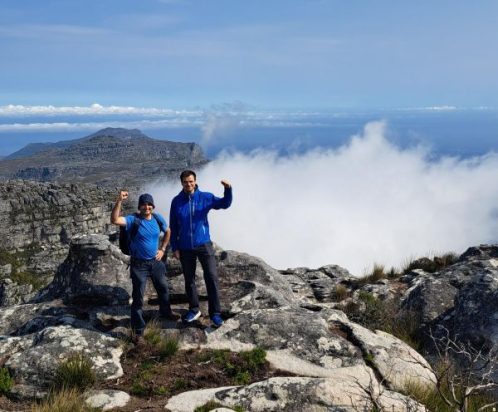
I have been a regular contributor to this particular conference series since 2007, which is held every three years and, perhaps unusually, always in the same city. As in previous editions, it was a very enjoyable experience being there and for once the weather, which can be rather fickle in September owing to the dominating presence of Table Mountain over the city, was settled for the entire time of my stay. Indeed, I even braved a climb of Table Mountain with a considerably younger colleague (albeit for me I was climbing the mountain for a second time), which according to the path map constituted a 670 metre ascent from the starting point to the summit. I am delighted to report that we made it up there successfully (see photo) and I was in much better shape than during my previous climb in 2013!
My featured lecture was the second technical talk of the conference, the first being on the practical aspects of deployable structures for self-assembly in space. While that talk was well presented and interesting, the session chair appeared to relish making a point that there were no equations presented within it. While I realise that an excessive number of equations within a conference presentation, particularly in cases where those equations are not discussed or explained properly, may easily render a talk unintelligible, it felt to me that the chair was trying to make a point for the sake of it.
Why is it that some engineers, and for that matter some scientists, feel the need to be apologetic regarding their mathematical literacy? I do not observe people going around apologising for being able to read and write properly; moreover, I do not recall anyone publishing a book entitled An Engineer’s Apology (although a quick web search revealed some short articles with that title … ). In the last editorial [3], Andy Harrison FIMA eloquently discussed the false dichotomy between artistic creativity and mathematics, and that also resonates strongly here.
When it came to my turn to present, my lecture explicitly focused on the mathematical modelling of structures susceptible to instabilities, which need to be carefully considered particularly when designing thin metal structural components that are compressed. A common example being the design of steel columns within a multi-storey building. Naturally, as I am not one to take things lying down, I now felt the need to make a positive point regarding the presentation of equations in my talk.
The more serious point I was trying to make in the lecture overall was that while standard computational methods – on which structural engineers rely daily – are largely excellent at analysing straightforward structures, the potential presence of structural instabilities (including the prospect of bifurcations and other nonlinear effects within the underlying system) can introduce serious problems for standard solvers. This is because such effects can introduce singularities that can cause severe convergence problems and mitigation efforts within standard software can end up providing misleading and possibly unsafe solutions. However, more rigorous mathematical modelling with their resulting algorithms can provide more accurate insights and procedures compared to standard methods. Happily, the talk seemed to go down well with the audience and I could relax for the remainder of the conference; I enjoyed watching various interesting research talks, making fresh contacts, catching up with old friends and enjoying the excellent food.
Communication is key to any scientific endeavour. I have often said to students, whether they are undergraduate or masters students conducting final projects, or doctoral research students, that while rigour is obviously and critically important, good work that is presented without clarity has limited impact. There is immense value in determining how to present an argument, a derivation, or a particular set of results with clear logic and concision. Technical conferences, research seminars and informal conversations, alongside formally written articles, whether for a journal, a report for industry, or dare I say, an article in Mathematics Today, are essential routes for dissemination.
With clear dissemination comes a wider understanding that leads to the corresponding field advancing. I hope that you, our readers, will continue to support and contribute high quality articles and letters to Mathematics Today (email: Rebecca.Waters@ima.org.uk). The editorial board will endeavour to continue curating and supporting the diverse and interesting contributions made to the magazine fairly.
Ahmer Wadee CMath CSci FIMA
Imperial College London
References
- Champneys, A.R. (2025) Westward Ho! Musing on mathematics and mechanics: The mechanics of the Young, Mathematics Today, vol. 61, no. 2, pp. 37–41.
- Parc, S. ed. (2014) 50 Visions of Mathematics, Oxford University Press.
- Harrison, A. (2025) Editorial, Mathematics Today, vol. 61, no. 5, pp. 122–123.
Reproduced from Mathematics Today, December 2025
Download the article, An engineer’s non-apology (pdf)