It is 5am on 10 April 2025 and I am stood, bathed in moonlight, on the slopes of Two Tree Hill¹, waiting for the Moon to align with the 700-foot tall long-wave antennae at Wychbold. As I wait, I ponder the mathematics that has led me to stand at this location, at this moment, confident that in 25 minutes the setting Moon will sit between the antennae and let me capture this image.
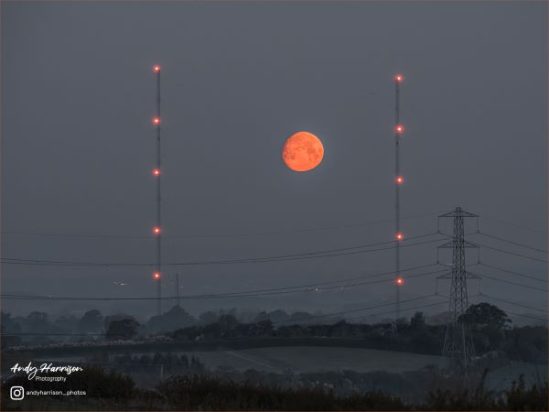
Creating an image like this depends on:
- celestial mechanics – to know where the Moon will be at a given time relative to landmarks on the ground.
- geometry and trigonometry – to determine the line of sight, ensuring that I can see both the Moon and the antennae from my shooting spot.
- optics – to allow me to focus on the Moon and antennae simultaneously, which is not as trivial as you might imagine.
When we utilise the tools of applied mathematics we can create amazing things.
Applying mathematics allows us to tackle key business and industrial problems, which drive prosperity, innovation and quality of life. But, if we consider Maslow’s hierarchy of needs, quality of life is not just about physiological and safety needs, it includes, ultimately, self-actualisation: including the appreciation of beauty. We can all agree that there is inherent beauty in mathematics, but mathematics can also be a tool for creativity. Mathematics is often used to create beauty.
It would be easy to embrace the zeitgeist and focus on generative AI as a tool to create. The use of generative AI is part of my creative workflow – usually to remove distractions – and it is an amazing tool for creativity. There is a great deal of mathematics that underpins AI, but there is also a lot of mathematics that is not AI. A lot of mathematics that is well founded and has been known for centuries. It is the application of this mathematics that allows me to create images like the one above.²
The mathematics of celestial mechanics, geometry and trigonometry, and optics not only allows me to create images of the Moon setting but also Milky Way landscapes and deep-sky objects. Mathematics also gives me the tools to take the dull, raw image of the Orion nebula on the left (see below), which I took in my light polluted back garden in Worcester, and process the data within the image to produce the image on the right.
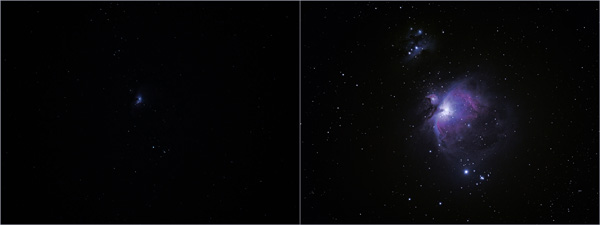
But why is this amazing and how do we convey the joy and excitement of creating images like this to others? I do not mean, why is the image beautiful; that is the realm of psychology. I am talking about taking a simple equation and exploring the consequences of where it takes us, not just the exploration of the mathematical landscape but the universe of applications. When we did linear equations at school, did we imagine that the end product would be ChatGPT and other Large Language Models (LLMs)? When we did trigonometry, did we see celestial mechanics, landing rovers on Mars and these images?
We need to share this joy, this excitement, this passion. We often talk about STEM (science, technology, engineering and mathematics) and the need to engage with the next generation of scientists, engineers and industrialists. We also need to consider the creatives, who often dismiss mathematics as irrelevant to them. More than that, all the scientists, engineers and industrialists are not one dimensional. The quality of their life can, and should, include creativity.
As a teenager, I had a creative side as well as an analytical one. I wrote poetry (I even came second in an Eisteddfod) and aspired to be a writer. But I abandoned that to be a mathematician, because I convinced myself it was either or. It can be both and one can feed the other.
We should tackle this artificial dichotomy between mathematics and art head on. Despite the historical and inherent connections between mathematics and art, our modern culture and educational system emphasise mathematics’ objectivity and logic as opposed to the subjective and emotionally driven realm of art. There is no dichotomy; they are not separate.
Historic examples of the use of mathematics in art and architecture can be seen in Mesopotamia and Egypt through the use of geometric designs and proportionality [1]; and in the use of the golden ratio in Greek sculpture and Renaissance art. And, while fractals are mathematical constructs, how many of us as teenagers in the 1990s had a poster of the Mandelbrot set on our bedroom wall? Mathematics has been a tool for creativity and art throughout human history, so, why, in the 21st century, is the value of mathematics often diminished and seen as the antithesis of creativity?
How should we deliver this message? It is not about talking to ourselves or the people who are already drawn towards mathematics and analytical roles; we need to reach the people who dismiss mathematics and its power. We could go to a literary event such as the Hay Festival and give a talk about mathematics, which would draw in those already interested in mathematics. Instead, we should talk about creativity then weave in mathematics as just another tool, akin to an easel or a paintbrush. We do not need everyone to use, or even like, mathematics as much as we need people to understand its importance: that it is part of the fabric of society.
I did not need to do any of the mathematics required to create my images. Instead, I used a couple of apps on my phone: PhotoPills and Planit Pro. The apps did the mathematics! This is a message we need to share: you do not need to understand the mathematics to reap the benefits of its application and to appreciate the power of the mathematics. I do not need to understand loss functions, backpropagation and the attention mechanism at the heart of LLMs to use them to answer my questions or to create.
There has been a meme that AI will not take our jobs but those who use AI will take the jobs from those who do not. I would argue that we can replace AI with mathematics in that statement, and it will still be true.
What does success look like? How will we know that we have been heard? One measure of success is that people come to listen. Another measure is that they move up the levels of the conscious competence model from conscious incompetence to conscious competence, to eventually unconscious competence. Our greatest success will be when mathematics is applied to create amazing things, but users are unaware of the mathematics underneath it. That is where Google searches are; and where LLMs (such as ChatGPT, Claude and Gemini) are. But, for mathematics to be valued, we need to make people aware that mathematics underpins this. Perhaps, counterintuitively, we need to take people back to conscious competence.
Why is this something on which we should expend effort? For me the applications in IMA is key to our identity and is our unique selling point. I am not talking about applied mathematics but about the application of mathematics – in its broadest sense. That should be what sets us apart. Celebrate the application of mathematics and its role as a tool for creativity!
Hopefully, you are keen to understand the mathematics that allowed me to create the image of the setting Moon at the start of this editorial. That though is for another article.
Andy Harrison FIMA
IMA VP Business, Industry and Government
Notes
- Two Tree Hill in Worcestershire: 52° 17’ 30” N, 2° 2’ 37” W.
- If you want to go out and try some astrophotography, I would recommend Photographing the Night Sky [2] or The Complete Guide to Landscape Astrophotography [3].
References
- Høyrup, J. (2008) Geometry in Mesopotamia and Egypt, in Selin, H. (ed.) Encyclopaedia of the History of Science, Technology, and Medicine in Non-Western Cultures, Springer, pp. 1019–1023.
- Wallace, A. (2024) Photographing the Night Sky, FotoVue.
- Shaw, M. (2017) The Complete Guide to Landscape Astrophotography, Routledge.
Reproduced from Mathematics Today, October 2025
Download the article, Mathematics as a Creative Tool (pdf)