The winners of the Gold, Silver and Bronze awards for mathematics at The Parliamentary & Scientific Committee’s STEM for Britain 2026 were announced on Tuesday 17th March at a prize-giving ceremony at the Houses of Parliament, Westminster.
The three winners – Torin Fastnedge AMIMA (University of Oxford) Gold, Zita Borbala Fulop (University of Glasgow) Silver and Freya Bull (University College London) Bronze – were selected among 20 finalists from a field of more than 100 applications within the mathematics category.
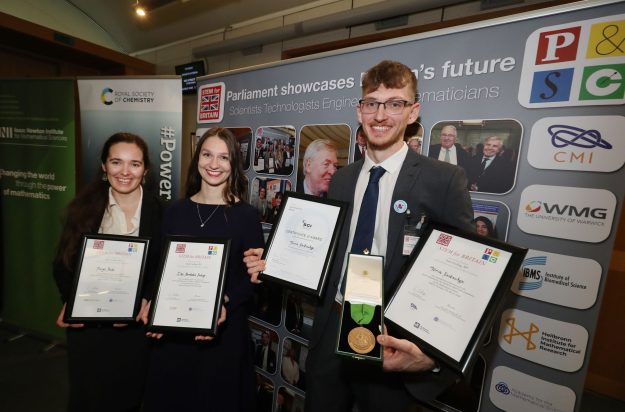
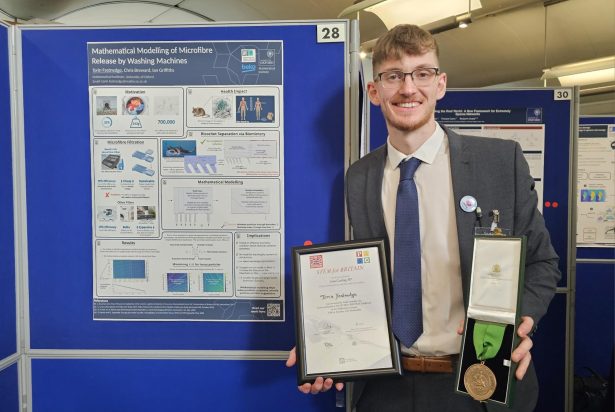
Torin Fastnedge AMIMA (University of Oxford), who won the Gold award for his paper on Mathematical modelling of microfibre release by washing machines, said:
I am absolutely delighted, and honestly very surprised, to have won the Gold Medal. It means a great deal to have my research recognised not only for its scientific value, but also for the way it communicates an important issue to policymakers. By taking part, I have been able to raise awareness of laundry microfibre pollution and to show how mathematicians can use their skills to tackle these real-world environmental challenges. Through this work, I hope to contribute to efforts to prevent further microplastic pollution from entering into our already heavily polluted oceans.
Zita Borbala Fulop (University of Glasgow) who won the Silver award for her paper on Personalised Brain Cancer Treatment: Improving Drug Delivery with Electric Fields, said:
I’m incredibly honoured to receive the silver award and to have had the opportunity to share my research at such a prestigious event. My work uses mathematics to improve how we treat brain cancer by exploring new approaches to drug delivery and personalised treatment planning. I’m very passionate about this research, and it was rewarding to see that all the hard work I’ve put into it got recognised. I hope this highlights the important role mathematics can play in making a real difference to patients’ lives. This is just the beginning, and receiving this award has motivated me even more to continue this work.
Freya Bull (University College London), who won the Bronze award for her paper on Predicting the incidence of catheter-associated bacteriuria, said:
It was really great to present at STEM for Britain and very exciting to win a prize. The quality of posters and research being presented by all the finalists was so good, it was really inspiring to hear about so many interesting and diverse projects. My poster presents the work I did during my PhD, where I developed a mathematical model for bacterial colonisation of urinary catheters. For much of my PhD I felt quite insecure about my work, since it is so different to anything anyone around me in Edinburgh was working on. It was really nice to present it yesterday and see how it complemented and fit with the other research being presented!
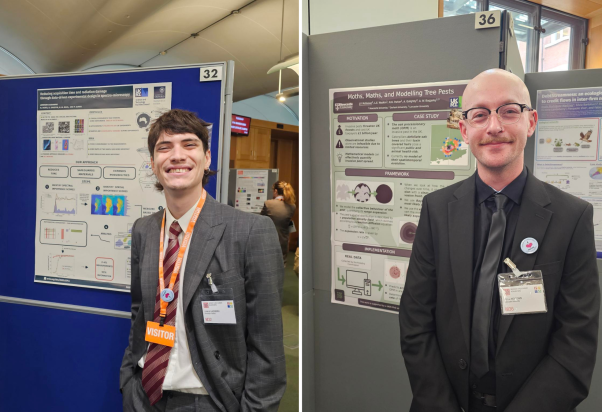
The IMA were in attendance for the Academy for the Mathematical Sciences, and were thrilled to see several IMA member finalists in the room. Lorenzo Lazzarino AMIMA (University of Oxford) shared his research on Reducing acquisition time and radiation damage through data-driven experimental design in spectro-microscopy, and Jamie McKeown AMIMA (Newcastle University) shared his research on Moths, Maths, and Modelling Invasive Tree Pests.