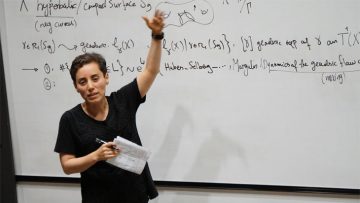
At the time of writing this editorial, the IMA London and South East Branch, which I have had the privilege of chairing since 2016, has just screened a film profiling the life of the first woman ever to be awarded the Fields Medal, the Iranian mathematician Maryam Mirzakhani [1]. For organising the screening, much credit must go to my colleagues at Imperial: John Craske MIMA, Ioanna Papatsouma FIMA and Davoud Cheraghi. The film was followed by Davoud quite bravely fielding audience questions because he and Maryam were both undergraduates at Sharif University of Technology in Tehran at the same time, albeit in different year groups.

The hour-long film tells the story of a group of gifted school friends from Iran who shared a love and passion for mathematics – with Maryam emerging as their superstar. They participated in their national and then International Mathematics Olympiad team, subsequently shone at Sharif University, pursued doctorates in the United States and then flourished in their respective research fields. It is a story that outlines the various mathematical achievements of Maryam through her contemporaries, her supervisor, her students and many collaborators with whom she worked. It particularly resonated with me regarding the special relationships that one builds with one’s own students and collaborators that can make the pursuit of solving difficult intellectual problems downright enjoyable.
The film itself is inevitably very moving with Maryam tragically succumbing to breast cancer at the terribly young age of 40. Somehow, however, the film also offered me hope that even amidst the turbulence already in 2026, shared intellectual pursuits can break what might be perceived to be impenetrable boundaries, whether it is the glass ceiling or barriers between quite different cultures and traditions. If you get a chance to watch the film, I highly recommend it.
A key feature of the Maryam Mirzakhani story and those of her contemporaries is that of them travelling from Iran to the United States to continue their mathematical education, initially to doctoral level and then beyond. The mobility of people, particularly for the young to enhance their education, in my view, has been a force for good in breaking down barriers and creating a greater diversity of ideas. When individuals with different perspectives converse and exchange ideas, it appears to provide impetus to the creative process in which scientific breakthroughs can be made or technological innovations are conceived. This has been a driving factor for economic growth in which students of the mathematical sciences and related subjects have played an essential role.
Moreover, for the individuals, exposure to different cultures (in everyday life, in education and in work) and languages in unfamiliar countries tends to broaden the mind in ways that are difficult to achieve otherwise. Therefore, I was personally delighted to see the UK government making the decision in December 2025 to rejoin the wide ranging Erasmus+ scheme from 2027 [2]. It is worth remembering that the UK was a founding member of the original Erasmus scheme in 1987; it initially focused entirely on higher education student exchanges.
Since 2014, the scheme’s present incarnation, Erasmus+ has, alongside higher education, also provided opportunities for exchanges within vocational education and training, adult and school education (incorporating early childhood education and care), youth work and sport. Obtaining significant and sustained economic growth has been stated as a key priority for the UK government for a number of years. To facilitate the achievement of this objective, a highly-skilled and technically educated workforce will be essential in beginning to turn around from the stagnation and the general atmosphere of negativity that appears to have set in.
Indeed, the UK government’s recently published industrial strategy document [3], identified eight sectors, coined the ‘IS-8’: Advanced Manufacturing, Defence, Clean Energy Industries, Digital and Technology, Creative Industries, Financial Services, Life Sciences, and Professional and Business services; all of which will benefit from attracting and developing talent within the mathematical and related sciences to various extents.
The UK previously participated in Erasmus+ from its inception right until it left the European Single Market at the end of 2020, and it was replaced by the Turing scheme. One criticism that has faced the Turing scheme is that unlike Erasmus+, which is primarily an exchange programme and hence designed to be cost neutral for participating institutions, there was no funding for those institutions sending people to the UK, inevitably making the UK a much less attractive destination.
Beyond 2027, as the UK rejoins Erasmus+, I hope that willing and enthusiastic participants will again benefit fully from this excellent and benevolent programme, whether they experience the scheme from inside or outside the UK.
Turning to lighter matters, although absolutely not trivial for some, followers of English cricket cannot have failed to notice that their men’s team has ‘excelled’ itself once again by losing the Ashes in Australia at practically the earliest available opportunity. Perhaps this was not entirely surprising since regaining the urn away from home has been notoriously difficult historically – England have not regained the urn in Australia since the tour of 1970/1971, likewise it was back in 1989 that Australia last regained the urn in England.
Of course, growing up in Yorkshire, particularly with a cricket-obsessed father and having myself played up to university level, I have followed the team’s fortunes for several decades with great interest. Indeed, the fabled ‘England batting collapse’ has been a recurring feature of many summers and there were a few in the latest series, notably in the first test match. One of my favourite lines regarding this particular topic came from the comedy writer Andy Hamilton who once quipped on BBC Radio 4’s The News Quiz that until his teens he was convinced the phrase ‘England batting collapse’ was in fact one word. In cricketing circles, the fielding captain will often hope to trigger the collapse phenomenon at some point and they can frequently be heard encouraging their side with remarks such as ‘one brings two’, implying that dismissing one batter can quickly bring about another dismissal which in turn can then cause the entire innings to unravel.
In more recent years, I have often wondered if anyone has ever conducted any serious modelling on this collapse phenomenon, which is obviously a hugely complex stochastic system. The variables within such a problem are manifold, including the state of the playing surface and the ball, the atmospheric conditions, the quality of the bowling attack and their confidence levels, the difficulties batters have starting their individual innings, the match situation, the amount of risk each side takes during a given passage of play, and so on. Inevitably, lots has been written and said in the media about the England team’s performance linking their defeat variously to a lack of preparation, ineptitude in game awareness, or simply being out-played by a superior opposition.
However, was there something more intrinsic caused by the outright attacking and carefree approach that England have evidently adopted more recently under their current management? It is well-known that perturbing dynamical systems can destabilise them and that the required level of perturbation to trigger destabilisation can depend on the inherent stability level of the system’s present state. Therefore, can an innings be destabilised due to the combination of the match situation with perhaps injudicious or overtly risky tactics? Are there any inherently existing tipping points which, once transgressed, renders the occurrence of a batting collapse practically inevitable? If anyone reading this piece has conducted a scientific study on this topic or perhaps now plans to do so, I can guarantee at least one interested reader!
Ahmer Wadee CMath CSci FIMA
Imperial College London
References
- Csicsery, G.P. (2020) Secrets of the Surface: The Mathematical Vision of Maryam Mirzakhani, ZALA films.
- European Commission (2026) Erasmus+: EU programme for education, training, youth and sport.
- Department of Business and Trade (2025) The UK’s Modern Industrial Strategy, UK Government, CP 1451.
Reproduced from Mathematics Today, April 2026
Download the article, Maryam Mirzakhani, Mobility of Scientists and Cricketing Instabilities (pdf)