A cube is sliced vertically along the line shown in the diagram and the smaller part is thrown away.
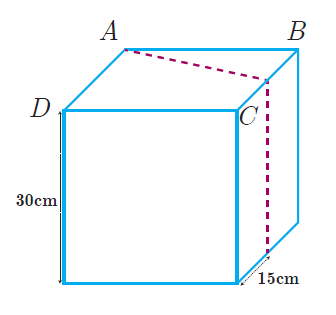
The remaining prism is going to be sliced vertically downwards again by a line going through corner  .
.
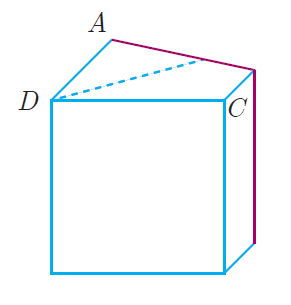 Where would the slice have to be to split it into two equal volumes?
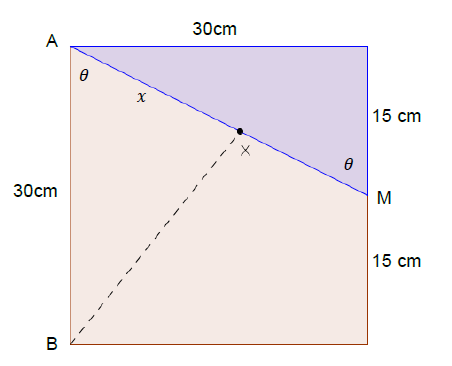 This is a challenging task.
There are a number of possible approaches. This is just one of them.
The trick is to realise that it is only necessary to divide the area of the top surface into two equal sections.
Area of trapezium  .
.
Area of triangle  .
.
Area of triangle  .
.
The right angled triangle that was initially removed can be used to find  .
.
Hypotenuse  .
.
So  .
.
Using the formula , the area of triangle  could also be written as
  .
.
Which simplifies to  .
.
So  giving
  cm or
cm or  cm
cm to 3s.f.
So the cut should go from corner  to a point that is
  cm along the line
  .
.