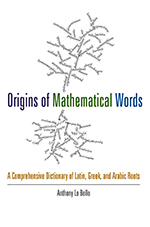
Anthony Lo Bello
JOHNS HOPKINS UNIVERSITY PRESS 2013, 368 PAGES
PRICE (PAPERBACK) £32.00 ISBN 978-1-421-41098-2
 Readers expecting a dictionary in the purely descriptive style of the OED are in for a shock with this book, which instead takes the prescriptive approach of Samuel Johnson, with frequent condemnation of supposedly ‘bad’ words. Indeed, the language employed suggests that this was a very deliberate choice; many words are, for example, dismissed as ‘low’, a favourite epithet of Johnson, meaning simply ‘vulgar’. Moreover, this dictionary frequently exhorts us to adhere to the usages of the nebulously-defined ‘best authors’, to whom Johnson also appealed.
Etymological criticism is in fact the major theme of the book, with many common mathematical words being attacked (e.g. ‘binomial’, ‘statistical’). Indeed, a large number of the entries appear to have been included specifically to be criticised. There thus appear many words that do not really belong in a mathematical dictionary (e.g. ‘conversation’, ‘robust’). It is possible that some of the cutting remarks made about certain words are meant to be tongue-in-cheek, but these criticisms, coupled with the Johnson-like style, lend the book an unfortunate air of intellectual snobbery. A particularly disagreeable example of this appears under the entry ‘PowerPoint’, where the author refers to the habit of placing capital letters in the middle of words as a ‘childish practice, which appeals to the intellectually limited’.
One obsession of the author is the denunciation of the combination of Greek and Latin components to make new words (e.g. ‘diffeomorphism’, ‘orthogonal’). However, his
oft-repeated complaints about such terms appear to miss the points, first of all that the words in question are neither Greek nor Latin, but English, and, secondly, that this is precisely how new words (and, more generally, languages) develop: through the combination of words and word-fragments that would not previously have gone together.
Any book of this type can be criticised, not always fairly, for its omission of certain terms. However, the inclusion of the word ‘comprehensive’ in the subtitle does appear to be asking for trouble. One slightly peculiar omission that struck me was that, although the book features such terms as ‘Abelian’, ‘coset’ and ‘subgroup’, and even ‘semigroup’ and ‘monoid’ (though the latter with a questionable definition), it does not contain the word ‘group’. Surely ‘group’ would have been a more natural term to include than ‘pseudoequicontinuity’? Another point to which I take exception is the author’s curious claim that the word ‘factorize’ is obsolete.
A rather more grave charge that can be levelled against this book, however, is that, in some instances, it fails in its purpose as a (mathematical) dictionary. Often (e.g. under ‘contour’ and ‘incommensurable’), we find that etymologies are given, but that the mathematical sense of a word is not, or that the etymologies trace the origins of a term as a word in English, but do not explain how it came to be used with its mathematical meaning – in this context, the latter is no less a part of a word’s etymology than its Greek or Latin roots.
With regard to presentation, the appearance of the mathematical content of the dictionary could have been better: superscripts often overlap with the symbols to which they are attached, for example.
Although I have levelled many criticisms at this book, there are also some good points to be made. The dictionary clearly sets out to be different from previous mathematical dictionaries. The prescriptive style is probably part of this, but so too are the many interesting discursive entries: certain words are used as jumping-off points for broader discussions of related ideas. Thus, for example, ‘Cartesian’ leads into a survey of the main points of Descartes’ philosophy. The entries for ‘calendar mathematics’ and ‘Euclid’, for instance, make similarly interesting reading.
Overall, this is a very scholarly book, although it contains too much that is subjective. In summary: it is certainly interesting, and undoubtedly well-researched, but is marred by the various peculiarities mentioned above.
Christopher Hollings MIMA
Book review published directly onto IMA website (October 2014)