Milind Tambe
CAMBRIDGE UNIVERSITY PRESS 2012, 334 PAGES
PRICE £48.00 (HARDBACK) ISBN 978-1-107-09642-4
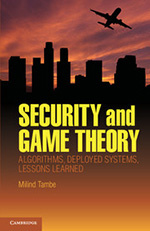 The need for security of transport around the world has never been so high, because of the increase in the number of threats from terrorism and other sources. Security and Game Theory provides an insight into how game theory can be used to allocate the limited resources of the governing bodies of different companies, which will decrease the likelihood of such events happening.
The book is split into four main sections; the first gives a brief informal introduction as to what game theory is, to allow people who are new to the topic to understand the book. Examples are given of how it is used in airports and ports. This is followed by a brief history into how attacks on airports have developed and what actions have been taken to try to diminish this. It then provides a basic idea of how adversaries go about deciding their moves.
The next section goes into more depth about how programs were created for Security at LAX; the Federal Air Marshals Service, and on a larger scale with security allocation of airports on a national scale. Great explanation is given about techniques used to reduce the likelihood of an attacker being able to read it; each variable included and each constraint involved is explained. A brief explanation of the models is provided, including how the user can alter information if needed for unknown circumstances. A result and evaluation is given, showing that each model offers the best method of allocating the resources by comparing with other known techniques and showing the improvement via graphical methods. This is followed up by looking into how it can generally be used on a much larger scale (with limited information about adversaries), assisting routine security checks at airports.
The book then discusses future research to try to minimise current problems associated with irrational behaviour. Current models tend to assume players act rationally when this isn’t always the case.
All in all, this book is a very interesting read and would provide anyone interested in game theory with in depth examples of its use in real world applications. With excellent examples of many situations where it has been used, Security and Game Theory gives great detail that shows security is better off with the use of game theory. This book is aimed at research students, security analysts and practitioners obtaining overviews of research, and other researchers familiar with game theory, but I would recommend this book for anyone who would just like to know more about the subject.
Martyn Deverell