Colin Adams
PRINCETON UNIVERSITY PRESS 2014, 240 PAGES
PRICE (HARDBACK) £16.95 ISBN 978-0-691-16190-7
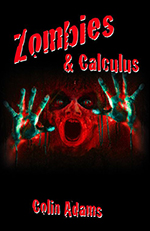 Generally speaking, Mathematics Today doesn’t review fiction. There are many, more mainstream publications that cater for such works and, whilst they are appropriate for specialist mathematics texts, our review and publication cycles are not well matched to the faster timelines associated with fiction. So, it was with some trepidation that I approached this book. The trepidation was increased by the subject matter – I’m not scared of calculus, but zombies, well, they’re a different matter.
The book is, in essence, a discussion of calculus wrapped in a science fiction story. It is split into three parts. The first, and largest, is an adventure story centred on a college campus during a zombie epidemic. Despite the fast-paced action that is unfolding, the key participants still manage to find some time to discuss aspects of calculus and, more importantly, use it to help them in their battle for survival. This puts the concept of applied mathematics in a whole new light.
The second part is a series of amplifications, which add extra detail to the calculus-based discussions. These are (presumably) used when the author feared a longer discussion would distract too large a proportion of the audience. However, they are written so that they fit seamlessly into the main narrative. Hence, a reader has two choices: they can just stick with the core story, covering interesting pieces of calculus as they go; or, by following the signposts between the front and back of the book, they can read a coherent story that includes longer discussions of the mathematics. It is to the author’s credit that both approaches feel natural. Both make sense and neither presents the reader with sudden jars in the narrative.
The third part of the book is an extended discussion between two of the main protagonists. It allows a more structured discussion of the basics of calculus than would be possible within the story-based construct that is used in the main part of the text.
At one level, the story is somewhat predictable. That said, it starts with a bang – we are barely four pages in before the first, somewhat gruesome, zombie attack occurs. It is written well enough to grab a reader’s interest, including end-of-chapter cliff-hangers and a love triangle sub-plot. Humour also abounds – in one scene a professor is recapping the normal distribution with a student when, having drawn a picture of the distribution, he asks, ‘Is this picture ringing any bells?’
As zombies are progressively taking over the campus it is, at least on one level, hard to believe that people would stop to discuss topics like population growth, predator-prey dynamics and pursuit-evasion curves. However, I guess, ‘once a teacher, always a teacher’, so the discussions fit in well with the characters and, in many cases, they are directly relevant to surviving the unfolding disaster. Ultimately, they end up being a believable part of what, it has to be said, is a pretty unbelievable story.
If it’s true that literature must pass comment on the prevailing social situation, then that box is ticked as well. The author pokes fun at the use of consulting firms, counsellors and excessive worrying about legal culpability. His most challenging comment, however, comes right at the end of the story, when he notes that his band of survivors may face more danger from other humans than from the zombies. This is either highly insightful, or decidedly downbeat, depending on your point of view.
Overall, this book was much better than I feared. The story is entertaining enough and the discussions about calculus are both well handled and informative. The choice of subject matter means it’s unlikely to appeal to a wide audience. However, it’s highly recommended for those just being introduced to calculus, or those who need a user-friendly recap of the basics. It may just help them survive – their education, that is, rather than a zombie attack!
Rob Ashmore CMath CSci FIMA
Software and Systems Dependability Team, Dstl
The views and opinions expressed herein are those of the author and do not necessarily reflect those of Dstl.
Book review published directly onto IMA website (June 2015)