Several notable events have occurred during recent months. In February, a welcome Government report, the Blackett review Computational Modelling: Technological Futures, was published. This report considers the rapid evolution of UK computational modelling capability and how it could be better used in both the public and private sectors. It concludes by stressing the importance of computational modelling for making good decisions that affect all of society.
In March, Professor Robert Langlands (Institute for Advanced Study, Princeton, USA) was announced as the 2018 Abel Prize winner ‘for his visionary program connecting representation theory to number theory’. His radical insights have attracted hundreds of the world’s best mathematicians over the last fifty years and have been described as providing a grand unified theory of mathematics (see page 80 for more on Langlands’ work). The Abel prize is one of the most prestigious international honours in mathematics and is awarded annually by the Government of Norway along with a monetary sum of six million kroner. Previous recipients include Professor Yves Meyer (France) and Sir Andrew Wiles (UK).
April saw the creation of United Kingdom Research and Innovation (UKRI), as specified by the Higher Education and Research Act 2017. With a budget of more than £6 billion, this organisation unites the seven Research Councils with two other councils, Innovate UK and Research England, which is new. Its ambitions are to push the frontiers of human knowledge and understanding, to deliver economic impact and increased social prosperity, and to create social and cultural impact. Opportunities exist for mathematicians to apply across all councils for funding from this budget, as a means of developing original ideas and supporting collaborative projects.
An influential new report The Era of Mathematics was published on 27 April, available at https://epsrc.ukri.org/newsevents/news/mathsciencereview/. It explores the critical role of mathematical sciences to the UK’s increasingly innovative economy and is based on a review led by Professor Philip Bond (Universities of Bristol and Oxford) with support from EPSRC and KTN. The review was proposed during a meeting at the International Centre for Mathematical Sciences (Edinburgh) in October 2015 and several prominent IMA members were appointed to the review committee. The report makes nine recommendations to ensure that the UK becomes a world leader in mathematical science knowledge exchange, including:
- the establishment of an Academy for the Mathematical Sciences to facilitate links between academia, government and industry;
- the creation of a minimum of 100 additional PhD places per year dedicated to training mathematical scientists;
- tripling of the funding that goes to mathematical sciences.
I hope that you enjoyed reading April’s issue of Mathematics Today with original features by McKee and Tomé (analytic ripples), Rochead (slimming targets), Champneys (solitary waves), Larcombe (mathematical writing), Lawrence (Erdős numbers) and Ashmore (data gaps). The network section included another fascinating piece by Your Doctor (life spans) who has generously contributed similar, well-informed articles to this magazine for more than ten years!
June’s issue also contains a variety of topics, including cubics, conflicts, synchronisation, descriptive geometry and sewers, so you are bound to find something of interest inside. If you are inspired to write and submit a paper for possible publication in a future issue, please contact the Editorial Officer (rebecca.waters@ima.org.uk) or refer to the IMA website for further details. We also publish some of the printed articles online: https://ima.org.uk/publications/mathematics-today.
Two well-established conference series continue this June, the 10th IMA International Conference on Modelling in Industrial Maintenance and Reliability, chaired by Professor Philip Scarf (University of Salford), and the 6th IMA Conference on Numerical Linear Algebra and Optimization, co-chaired by Professor Michal Kočvara and Dr Daniel Loghin (University of Birmingham). The IMA will also present a day of mathematics on 28 June for pupils aged 16+. This is a free event at University College London with an exciting programme of talks by speakers who include Professor Helen Wilson and Dr Hannah Fry.

More generally, 2018 marks the centenaries of several significant historical events, including UK laws that entitled women to vote and stand for Parliament, and the armistice that ended the horrendous First World War. However, it also marks the centenaries of two related mathematical discoveries that are both astonishing and brilliant. The first is Felix Hausdorff’s dimension [1] and the second is Gaston Julia’s iteration of rational functions [2].
The Hausdorff dimension  of a subset
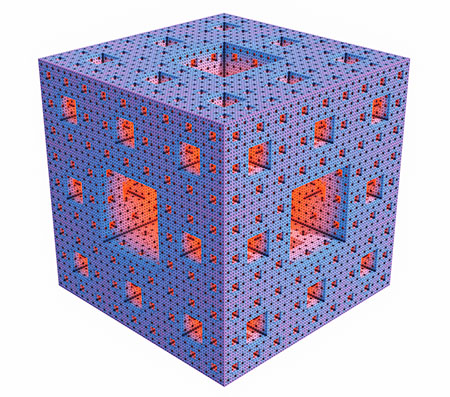
  of a metric space is an invariant, non-negative extended real number that measures the roughness of . It generalises the topological dimension of objects such as a point (0), line segment (1), square (2), cube (3), etc. to allow non-integer values for fractals such as the Cantor set (~0.6), Sierpinski carpet (-1.9) and Menger sponge (-2.7) shown in Figure 1. It also characterises the fractal nature of geographical coastlines, though space-filling curves such as the Peano curve (2) and Hilbert curve (2) have the same dimensions as the spaces that they fill. Recent research has successfully applied this dimensional measure for the analysis of dynamical systems, medical diagnosis, environmental modelling, image compression and facial recognition.
Now consider a rational function  where
where  and
and  are complex polynomials with no common divisors. The Julia set
  of this function is defined as the boundary of the set of points that do not approach infinity following repeated iteration of
  . Consequently, arbitrarily small perturbations in such systems result in chaotic dynamical behaviour. An illustrative Julia set is shown in Figure 2. In contrast, the Fatou set published by Pierre Fatou in 1917 comprises points such that all nearby points behave similarly following repeated iteration of , so such systems exhibit regular dynamical behaviour. Their work jointly initiated the study of complex dynamics, which subsequently generated some stunning mathematics and many beautiful pictures!
On the subject of computational modelling, I was pleased to discover that a colleague on the IMA North West Branch committee, Dr Stephen Lynch (Manchester Metropolitan University), recently succeeded in publishing a second edition [3] of his book on dynamical systems with applications using Mathematica. He has published other books on dynamical systems with Maple and Matlab, and a version involving Python should be available from the end of this year. He is also jointly writing a book on Python for A-level mathematics and beyond with Tom Button (Mathematics in Education and Industry). The IMA usually receives copies of new mathematical books for review, though you would need to act quickly if interested: email karen.hedderley@ima.org.uk for the current list of books available for review.
Finally and perhaps most importantly, the IMA’s annual general meeting will take place at 4.45 p.m. on 27 June at the Royal Society in London. That same evening, Professor Alistair Fitt will deliver his Presidential Address, intriguingly titled My Mathematics Bucket List. Admission to the talk is free, though a fee is payable for the subsequent reception. Advance booking is required for what will undoubtedly be an informative and entertaining presentation (see page 83). If you cannot attend this event, you will be pleased to learn that Alistair will repeat his address to the IMA’s regional branches during the course of his tenure.
David F. Percy CMath CSci FIMA
University of Salford
References
- Hausdorff, F. (1918) Dimension und äußeres Maß, Mathematische Annalen, vol. 79, pp. 157-179.
- Julia, G. (1918) Mémoire sur l’itération des fonctions rationnelles, Journal de Mathématiques Pures et Appliquées, vol. 1, pp. 47-246.
- Lynch, S. (2017) Dynamical Systems with Applications using Mathematica (second edition), Springer, Cham.
Reproduced from Mathematics Today, June 2018
Download the article, Editorial, June 2018 (pdf)