This month’s editorial celebrates the successes of several mathematicians who recently received major awards for their outstanding achievements and contributions.
IMA Gold Medal
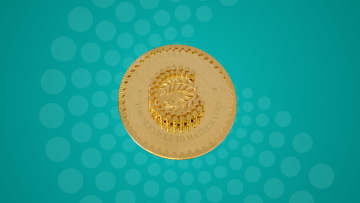
IMA Gold Medals are awarded biennially in recognition of outstanding contributions to mathematics and its applications over a period of years. The worthy recipient on this occasion is Professor Reidun Twarock FIMA, who is a German-born mathematical biologist based in the Department of Mathematics at the University of York. She is awarded the IMA Gold Medal 2018 for her work in the field of mathematical virology, an emerging subject that she founded and in which she is the world leader. Further details are presented on page 181.
Christopher Zeeman Medal
Christopher Zeeman Medals are awarded jointly by the IMA and LMS, also biennially, to recognise and acknowledge the contributions of mathematicians involved in promoting mathematics to the public and engaging with the public in mathematics in the UK. This year’s winner is Dr Hannah Fry, who is a Senior Lecturer in the mathematics of cities at University College London. Besides her mathematical research, she has a sustained and distinguished record of communicating mathematics to the public. See page 180 for more information.
IMU Awards and Medals
On a global scale, the International Mathematical Union (IMU) represents more than 80 countries and has the primary objective of promoting international cooperation in mathematics. Every four years, the IMU hosts an International Congress of Mathematicians (ICM), a large conference at which it presents significant prizes and awards. This year’s ICM took place in Brazil during August and brief details of the winners follow.
Fields Medal
Perhaps the most celebrated award is the Fields Medal for mathematicians aged 40 or under. This award recognises outstanding mathematical achievement for existing work and the promise of future achievement. There were four recipients this year: Caucher Birkar, Alessio Figalli, Peter Scholze and Akshay Venkatesh.
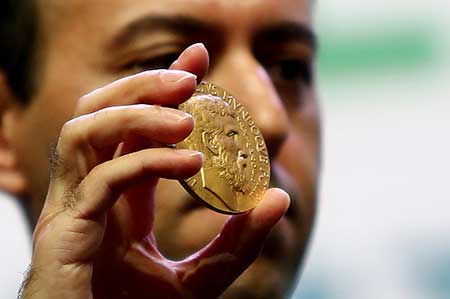 Iranian by birth, 40-year-old Caucher Birkar moved to the UK as a refugee in 2000. He is now a Professor in the Department of Pure Mathematics and Mathematical Statistics at the University of Cambridge and has research interests in algebraic geometry. His citation states that this award is given, ‘For the proof of the boundedness of Fano varieties and for contributions to the minimal model program.’ Amazingly, his medal was stolen within minutes of his receiving it! However, the IMU readily presented him with a replacement during the ICM.
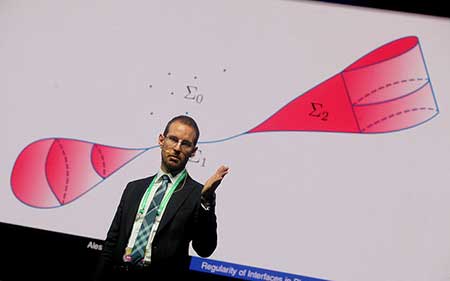 Alessio Figalli was born in Rome in 1984 and has already pursued an academic career in Italy, France, USA and now Switzerland, where he is a Professor of Mathematics at ETH Zurich, the Swiss Federal Institute of Technology in Zurich. He conducts research within the broad areas of calculus of variations and partial differential equations, and specifically tackles theoretical issues relating to the optimal transport problem. The citation for his award reads, ‘For contributions to the theory of optimal transport and its applications in partial differential equations, metric geometry and probability.’
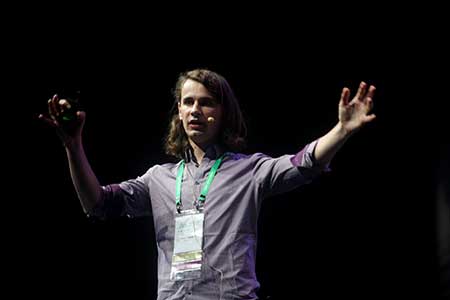 The youngest of the Fields Medal winners is 30-year-old German mathematician Peter Scholze. He is a Professor at the Mathematical Institute of the University of Bonn, a position to which he was appointed when just 24, and a Director at the Max Planck Institute for Mathematics, also in Bonn. His highly regarded research into algebraic geometry led to this award of a Fields Medal, ‘For transforming arithmetic algebraic geometry over p-adic fields through his introduction of perfectoid spaces, with application to Galois representations, and for the development of new cohomology theories.’
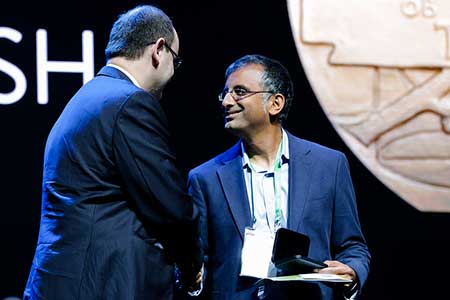 Akshay Venkatesh was born in India in 1981 and moved to Australia as a young child. At the tender age of 16, he gained a first-class honours degree in pure mathematics from the University of Western Australia and subsequently pursued an academic career in the USA. For the past 10 years, he has been a Professor of Mathematics at Stanford University and recently transferred to the Institute for Advanced Study in Princeton. His citation reads, ‘For his synthesis of analytic number theory, homogeneous dynamics, topology, and representation theory, which has resolved long-standing problems in areas such as the equidistribution of arithmetic objects.’
Chern Medal
Another presentation that the IMU makes at each ICM is the Chern Medal, which was introduced in 2010. This is presented to an individual whose accomplishments warrant the highest level of recognition for outstanding achievements in the field of mathematics, and is accompanied by a substantial cash sum.
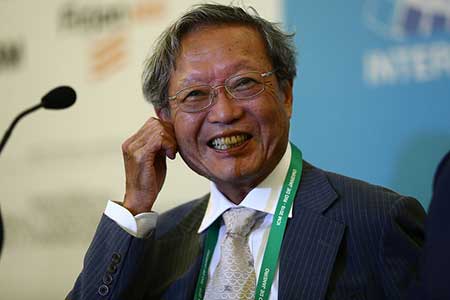 The 2018 laureate is Masaki Kashiwara, Emeritus Professor of Mathematics at Kyoto University, Japan, who has made leading contributions to solving complex problems. During the opening ceremony, IMU President Professor Shigefumi Mori commended him, ‘For his outstanding and foundational contributions to algebraic analysis and representation theory sustained over a period of almost 50 years.’
Carl Friedrich Gauss Prize
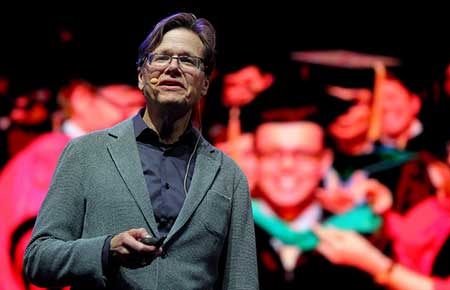 I was particularly pleased to read that the Carl Friedrich Gauss Prize for impact outside mathematics was awarded to David Donoho MIMA, who is an editor for the IMA journal Information and Inference. He is a Professor of Statistics at Stanford University in the USA and was awarded the 2018 Carl Friedrich Gauss Prize, ‘For his fundamental contributions to the mathematical, statistical and computational analysis of important problems in signal processing.’ For more information on this award please see page 184.
Rolf Nevanlinna Prize
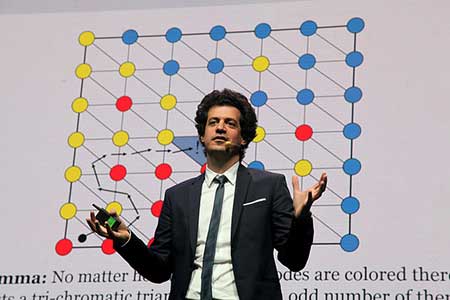 The IMU awards the Rolf Nevanlinna Prize for outstanding contributions in mathematical aspects of information sciences, which includes computer science, scientific computing and numerical analysis. Like the Fields Medal, candidates must be at most 40 years old. This year’s winner is Constantinos Daskalakis, who is a Professor of Electrical Engineering and Computer Science at the Massachusetts Institute of Technology in the USA. He received this award, ‘For transforming our understanding of the computational complexity of fundamental problems in markets, auctions, equilibria, and other economic structures. His work provides both efficient algorithms and limits on what can be performed efficiently in these domains.’
Leelavati Prize
Finally, the IMU awards the Leelavati Prize to recognise outstanding contributions for increasing public awareness of mathematics as an intellectual discipline and the crucial role it plays in diverse human endeavours.
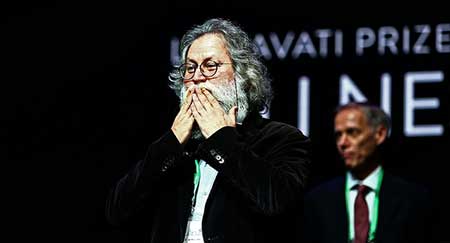 This year’s award went to Turkish mathematician, Ali Nesin, ‘For his outstanding contributions towards increasing public awareness of mathematics in Turkey, in particular for his tireless work in creating the “Mathematical Village” as an exceptional, peaceful place for education, research and the exploration of mathematics for anyone.’ Born in Istanbul, Ali Nesin studied in France and the USA, and took several temporary positions at prestigious universities in the USA before returning to his native country to pursue his father’s work as director of the Nesin Foundation, which provides educational opportunities for deprived children, and he created the Nesin Mathematics Village.
As mathematics enhances the quality of all our lives immensely in a huge variety of ways, it is truly heart-warming to read about all these fabulous contributions that have been publicly acknowledged and rewarded. This summer has seen natural and man-made disasters, political and economic turmoil, technological advances and environmental crises, so there remain plenty of opportunities and necessities for developing and applying mathematical methods. For each of the above winners though, there are thousands of other mathematicians whose contributions might not be worldleading but are nevertheless important, including the teachers and communicators who convey our knowledge and enthusiasm for the subject to future generations. Some of these have contributed fascinating articles to this magazine and I hope that you enjoy reading about their new discoveries.
David F. Percy CMath CSci FIMA
University of Salford
Reproduced from Mathematics Today, October 2018
Download the article, Editorial, October 2018 (pdf)