In this article, we look at an unconventional method for calculating areas of any polygon on an integer lattice, namely, Pick’s theorem. We present the theorem and give a brief inductive proof. We then study a series of interesting applications, including a proof of the fact that an equilateral triangle cannot be drawn on an integer lattice having its vertices at grid points. We also give examples of problems from other fields of mathematics that can be approached via Pick’s theorem. Finally, we show the unexpected result that Pick’s theorem does not generalise straightforwardly to three dimensions, but has other higher-dimensional analogues.
1 Introduction
Pick’s theorem is an example of a theorem that is not widely known but has surprising applications to various mathematical problems. At its essence, Pick’s theorem is a geometrical result, but has algebraic implications, as we will see later. The theorem was first published in 1899 by the Austrian mathematician Georg Alexander Pick [1].
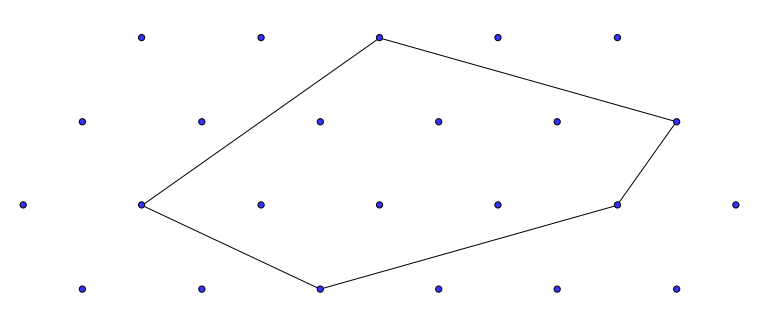
We now introduce the main result due to Pick by way of a simple physical application. Let us suppose that an artist is employed to paint a giant mosaic that consists of numerous square tiles. Furthermore, let us assume that the artist is an ardent admirer of Cubism, and the shape to be painted is a complex-looking polygon (possibly concave) with vertices that lie at intersections of the tiles (see Figure 1 for a sample representation).
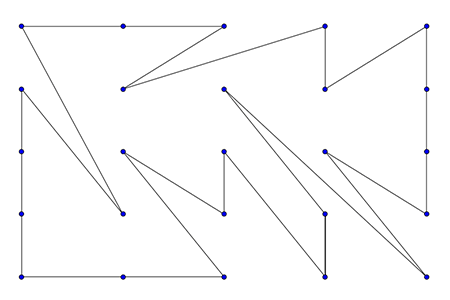
Since the mosaic is quite large, ideally, he would like to know how much paint he would need in advance. This amounts to accurately calculating the area of the polygon. However, its shape is quite complicated and even a simple triangulation would require lots of intermediate steps to obtain the final answer. If the artist knew Pick’s theorem though, he would solve this seemingly laborious problem very quickly. It involves a simple counting of lattice points in a way that will be made more precise in the next section, but gives fascinating and useful results.
2 Pick’s Theorem
We now state Pick’s theorem [2] and give an outline proof of it.
Theorem 1 (Pick’s Theorem). Given any simple polygon whose vertices lie on an integer grid, its area,  , is calculated according to the following formula:
(1) 
where  is the number of grid points inside the polygon,
  is the number of grid points that lie on the boundary of the polygon, and by ‘simple’ we mean a polygon without holes.
The classical proof, which is rather long-winded, is of inductive nature and consists of three steps. Assuming that the formula (1) is valid for a polygon and a triangle, we can prove that it is valid for the figure that is obtained by gluing the polygon and the triangle along a common edge [3]. This is done by a pure counting of the interior and boundary points in the newly formed figure, where it helps to introduce a variable for the number of boundary points along the common edge. The next step is to observe that any polygon can be triangulated (using diagonals, for example). Finally, the third step is to show that Pick’s theorem is valid for triangles, which, together with the first two steps and simple induction, gives the proof of the theorem. To show this, one needs to go through a series of simple steps proving the result for rectangles with sides parallel to the grid lines, right-angled triangles obtained from those rectangles by cutting them along the diagonal, and finally for general triangles by attaching right-angled triangles to their sides, thus turning them into rectangles, and then using the previous parts.
A slightly more illuminating proof, which relies on a similar inductive argument, associates angles to each point of the polygon and is given in [1].
3 Results and discussion
Applying Pick’s theorem to the artist’s polygon in Figure 1, we see that  , and therefore the area is immediately calculated to be
  .
.
At a first glance, it might appear that Pick’s formula is quite restrictive in that the polygon under consideration has to have its vertices lying on grid points. However, if this is not the case, we can always refine our grid sufficiently that the polygon vertices lie approximately on grid points, and thus obtain an arbitrarily good approximation to the area of the polygon. Similar reasoning applies to curved shapes, since we can always approximate them by polygonal ones and then superimpose a fine enough grid. In practice, one can draw a square grid on a transparent piece of paper and lay it on top of the shape whose area is sought.
A useful property of Pick’s formula, that we immediately note, is that it is invariant under shearing of the lattice, since this changes neither the area of the polygon, nor the number of its interior and boundary points. Also, scaling the distance between grid points in one direction simply scales the area of the polygon. These two observations can be used to show that Pick’s formula is valid for sheared (triangular) grids as well, provided we take account of any scaling in the direction perpendicular to the shearing one. In Figure 2, we show a sheared grid which consists of equilateral triangles. To accommodate equilateral triangles the grid spacing in the ‘vertical’ direction has been squashed by a factor of  . Thus, Pick’s formula for this grid is given by (1), multiplied by this factor. Therefore, the area of the polygon in Figure 2 is
  .
.
Finally, Pick’s theorem readily generalises to polygons with holes. The modified formula becomes [2]
(2) 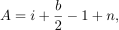
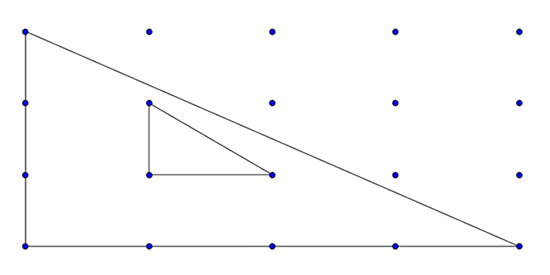
where  is the number of holes. The proof involves a simple counting of the interior and boundary points of the polygon with the holes, without the holes and the holes themselves. In Figure 3, we show a simple triangle with one hole. Using (2), the area is then
  .
.
4 Curious applications
Pick’s theorem can be used to tackle a number of problems in different fields of mathematics. To give a flavour of this, we present two separate problems: geometric and algebraic.
Although square integer grids are ubiquitous in our life, it is a fact that one cannot draw one of the simplest figures, namely, an equilateral triangle with its vertices being grid points on such a lattice. Some standard proofs involve tedious algebra and trigonometry, whereas Pick’s theorem proves the result immediately. Suppose we have drawn an equilateral triangle with sides of length  on a square grid. Then, its area is given by the well-known formula
  . Since the vertices of the triangle are integer points, then
  is an integer (by Pythagoras’ theorem, for example), and thus the area is an irrational number. However, Pick’s formula on square grids always gives a rational area. This contradiction proves the initial claim. The same argument shows that regular hexagons cannot be drawn on a square integer grid either.
Another interesting application arises in the so-called Farey sequences,  . These are sequences of rational numbers of the form
  in an increasing order with
  and
and  and coprime (gcd
 ). For example,
  [4]. One property of such sequences is that if
  are neighbours of a Farey sequence, then
  . This can be proven easily by Pick’s theorem, once converted into a geometrical problem. We, thus, represent each fraction as an integer point with coordinates
  on a square grid. Noting that is the slope of a ray that passes through the origin and the point under consideration, we see that all points from the Farey sequence can be obtained in the correct order by sweeping a ray through the origin and noting down each lattice point it hits, provided we always take the closest point to the origin if several lie on the same ray (this is because of the requirement that and be coprime).
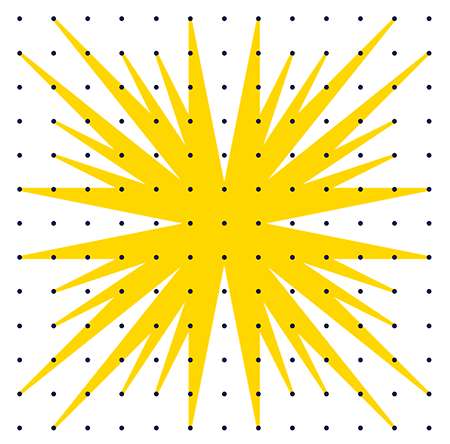
In Figure 4, we show an example of a Farey sunburst, obtained by mirroring the polygonal curve that we get for  in the first octant to obtain a closed shape. As a side note, its area is given by Pick’s theorem and is
  . If we now consider two neighbouring elements in a Farey sequence, , then we first note that there are no lattice points along the segments that connect these points to the origin apart from the end points, again because of coprimality. Furthermore, the segment connecting the two points cannot contain other points either, since these points are assumed to be neighbours, and thus sweeping a ray between them will not encounter any other points. This is also the reason why there are no interior points in the triangle consisting of the two points and the origin. Thus, by Pick’s theorem, this triangle has area of
  . However, from analytic geometry, this triangle has area given by [4]:
![\[ (1/2)\det\begin{pmatrix}c & d \\ a & b\end{pmatrix} = (bc-ad)/2. \]](https://ima.org.uk/wp/wp-content/ql-cache/quicklatex.com-cc6238f5433615e4435f3fb75ebb2b01_l3.svg "Rendered by QuickLaTeX.com")
Hence, the result follows.
5 A Surprising result in three dimensions and other generalisations
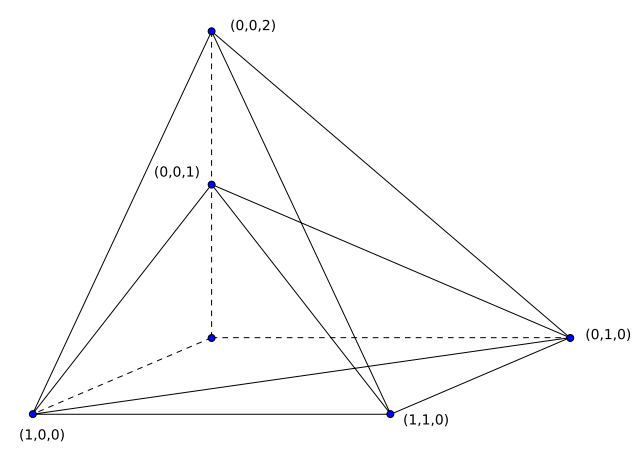
Intuitively, one might hope that Pick’s theorem can be easily generalised to three (or more) dimensions for volume of solids, etc. However, in 1957, J. Reeve produced an example of what is now known as the Reeve tetrahedron (see Figure 5), which shows that Pick’s theorem does not have a direct analogue in three or more dimensions [5]. He considered a tetrahedron with vertices at  ,
,  ,
,  , and
, and  , where
  is a positive integer. It can be easily seen that there are no interior or boundary points in this tetrahedron regardless of what is. However, the volume is calculated to be
  , and thus takes infinitely many values for different .
 and
and 
Nevertheless, we remark that Pick’s theorem still has some close analogues in more than two dimensions in what are known as Ehrhart polynomials, which contain information about the relationship between the number of interior points and volume of general (dilated) polytopes [3].
6 Conclusions
We have looked at Pick’s theorem, a beautiful and simple mathematical result with numerous surprising applications in various fields. We considered a few simple generalisations in terms of sheared and scaled grids, polygons with holes, and explained how Pick’s theorem provides a good approximation for area calculations even for curved shapes or polygons whose vertices do not necessarily lie on lattice points, provided we take a fine enough grid. We have studied two separate problems, namely, the impossibility of drawing an equilateral triangle (and hexagon) on an integer grid (which, however, could be done on a sheared grid such as the one described in Section 3) and a property of Farey sequences. Rather surprisingly, Pick’s theorem does not directly generalise to more dimensions, but it is a fundamental result that still finds applications in the most unexpected places.
Kristian Kiradjiev AMIMA
University of Oxford
Acknowledgements
I would like to thank my wife Alina Kiradjieva for helping me come up with the catchy title of this article.
Notes
This article is the Graham Hoare Prize 2018 winning article.
References
- Bogomolny, A. (1998) Pick’s theorem, www.cut-the-knot.org/ctk/Pick.shtml (accessed 30 July 2018).
- Davis, T. (2003) Pick’s theorem, www.geometer.org/mathcircles/pick.pdf (accessed 30 July 2018).
- Wikipedia (2018) Pick’s theorem, en.wikipedia.org/wiki/Pick%27s_theorem (accessed 30 July 2018).
- McRae, G. (2018) Farey sequences, mediant, Pick’s theorem, 2000clicks.com/mathhelp/BasicSequenceFarey.aspx (accessed 30 July 2018).
- Reeve, J. (1957) On the volume of lattice polyhedra, Proc. London Math. Soc., vol. 7, pp. 378–395.
Reproduced from Mathematics Today, December 2018
Download the article, Connecting the Dots with Pick’s Theorem (pdf)