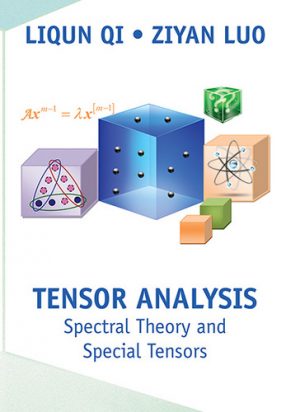
 Liqun Qi and Ziyan Luo
SIAM 2017, 319 pages
PRICE (PAPERBACK) £85.50 ISBN 978-1-61197-474-4
This book is concerned with tensors, their eigenvalues, their applications to Hypergraph Theory and various special types of tensors. It should be made clear that the definition of a tensor used here is not limited to that usually considered for tensors representing physical quantities.
All chapters finish with a section containing exercises. It contains six chapters as follows:
Chapter 1 – Introduction. This chapter introduces tensors but from an advanced perspective. It considers tensors of rank m and dimension n. It defines symmetric tensors and describes some different types of tensor product, including outer product, k-mode product, inner product and Hadamard product. CANDECOMP/PARAFAC decomposition, Tucker decomposition, Completely Positive decomposition and Vandermonde decomposition are also covered.
Chapter 2 – Eigenvalues of Tensors. This chapter initially reminds the reader of eigenvalues and eigenvectors of matrices, using tensor notation. Four kinds of eigenvalues and their related eigenvectors are defined and considered in some detail: eigenvalues, H-eigenvalues, E-eigenvalues and Z-eigenvalues. Other types of eigenvalues are mentioned: D-eigenvalues, M-eigenvalues, U-eigenvalues, and generalized or B-eigenvalues. Methods of computation of these various kinds of eigenvalues are considered. There are many applications of eigenvalues and their related eigenvectors, including automatic control, quantum information, spectral graph theory and medical imaging. It is therefore extremely important to be able to calculate the various kinds of eigenvalues, etc. Due to the nature of tensors, particularly high order tensors, the calculations are NP hard so that computer solutions are inefficient, if not impossible to conduct. At present it seems the highest order tensors where these calculations are attempted is fourth order with four dimensions each (these tensors have 44 = 256 components).
Chapter 3 – Nonnegative Tensors. The chapter describes the latest research and related topics with respect to non-negative tensors and Perron-Frobenius Theory. The chapter contains the following sections: Perron-Frobenius Theory for Irreducible Nonnegative Tensors, Weakly Irreducible Nonnegative Tensors and Positive Eigenvalue, Strongly Nonnegative Tensors and Existence of a Positive Perron Vector, The Perron-Frobenius Theorem for Homogeneous Monotone Functions, The Cyclic Index, Primitive Tensors and Weakly Primitive Tensors, Symmetric Nonnegative Tensors, Algorithms for Computing the Largest Eigenvalue of a Nonnegative Tensor, Essentially Nonnegative Tensors and Some Further Properties of Nonnegative Tensors, Higher Order Markov Chains and Transition Probability Tensors, and Stochastic Tensors.
Chapter 4 – Spectral Hypergraph Theory via Tensors. This chapter first defines hypergraphs and introduces some terminology and some recent history. The next section investigates the spectral properties of the adjacency tensor, Laplacian tensor and sign less Laplacian of a given uniform hypergraph. Following this graph invariants of uniform hypergraphs are considered. Odd-bipartite hypergraphs are covered in the subsequent section. The other sections include the following topics: hypergraphs with large or small spectral radius, computing extremal eigenvalues of large scale tensors of hypergraphs, spectral theory for directed hypergraphs and finally multi-hypergraphs, non-uniform hypergraphs and random hypergraphs. Some of these topics are in their infancy.
Chapter 5 – Positive Semidefinite Tensors. There are many applications of this kind of tensor. Evidence of their use has been found in at least five different topics. The chapter contains the following sections: Positive Semidefiniteness, Inclusion sets for Tensor Eigenvalues, Diagonally Dominated Tensors and their Extensions, M-tensors and H-tensors, B0 and B-Tensors, SOS tensors and PSD Hankel Tensors. Some of the proofs given are improvements on those provided in the original research publications. There are also comments in the end of the chapter regarding further research possibilities.
Chapter 6 – Completely Positive Tensors and Copositive Tensors. Completely positive tensors have applications in a number of areas of study, including computer vision. These tensors are an extension of completely positive matrices and were first introduced by Qi in 2014. Copositive tensors are used in existence issues such as Pareto eigenvalues for tensors. This chapter covers the properties and applications of these two kinds of tensors. The sections in the chapter are: Properties of Completely Positive Tensors, Strongly Symmetric Hierarchically Dominated Nonnegative Tensors, Positive Cauchy Tensors and Nonnegative Strong Hankel Tensors, Other Checkable Subclasses of Completely Positive Tensors and one section on Copositive Tensors.
In conclusion, this is a book aimed at researchers working in Tensor Analysis, or those interested in such results for use in more applied areas. The book uses extremely terse notation which takes some effort to comprehend, however the other option appears to be rather verbose notation, which may be easier to follow but is not suitable for journal publications. It is a book that is extremely useful, at minimum, as a collection of relatively recent research results in the subject, whilst also suggesting areas where further effort would be productive.
John Bartlett CMath MIMA
Book review published directly onto IMA website (December 2018)