Don’t wait to be landed with a huge project before you start practising the habits of good project management. The skills you apply to small tasks prepare you to be able to take on bigger projects.
When does a task become a project? Projects usually aim to create an end-product that will create a positive benefit for the group or organisation who set up the project. The creation, organisation and monitoring of the range of tasks that for part of the project is project management. Projects nearly always have a deadline, and it is worth noting that these can be deceptive, initially making you think you have plenty of time to complete everything necessary. Additionaly you will likely be depending on others for resources or for their work, to enable completion of the project.
Plan from the deadline to the start date to work out the critical path. This will guide you as to what needs to be done, by when, before other things can happen, within the time available. Delays on the critical path will mean you fail to meet the deadline.
 The better you are at realistic estimates of how long it takes to do things, and the better you are at ensuring other people deliver to you on time, the better you will be at project management. So take time to reflect on how long you actually spent on tasks you have completed and start building your guestimating skills. Understanding what and where the risks are – what can go wrong, who is most likely to let you down and why – enable you to mitigate and manage them effectively.
Do not take promises as read. If someone says you will have something in two weeks – do not wait for the two weeks to elapse before you ask for it – whether it is information or a tangible component. People don’t usually let you down deliberately but may forget they were supposed to do something, other stuff gets in the way and takes priority, they don’t understand what you really want, or can’t actually do (don’t know how to do) what you want them to or a combination of all these.
So if someone agrees something, follow up a day later with a note confirming what you are expecting and asking if they have everything they need to be able to do what they need to deliver to you on time. This reminds them of the commitment and gives them the opportunity to ask for extra information if they need it, either because they forgot to ask at the time or on thinking about their task have realised they need more information. The response you get will help you gauge whether you can be confident they know what they are doing. Then, half way through the time they have to work on the activity, make contact asking if they have everything they need for the deadline, reminding them that you still need it by then and are they comfortable they can still meet their deadline.
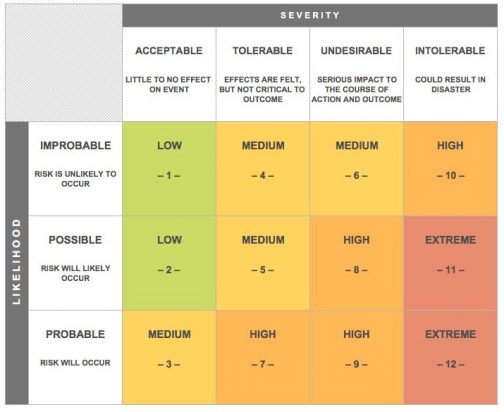 A helpful tool for risk management is a Probability Impact Grid or Risk Matrix. This is a 3 by 3 grid where you can allocate risks as high, medium and low likelihood and impact. It helps you visualise the amount of risk in a project and prioritise which ones you need to tackle. The highly likely and high impact risks need to be mitigated first, followed by the high/medium and medium/high risks. Again, the better you get at spotting risks and assessing their likelihood and impact and then successfully mitigating and managing them, the better your project management skills will become. More information about impact grids and some free templates can be found here
Image Credit:
U3115299 [CC BY-SA 4.0], via Wikimedia Commons