Two cousins – Dr Nira Chamberlain, President Designate of the IMA, and Dr Clive Fraser, Professor of Economics – wrote this joint article to say ‘Happy 100th Birthday David Blackwell!’ David Blackwell said [1, p. 20]:
Basically, I’m not interested in doing research and I never have been … I’m interested in understanding, which is quite a different thing. And often to understand something you have to work it out yourself because no one else has done it.
According to mathematics professor Scott Williams, David Blackwell is one of the greatest Black mathematicians to have ever lived [2]. On 24 April 2019, we celebrate the centenary of his birth. However, David Blackwell remains relatively unknown, which is similar to Katherine Johnson’s story before Hidden Figures [3], despite the heights that he attained in mathematics. We explain some of the reasons for keeping his name alive.
In 1941, when David Blackwell was just 22, he earned a PhD from the University of Illinois. Amazingly, this was within six years of him leaving high school. During his post-doc year, spent at the Institute for Advanced Study with a Rosenwald Scholarship, his work caught the eye of great mathematicians such as John von Neumann. Nevertheless, he was prevented from attending lectures at the nearby Princeton University because of his race. Moreover, at the end of his post-doc, because of racism, he could only get an academic post at a historical Black college or university. It took another 13 years and 20 published articles before Blackwell obtained permanent employment at a research-oriented institution, the University of California at Berkeley.
By the time he was 40, David Blackwell had accomplished what most mathematicians would consider a lifetime’s work. He had co-written a book regarded as a classic [4], published 35 papers (three in the Annals of Mathematics), and had been an invited speaker all over the world, including a lecture on controlled random walks that he gave at the 1954 International Congress of Mathematicians in Amsterdam. The following year he was elected President of the Institute of Mathematical Statistics. Many more honours were to come his way. He became Vice President of the American Statistical Association, Vice President of the International Statistical Institute, and Vice President of the American Mathematical Society. In 1965, he became the first African American named to the National Academy of Sciences. He is still the only Black mathematician so honoured.
When interviewed by Donald Albers [1, p. 21], Blackwell stated that the work that gave him the most satisfaction was on infinite games [5]. He had discovered a game theory proof of the Kuratowski reduction theorem and thereby pioneered a connection between the areas of game theory and topology [6].
In 1979, Blackwell won the von Neumann Theory Prize (from the Institute for Operations Research and the Management Sciences). Though most (but not all) of Blackwell’s work was in statistics, his work exhibits a strong theoretical mathematics background.
In 2002, the Mathematical Sciences Research Institute in Berkeley and Cornell University established the Blackwell-Tapia Award to honour David Blackwell and Richard Tapia, another distinguished mathematician. This recognised that they were role models to more than a generation of African American and Hispanic American mathematics students and professionals.
One of the present authors (Fraser) had the good fortune to meet Professor Blackwell in 1990 when Blackwell was awarded an honorary DSc at the University of Warwick. As Fraser noted in an article that he wrote for Chalkdust Magazine [7],
He [Blackwell] confirmed, without bitterness or rancour, the veracity of the accounts of his treatment in the 1940s and early 50s that I had read.
David Blackwell is a peerless role model. He overcame an environment in his early career that was as hostile to Blacks in academia as it was in general life to become one of the foremost mathematical research scientists of his time. He did this while being a renowned undergraduate teacher and supervisor of 64 PhD students, many of whom described him as the best teacher they had ever encountered.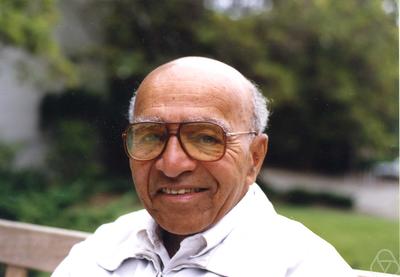
David Blackwell passed away on 8 July 2010 (aged 91). His stellar achievements will keep his name alive for a long time to come.
Nira Chamberlain CMath CSci FIMA
University of Loughborough
Clive Fraser
University of Leicester
References
- Albers, D. and Alexanderson, G.L. (2008) Mathematical People: Profiles and Interviews, 2nd Edition, AK Peters/CRC Press.
- Williams, S.W. (2008) David Harold Blackwell, The Mathematics Department of The State University of New York at Buffalo, www.math.buffalo.edu/mad/PEEPS/blackwell_david.html
- Shetterly, M.L. (2017) Hidden Figures: The Untold Story of the African American Women Who Helped Win the Space Race, William Collins.
- Blackwell, D. and Girshick, M.A. (1954) Theory of Games and Statistical Decisions, John Wiley & Sons.
- Blackwell, D. (1967) Infinite Games and Analytic Sets, Proceedings of the National Academy of Sciences, vol. 58, no. 5, pp. 1836–1837.
- O’Connor, J.J. and Robertson, E.F. (2009) David Harold Blackwell, MacTutor History of Mathematics archive, www-groups.dcs.st-and.ac.uk/history/Biographies/Blackwell.html
- Fraser, C. (2018) David Blackwell and me, Chalkdust magazine blog, chalkdustmagazine.com/blog/david-blackwell-and-me/
Reproduced from Mathematics Today, April 2019
Download the article, David Blackwell Centenary (pdf)
Image credit: David Blackwell 1999.jpeg by George Bergman / Wikimedia Commons / GNU Free Documentation License