
The Monty Hall problem (MHP) is an attractive puzzle. It combines simple statement with answers that seem surprising to most audiences. The problem was thoroughly solved over two decades ago. Yet, more recent discussions indicate that the solution is incompletely understood. Here, we review the solution and discuss pitfalls and other aspects that make the problem interesting.
The MHP, equivalent to the three-prisoner puzzle, is a brain teaser from probability theory. In 1990, vos Savant succinctly presented a solution [1], which was spelled out by the same author in two subsequent notes [2, 3]. Shortly afterwards, her solution was challenged by Gillman [4, 5], who argued that she had implicitly considered a modified version of the game, and proceeded to present a thorough solution. Nonetheless, the lucid explanations in Gillman’s articles seem not to have been thoroughly absorbed, since more recent discussions have presented incomplete analyses of the problem. Very recent examples, which we single out because they appear in books of outstanding quality, are due to Ben-Naim [6] and Miller [7]. Yet another survey of the various aspects of MHP seems, therefore, warranted.
1. The Monty Hall game
The rules of the game are simple. Monty Hall shows three closed boxes to a contender – call her Portia. One of them contains a car, while a goat stands inside each of the other two. The boxes are symmetrically placed around a circular track, which can be freely rotated around its centre. Portia chooses one of the boxes, and the track is immediately rotated as shown in Figure 1.
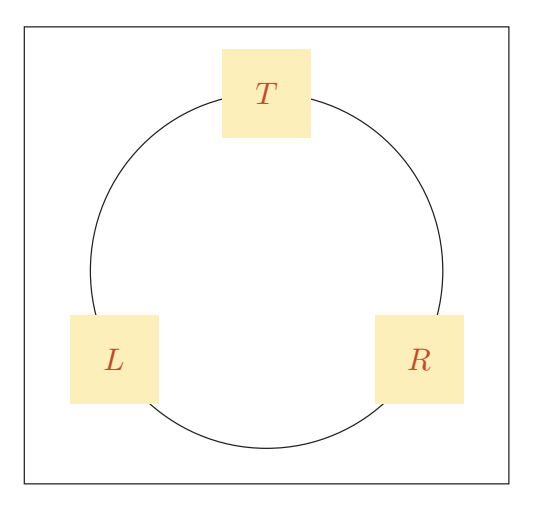
 ). The other two boxes are now at the positions labelled
  and
and  .
.Monty Hall knows where the car is. He opens one of the two boxes at the bottom of the figure – box , for definiteness – to show Portia that it contains a goat, and asks her whether she wants to stick to her choice or switch to box . The problem asks for the probability  that Portia will win the car if she decides to switch.
2. Gillman’s versions
Gillman pointed out that the game admits two variants [4, 5]. One of them, which he calls version I, follows the rules in Section 1.
2.1 Gillman’s game I
Gillman observes that a complete statement of the game in Section 1 calls for knowledge of Monty Hall’s tactics. The host has some freedom. If the car lies in box () in Figure 1, then his only option is to open door (). If the car lies in box , however, the host may open either door. We will call  the probability that he will open door . To compute her odds, Portia must know .
Let us assume that she does know and consider two illustrative situations:  and
and  . With , Monty Hall will blindly open door whenever given the choice. By opening door , he in practice admits to Portia that he had no choice, which means that the car must be behind door . Portia, therefore, asks to switch with the winner’s smile on her lips. In this case, the probability of winning by switching is
  .
.
With , by contrast, if the car is in box Monty Hall will open box . If the car is in box , he will also open box . Hence, the only piece of information conveyed to Portia when he opens is the obvious one: that box holds a goat. To switch or not to switch is then Portia’s question, because the chances are equal. In other words,  for .
for .
We can see that the probability depends on . To come to the same conclusion from another perspective, consider the probability  , of winning without switching. Clearly,
  . Before Monty opened the door, the probability was
  . When he opens door , a possibility is eliminated, but this will not change if boxes and are equivalent, i.e., if Monty is unbiased towards either box, i.e., if
  . We conclude that, with , the probability of winning by not switching is , and the probability of winning by switching is
  .
.
With , therefore, Savant’s argument applies, and the probability of winning by switching is . Clearly, vos Savant had the unbiased game in mind when she wrote on the subject [1–3], i.e., she considered the special case of Gillman’s game I. Gillman argued that she had another game in mind. That interpretation seems unfair, even though her solution does apply to Gillman’s game II, which we describe next.
2.2 Gillman’s game II
In the second version of the game, Portia must announce her decision to switch or not to switch before Monty opens the door. Knowing the host’s bias is now of no help to Portia, since she must make her decision before Monty opens either box. In that case, vos Savant’s argument is impeccable, for Portia’s choice cannot affect the probability that the car is in the top box. The probability that Portia wins by switching is, therefore,  .
.
3. Formal analysis
We now present mathematical proofs of the results derived on intuitive grounds in Sections 2.1 and 2.2.
3.1 Game I
First solution
We ask for the conditional probability that the car lies in box  (
( ), given that Monty has opened box
  (
( ). In other words, we ask for the conditional probability
  , where
  denotes event , i.e., the car is in box , and
  denotes event , i.e., Monty Hall has opened box . As Portia knows, if the car is in box , the probability that Monty will open box is
(1) 
Let us now turn to Bayes’ formula, which states that
(2) 
(3) 
The a priori probabilities that the car is in box or box are identical:  . Division of equation (3) by equation (2), therefore, shows that
(4) 
Moreover,  , because Monty Hall is forced to open box when the car is in box . From equations (1) and (4) it follows that
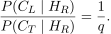
(5) 
We then recall that events  and
and  are mutually exclusive when event
  takes place (in other words, when Monty opens door , he is telling Portia that the car is either in box or in box ). This shows that the numerator and denominator of the fraction on the left-hand side of equation (5) add up to unity:
(6) 
Solution of the system of equations (5) and (6) yields the desired result:
(7) 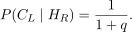
As expected from our discussion in Section 2.1, the probability that Portia wins the car by switching, therefore, varies from unity for to  for . When Monty is unbiased, and the probability is , as vos Savant predicted.
Second solution
We now follow Isaac [8] to present an alternative solution that seems more attractive because it starts by surveying the space  of possible events. Let
  (
( ) denote the event in which the car lies in box . Let
  (
( ) denote the event that Portia switches to box
  , let
, let  indicate that Portia wins – she drives the car home – and let indicate that Portia loses – she trails back home in the company of a goat. Thus, for instance, the event
  is incompatible with
  : if the car is behind door , then Monty is forced to open door , and Portia would not switch to the open box, inside which she can see a goat.
The sample space comprises four combinations of events:
(8) 
We can now compute the probability for each combination on the right-hand side of equation (8). Each individual event () occurs with probability  . The combined event
  can occur only when, given that the car is in box , the host chooses to open box . Its probability is, therefore,
  . Likewise, the combination
  will occur only if the host chooses to open box . Its probability is
  . Finally, the last two combinations, which are independent of Monty’s bias, have probability each.
When the host opens door (event ), Portia rules out the first and the last combinations of events on the right-hand side of equation (8). She can then compute her chance of winning by switching from the probabilities for the other two combinations:
(9) 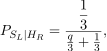
which yields the desired result
(10) 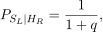
in agreement with equation (7).
3.2 Game II
Gillman’s game II is somewhat different. As in game I, Portia chooses a box, which is promptly moved to the top position, as in Figure 1. Monty then announces that he will soon show her a goat inside one of the two boxes at the bottom in Figure 1. Immediately after the announcement, before opening any door, he asks her whether she will switch to the other box. If Portia chooses to switch, what are her chances of winning the car?
First solution
As before, let us call () the event that the car is in position . As in Section 3.1, we can see that the probability is  (). Call
  the probability that Portia wins by switching if the car is in box (). The probability of winning by switching is
(11) 
If the car is inside box , switching will make Portia lose. Hence  . She knows that, in this case, the probability that Monty will choose box (box ) is (
 ), but that information is of no help, because the probability of winning is zero, either way.
On the other hand,  , for if the car is in box , Monty must open box , and Portia will be compelled to make the right choice, i.e., open box . Likewise,
  . It follows from equation (11) that
(12) 
(13) 
By contrast, if Portia decides to stick with her initial choice,  will be unitary, while
  . In this case, equation (12) yields
  .\\
.\\
Second solution
As in Section 3.1, let us follow Isaac [8] and consider the four possible combinations of events. The sample space is again given by equation (8), and the probability that each combination occurs is the one we have already computed:  for
for  ,
,  for
for  , for
, for  and for
  . In either of the latter two events, Portia drives the car home. The probability of winning by switching is, therefore, the sum of the two probabilities, and we recover equation (13).
Equation (13) agrees with the result derived in [1–3]. This does not mean, however, that vos Savant was playing game II. As already pointed out, all evidence indicates that she was considering game I with , i.e., with an unbiased host. Under that condition, equations (7) and (10) are also equivalent to equation (13).
4. A long series of game I
While discussing game I in Section 3.1, we assumed that Monty had opened door , and our computation of the probability relied on that assumption. If the game is played not once, but numerous times, we cannot assume that box will be opened every time. In a long series of games, the host’s bias becomes irrelevant. The distinction between games I and II is washed out, as the following discussion shows.
In a long sequence, the car will be in box in of the events. In those events, Monty has his way. Whether he has or has not a preference for one of the doors is entirely immaterial, however, for in the end Portia will take a goat home, if she decides to switch. Of course, if he is biased towards one of the doors, Portia will more often take home the goat in the other box, but that will be of no comfort to her.
In the other of the events, the car will lie either in box or in box . In those events, Portia’s decision to switch will add a brand new car to her assets. The odds of winning by switching, therefore, are , just as if Monty and Portia were playing game II.
Francisco A. B. Coutinho
University of São Paulo, Brazil
Eduardo Massad CMath FIMA
University of São Paulo, Brazil
Fundação Getúlio Vargas, Brazil
Luiz N. Oliveira
University of São Paulo, Brazil
References
- vos Savant, M. (1990, 9 Sept) Ask Marilyn, Parade, p. 22.
- vos Savant, M. (1990, 9 Dec) Ask Marilyn, Parade, p. 26.
- vos Savant, M. (1991, 7 Jul) Ask Marilyn, Parade, pp. 26–29.
- Gillman, L. (1991) The Car and Goats, Focus (MAA newsletter), vol. 11, no. 3, p. 8.
- Gillman, L. (1992) The Car and the Goats, Am. Math. Mon., vol. 99, no. 1, pp. 3–7.
- Ben-Naim, A. (2015) Discover Probability, World Scientific, New Jersey.
- Miller, S.J. (2017) The Probability Lifesaver, Princeton University Press, Princeton and Oxford.
- Isaac, R. (1995) The Pleasures of Probability, Springer, Berlin.
Reproduced from Mathematics Today, February 2019
Download the article, Monty Hall Problem Revisited Once More (pdf)


New Scientist 3232 1/6/19 pg 52 has “#04 Which door Solution” to a variant of MHP. They obviously haven’t read the Brazilain revisitation. But the NS version also raises the interesting question of how a working mathematician ‘ought’ to advise a contestant.
Taking Game I, the first solution seems to be expressed in terms of subjective probabilities, so ‘to be rational’ the contestant ought to think that it is best to switch. But there is no explicit argument for any ‘objective’ probabilty, and hence for what the contestant really ought to do. (Unless I have missed something?)
The second solution says explicitly that the car is equally likely to be behind any door. If this is a subjective probability it again seems relevant but not decisive. If it is meant to be an ‘objective’ probability it surely needs justification.
The use of a circular track is presumably intended to avoid one possible cause of bias in door selection. One might argue that within the spirit of such puzzles one ‘should’ take it ‘as read’ that there is no bias, and so the Brazilian analysis is correct. But the NS version has 5 doors in a row labelled A-E, which makes for a more interesting problem. In any case, as IMA members we are interested in real-world applications, not just academic puzzles.
I feel the need for an analysis of a sufficiently generalised and realistic version of the MHP that illustrates some of the issues that working mathematicians have in advising their less logical colleagues on issues involving choice. Please.