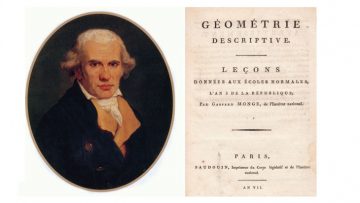
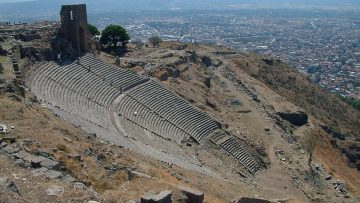
Au bout de ces ténèbres, une lumière pourtant est inévitable que nous devinons déjà et dont nous avons seulement à lutter pour qu’elle soit. Par delà le nihilisme, nous tous, parmi les ruines, préparons une renaissance. Mais peu le savent.¹ – Albert Camus
Gabriel García Márquez’s story Love in the Time of Cholera [2], a book much mentioned in the current crisis of COVID-19, ends with the old lovers on board a ship that is never allowed to come into port. I was reminded of this story in 2009 whilst, during a trip to France, I was told of a plot by some French academics to establish a new university to maintain their teaching of mathematics during the longest university strike in French history. I cannot testify that this included academics and students from all Parisian universities, but it was certainly a practice that my colleague and friend told me about, and of which she was part.
Just like in Márquez’s story, a vehicle was involved, of a sort. In this case, however, it was not a boat, but a metro train that travelled on line 14. This became known as Université Paris 14, a play on the number of the line on which learning journeys (in this case, very literally) took place. It also alluded to the fact that there were 13 official universities in Paris, so the new one was the 14th.
The way this temporary university was organised was simple. The lessons were public and took place every Wednesday from 2 pm on metro trains on line 14. Thus, learning, including of mathematical topics, was free, available to all who happened to be on the metro at that time. The students were sometimes in touch with the lecturers and knew which train to catch at which station so that they would end up learning the topics they indeed wanted or needed to learn about. In this way some innocent travellers got ‘caught in the crossfire’ of mathematics teaching – but my colleague’s account tells me that on many occasions such travellers would remain on the train to hear a lecture in its entirety.
Recently we have had somewhat of a challenge to remain teaching under our new circumstances. What vehicles do we have for teaching during this crisis? Well various electronic platforms have proven to be more useful than others, and some resources more freely available than others. To learn from history, a library or a museum that contains some old and some new mathematics would perhaps be helpful?
In the US, there is a Museum of Mathematics, MoMath, in Manhattan, New York. The museum got its charter from the New York State Department of Education in 2009 (the same year that Paris 14 was operating), and has recently had its millionth visitor. Considering this is a real physical place, that is not a bad number. We in the UK have been discussing the need for a mathematics museum of a similar nature for some time. MathsWorldUK records some of these efforts. It organises a programme whilst seeking the funding to become a real physical place, from which all its activities could eventually be organised.
It is interesting to consider what this crisis could teach us about mathematics. Certainly, more people than at any time in my lifetime have become interested in mathematical models and have begun to understand some of the concepts that underpin them.
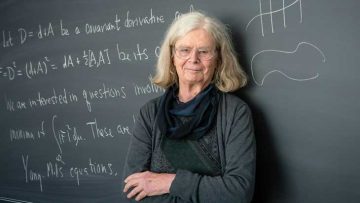
But what other mathematics can we suggest that our friends and their children learn during this period of crisis now that they have seen and understood exponential growth? I would certainly highly recommend the study of geometry, and in particular the geometry to be found in viruses, as so wonderfully described by our Gold Medallist from 2018, Professor Reidun Twarock [3]. If there were a course that explored and was structured around this topic, it would have something for everyone, from the very young to those very experienced in mathematics. And of course, people can study the history of geometry, as it is at the core of the virologists’ work. There are regular and semi-regular solids to be explored, the history of which is abundant and beautiful [4]. This is certainly an apt time for people to explore such mathematical topics and gain an understanding of what mathematics can contribute to our life and to the survival of the human race.
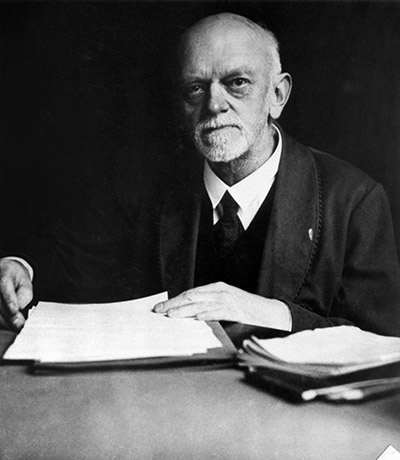
There have been many crises in the history of humankind. Moreover, many would argue that there have been crises in the history of mathematics. We can gain from these an understanding of what mathematics can and should be about. Though, we have not really had such a crisis since the 1920s and Hermann Weyl’s ‘new foundational crisis in mathematics’. Weyl, formerly a student of Hilbert, addressed the Hamburg Mathematical Seminar regarding the search for the foundations of mathematics, from which Hilbert’s own research programme was developed as a response. His aim was to provide a secure foundation for the discipline [5]. The crisis led to several discussions on the theme, and some thinking about the purpose that crises serve. Some decades after Weyl’s lecture, the Kuhnian concept of revolutions in science, and some argue revolutions that could engulf mathematics, led to an understanding (in layman’s terms) that crises inevitably lead to revolutions of a kind [6–8].
Whilst here I have dealt with some different threads, I want to bring them together for you now. These different stories of how love and how mathematics happen, and what happens in a crisis, have something in common. The good, the bad and the ugly – of the behaviour of and interactions between people – become very clearly and more easily defined in such times of extreme stress than at ordinary times. The things that can happen to us during such times are so extreme that the things we can learn from such events seem to be extreme too. And, from my lifetime of experience, these similar patterns come up in any crisis.
But let us finally concentrate on the best that comes out of such times. In the months ahead, despite the suffering and the fear, you can expect to see and hear some beautiful art, plus new and rapid advances in science, engineering and mathematics. People can be incredibly generous in sharing their work with others (unless there is some security implication relating to their work). This is readily apparent with the many hundreds and thousands of mathematicians and mathematics educators sharing their resources and time freely with others via social media. They are contributing to the home-schooling of millions of children forced into spending time at home. One need only glance over social media to see expressions of great hope that we will change our planet’s future in more ways than one. There are many positive thoughts and expressions about the high expectations that the human race will face up to our challenges, once this is all over. The crisis that we are now in will be overcome with the help of some new mathematics too. We need to let the world know how mathematics can help and about the great historical and cultural values mathematical history teaches us. So go on, spread the word. And stay safe.
Snezana Lawrence FIMA
Notes
However, at the end of this tunnel of darkness, there is inevitably a light, which we already divine and for which we only have to fight to ensure its coming. All of us, among the ruins, are preparing a renaissance beyond the limits of nihilism. But few of us know it [1, p. 269].
References
- Camus, A. (1981) The Rebel, translated by Bower, A., Penguin, (original work published 1951).
- Márquez, G.G. (1985) Love in the Time of Cholera, translated by Grossman, E., Penguin, London.
- IMA (2019) An Interview with Reidun Twarock FIMA, Math. Today, vol. 55, no. 5, pp. 170–171.
- Lawrence, S. (2019) A New Year’s Present from a Mathematician, Chapman & Hall, London.
- Zach, R. (2006) Hilbert’s program then and now, Philos. Log., vol. 5, pp. 411–447.
- Ernest, P. (1993) Are there revolutions in mathematics, Humanist. Math. Network. J., vol. 8, article 21.
- Weyl, H. (1921) Uber die neue Grundlagenkrise der Mathematik, Math. Zeitschrift, vol. 10, pp. 39–79.
- Van Dalen, D. (1995) Hermann Weyl’s intuitionistic mathematics, Bull. Symb. Log., vol. 1, no. 2, pp. 145–169.
Reproduced from Mathematics Today, June 2020
Download the article, Historical Notes: Maths in the Time of Quarantine (pdf)