Kevin Wagstaff recently retired from Defence Science and Technology Lab (Dstl). He is also an organiser for the IMA’s next Mathematics in Defence and Security Conference.
Can you briefly describe your career path to date?
I have worked for Dstl for over 35 years having graduated with a First Class BSc in Mathematics and Management Sciences. During that time I have applied mathematics and operational analysis to a wide range of problems helping to make Britain safer. I have had the opportunity to travel the world engaging with peers across the globe and have provided mathematical based scientific advice to the highest levels of government.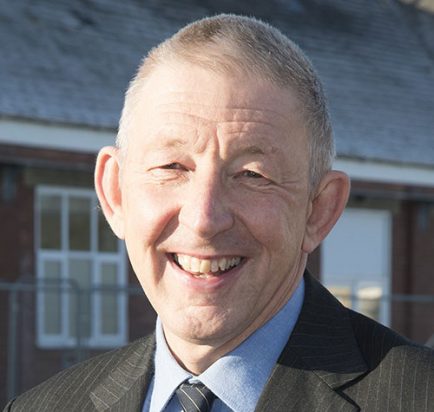
Throughout my career I have worked as part of multi-disciplinary teams of scientists and engineers and had lots of interactions with the end users of our outputs. I believe that my training as a mathematician has put knowledge exchange at the heart of everything I do, helping me to see the big picture and pull together complex scientific concepts in a way that is easily understandable by non-scientists and clearly demonstrates the impact.
How would you describe your professional expertise?
My formal training and education was focussed on numerical analysis, statistics, optimisation and OR. I did some work in the late 1980s on AI but at the time the computing power was not at the levels it is now and although many of the principles around neural networks and Bayesian statistics were theoretically well founded we failed to really deliver practical toolsets.
I then spent over 20 years in management and leadership roles developing and mentoring staff: now in the twilight of my professional career I have moved back into a technical role. This has led to really exciting work engaging with the Isaac Newton Institute, some really bright mathematics professors, and PA Consulting. We’re looking at new and novel ways to apply mathematics to some challenging problems around operating in a congested and contested electromagnetic environment. There’s some really cool mathematics out there and we are looking to see how we can pull people together from different mathematical disciplines to solve our problems and at the same time get some peer reviewed reports in the academic literature.
What is your experience in knowledge exchange (KE)?
As a mathematician and scientist in Dstl I believe that knowledge exchange is at the heart of everything I do. Throughout my career I have worked as part of multi-disciplinary scientific teams translating research outputs into practical outcomes that can improve the capabilities available for defence and security to make Britain safer.
As a mathematician I use my skills to advise on the balance of investment and cost effectiveness of competing technical options. In doing this I am required to have a reasonable understanding of a wide range of scientific concepts but more importantly the benefits that can be realised when the research delivers. As a mathematician I am often required to take a ‘system of systems’ view of the world that takes account of the big picture and brings together complex scientific concepts in a way that is readily understandable to non-scientific decision makers.
More recently I have been exposed to the concept of study groups and submitted a technical challenge to the European Study Group with Industry held at Cambridge last year. This allowed my organisation to take a challenge, that we had been wrestling with in the lab, to a collection of mathematicians who brought a whole new way of looking at the problem.
We were so impressed with this type of approach that I have now taken this one step further and put in place a more formal knowledge exchange mechanism working alongside the Isaac Newton Institute, leading mathematicians from across the country and PA Consulting. We held our first event in January, again at Cambridge, and took along six challenges that were worked upon intensely for a week by no less than 40 leading mathematicians.
We were so pleased with the outcomes that we have now allocated additional funding to investigate each one in more depth and potentially spin out research scholarships or PhDs. An example of one of these is the use of mathematical approaches developed in the field of astrophysics to optimally find an illicit mesh network!
What is the distinction between research and KE?
I think this distinction is becoming more blurred. With everyone having to provide business cases to secure funding then a good way of doing that is to demonstrate the value or impact of the research. In so doing you need to think about the ‘end user’ and this is where knowledge exchange comes in. I think the challenge is to strike a good balance between short and long term research to ensure that we aren’t just focussing on today’s problems but are forever pushing the boundaries and we are also looking for potential end users of our mathematical research.
What would you recommend to an early-career mathematical scientist who is passionate about knowledge exchange?
There is a growing trend and demand for scientifically evidence based decision making at the heart of government and mathematical knowledge exchange is at the heart of this. As mathematicians we are in an ideal position to be at the forefront of knowledge exchange as we are not tied to a particular scientific discipline such as physics or chemistry and are able to take a step back and assimilate everything into a common language.
Is there a knack to communicating mathematical ideas to people who are not mathematical scientists?
Absolutely! In my opinion the key is to understand the language of the audience. Scientists often like to stay in their comfort zone rather than putting themselves in the place of the recipient of the information. Don’t make any assumptions regarding their level of knowledge and avoid the use of acronyms! Practice giving your presentation or have your report reviewed by a non-scientist and take constructive feedback. It is very difficult and takes lots of practice to get this right. Don’t leave preparing your presentation or report until the last minute. With the prolific use of PowerPoint and other presentation media I often find that people will try and re-use a presentation they produced for a specific reason for everything: this is a recipe for disaster.
What is the biggest barrier to Knowledge Exchange (KE)?
I believe a big barrier is getting mathematics involved in supporting and addressing some of the challenges people are facing. One of the hardest things is the ubiquity of mathematics – that the same maths can be used to solve multiple problems. This means that you don’t always know what branch of mathematics is best suited to addressing your problem and it’s not always straightforward to find a forum where you can get feedback on the different mathematical techniques that could be applied.
As mathematicians we are not always the first port of call when people are looking for support as we often don’t deliver the end product. For example, to develop new communication devices the first choice may be a physicist, a new material a chemist, a new vaccine a biologist. The perception is that mathematicians tend to develop models at best! I believe this barrier can be overcome by working with those in other disciplines and proving that by including mathematicians a better outcome can be achieved.
I am doing this in my current project (mentioned above) where I am working to develop better ways of operating in the electromagnetic environment. Historically, this problem has always been seen as a physics and signals processing challenge. However, we are developing some novel ways of working to engage mathematical sciences and we hope to demonstrate more effective solutions can be developed collaboratively than if the problem was just looked at from the physics/engineering perspective.
How do you envisage the rest of your career progressing?
I will be retiring from full time employment later this year so I may do some volunteering and potentially some consultancy work but at this point in time I just plan to enjoy myself! Having said that as I will have more time I would like to share my knowledge with junior mathematicians, especially those from under-represented groups, and help promote mathematical sciences as a key discipline.
How do you maintain a healthy work/life balance?
Work will still be there when you come back but it is important to take time out: I often find I solve some of the most difficult work problems when I am relaxing!
Reproduced from Mathematics Today, October 2020
Download the article, Interview with Kevin Wagstaff CMath FIMA (pdf)