Chris Budd is the deputy director of Bath Institute for Mathematical Innovation and Gresham Professor of Geometry. He is also a member of the IMA’s Research and Social Media Groups, and he was our VP Communications, 2012–2015.
Can you briefly describe your career path to date?
I took a gap year, and this is really important because it was with industry working for Marconi. That experience completely changed my life because it showed me how maths is important in industry and the sort of challenges that industry has. I was using my maths for solving problems in radar. I then went to Cambridge for four years but I would spend every summer with Marconi applying the maths I was learning to real life problems which was really important to me. I went to do my DPhil in Oxford and did my first study group in 1984. For me, it just opened a whole new world and it was a transformative experience.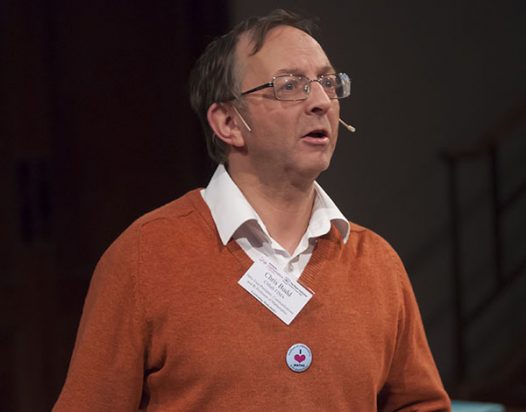
Who inspires you?
My original inspiration was without a doubt my grandfather Leslie Nickels, who everyone called Nick. Mathematics skipped a generation with me because my father was a clergyman but my grandfather was a scientist, working at the Royal Aircraft Establishment (RAE) during the war. He was one of the original pioneers of radar and so from a very early age we had long discussions about the use of science and mathematics. That inspired me from an early age personally. Actually since he died, we’ve been gradually unravelling all his diaries and finding out what he did because he never really told us whilst he was alive. He was so tied up with the secrecy but now we know he was at RAE during the war.
How would you describe your professional expertise?
I would call myself an industrial mathematician. I am interested in problems that come from industry and how you go about solving them and my expertise is a mixture of mathematical modelling, scientific computing, and being creative in problem solving.
What is your experience in knowledge exchange (KE)?
As I’ve said, for my gap year I was in Marconi’s theoretical support services which was all to do with knowledge exchange of mathematics in the whole of the company, so it goes right back to when I was 19 in 1979. The Study Groups with Industry exposed me heavily to knowledge exchange, and then my work with the Electricity Generating Board as a go-between with Oxford University was completely knowledge exchange. All of my academic career since then has been spent either working directly on problems for industry, teaching students about those problems or teaching students how to solve industrial problems. So, I would say basically I’ve been doing knowledge exchange for over 40 years.
What would you recommend to an early-career mathematical scientist who is passionate about knowledge exchange?
Study groups are the most marvellous way of meeting lots of different companies and making great connections with those companies. It also means that you’ll be meeting experienced academics but on an equal footing with them. The other thing about study groups is that it exposes you to real problems and not sanitised problems so you really get stuck in. I make sure my PhD students go to as many study groups as is reasonable and I find that they all have the same experience as I had. They all catch fire and really get involved with them and then want to get involved with knowledge exchange after that.
Don’t sit in your ivory tower and expect problems to come your way and everyone to beat a path to your door. It doesn’t happen that way. You’ve got to get your hands dirty but getting your hands dirty is great fun because you actually end up working with brilliant people in industry, working on brilliant problems, and have the satisfaction that you’re actually solving something.
Is there a knack to communicating mathematical ideas to people who are not mathematical scientists?
It’s very straight forward, you put yourself in their shoes. You try to always imagine yourself as the person you’re communicating with and see things from their direction.
What is the biggest barrier to Knowledge Exchange (KE)?
Unfortunately, one of the biggest barriers is a lack of respect for knowledge exchange by some of my colleagues who seem to regard KE as kind of low-level mathematics or even non-mathematics. That can affect your promotion, it can affect your funding, and it can affect whether you’re given time and resources to do it. I think the way to overcome this is to demonstrate that KE is exactly that. It isn’t taking mathematics and applying it, it’s learning new mathematics by doing exciting things. If we can show that exciting mathematics comes out of working with industry and tackling industrial problems then suddenly your colleagues become interested.
What is the most effective mechanism for KE?
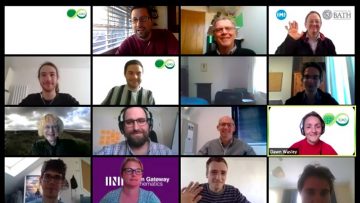
Well, I’d go back to study groups. They are insanely effective. What’s really exciting is that when we went into lockdown, we suddenly realised that we had in study groups a fantastically effective tool for dealing with the COVID crisis. So, a group of us, the Virtual Forum for Knowledge Exchange in the Mathematical Sciences (V-KEMS) have turned study groups into virtual groups and harnessed them for tackling these problems. It has been unbelievably successful. We’re getting teams of about 50 mathematicians working in these virtual teams to fire away at these big problems that we’re facing. It’s very exciting watching it happen.
We just had a study group looking at all the issues involved with opening up a campus, from how you open up an individual lecture theatre to how you run the buses. It’s a bit early to say how important that’s going to be because we’ve only just finished it. The study group before that, one of the problems that we worked on was how you can get supermarkets to operate safely and well, and the conclusions from that have gone all the way up to SAGE advising the government, and have been well reviewed.
Can you tell us an example of knowledge exchange?
My favourite example is the work I did with the Met Office, which I got a Knowledge Transfer Award for. We looked at the way weather forecasts were being made and what were called inversion layers which is where you get cold air close to the ground and warm air above. By applying a technique called adaptive meshing to this problem, we were able to halve the errors that were being made in that calculation and thus substantially increase the accuracy of the weather forecasts.
Forecasting near ground temperatures helps advise county councils on whether the roads are going to get icy or not. If you grit the roads and they don’t need gritting, you’ve unnecessarily spent taxpayers’ money. If you don’t grit the roads and they get icy then people die. So, it’s really important to get it right and this forecast helped the Met Office in advising the county councils on whether to grit the roads or not.
I was very excited that the EPSRC announced [1] the big funding for maths of £300 million, and they cited this work as one of two examples of the effectiveness of maths.
Do you feel that a change of attitude is required in order for KE to be more effective? If so, who needs to change their attitude?
Well, as I said, I’m still concerned that knowledge exchange is not regarded as proper mathematics by my colleagues. If we’re going to encourage more young people into knowledge exchange, they have to be valued as much mathematically as people doing more abstract mathematics. I also think it requires more core funding. Study groups are fantastic but they have to fund themselves. There’s very few other areas of maths that are required to fund themselves and that puts a huge demand on study groups. This was a recommendation that Philip Bond made that there should be core funding for study groups to support everything else. So, I do hope some of this new extra funding for mathematics will end up supporting study groups but I worry that it won’t be because they’re not regarded as proper mathematics.
It would seem odd given that the announcement [1] cited one of your examples. Many things in life are odd.
References
- EPSRC (2020) Major funding boost for mathematical sciences
Reproduced from Mathematics Today, October 2020
Download the article, Interview with Professor Chris Budd OBE CMath FIMA (pdf)