The Knowledge Transfer Network (KTN), Newton Gateway to Mathematics, Isaac Newton Institute (INI), and the International Centre for Mathematical Sciences (ICMS) have teamed up with representatives from the mathematical sciences community to establish the ‘Virtual Forum for Knowledge Exchange in the Mathematical Sciences’ (V-KEMS).
The aims of the initiative are to continue constructive KE during the lockdown for economic and societal benefit, and to set up valuable infrastructure for the future. Closely aligned to the Bond Review recommendation of a National Centre for Impactful Mathematics, V-KEMS will provide an interface for government and industry to access KE with the UK Mathematical Sciences community during the current crisis and beyond. We describe some pilot events below, as well as opportunities to get involved.
Business Brokering
Where industry, business, the public or third sector has an identified challenge/problem that would benefit from mathematical input, the Newton Gateway can rapidly connect them with academics who will undertake a scoping and triaging process. Organisations can submit a simple online request for brokerage.
In response to industry demand, the KTN is leading activities on how mathematical sciences might help with the short- to medium-term threats to agri-food supply and logistics due to COVID-19. Together with several academics, they have written a summary paper, and hosted an online discussion forum, which attracted 100 participants. The forum unveiled three priorities: collaborative logistics, provision for vulnerable people, and predictive modelling for dynamic targets.
Webinars/Scoping Meetings
The ICMS hosts a weekly seminar series on the ‘Scientific Understanding and Modelling of the Decontamination of COVID-19 Infected Spaces and Surfaces’, organised by the UK Fluids Network. They also streamed a public lecture by Professor Vicky Pope on how maths can help us respond to climate change. Both events are available to watch online. In addition to KE activities, the ICMS is coordinating a large and varied programme of online seminars for mathematical scientists all over the UK.
Virtual Study Groups
The first Virtual Study Group (VSG) ran from 20–23 April, hosted by the KTN and the Universities of Bath and Sussex, and coordinated by the ICMS via Zoom.
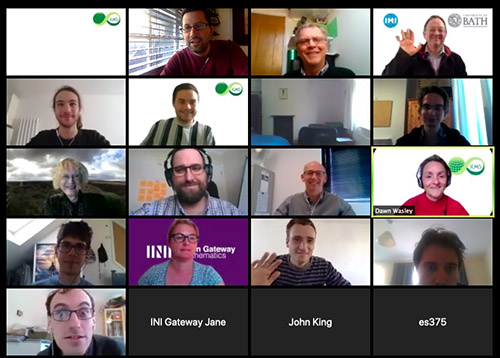
Attracting 30 participants, the VSG addressed a modelling resin phase separation challenge (from global chemical company, Scott-Bader), and a numerical analysis problem (from Bristol-based SME, Zenotech). Following the standard Study Group format of presentations and questions on the first day, each problem was assigned a coordinator and breakout room, and the whole VSG assembled each morning for a progress summary. Two half-hour presentations were given on the final day.
On the Tuesday, the Department of Health and Social Care submitted a third, and more urgent, COVID-19 related problem. The flexibility of the VSG meant a four-page report was delivered two days later. This led directly to a second workshop, 29–30 April, focusing on mathematical principles for unlocking the workforce, attracting over 50 delegates. A report on four complementary strands of the problem was delivered immediately afterwards.
The technology used was a mixture of Zoom (for meetings/conversations/breakout-space); Mural (online virtual collaboration space); WhiteboardFox (interactive graphical utility); HackMD (LaTeX-friendly interactive platform for exchange of mathematics, figures, and computations); and Dropbox/GoogleDrive (repositories for papers, reports, and data). The Mural collaboration space enabled easy interaction with all of the platforms.
Despite the added challenges of combining participation with caring responsibilities and other work meetings, excellent progress was made on all problems. One attendee commented:
I could easily attend the study group while fulfilling my child-caring commitments. This is a very family friendly solution, even for post-Corona times.
This positive experience clearly demonstrates that the Study Group concept of collaborative and inclusive teamwork can operate successfully in a virtual environment, and that VSGs offer increased agility. We hope to run many more in the future.
First INI Virtual Programme
In collaboration with the Royal Society RAMP (Rapid Assistance in Modelling the Pandemic) initiative, the INI commenced a four-month virtual programme on ‘Infectious Dynamics of Pandemics’ in May. This involves targeted discussion groups and webinars, live and recorded presentations, and an opportunity to access bespoke courses in pandemic modelling. As a direct follow-on to INI’s successful 2013 ‘Infectious Disease Dynamics’, the online repository of resources are recommended to those with strong mathematical backgrounds and an interest in pandemic modelling.
We are keen to offer our services and expertise to the whole mathematical sciences community to foster new links and address current, emerging, and long-term topics. Please contact Matt Butchers to discuss ideas further. We wait to hear from you!
Joanna Jordan FIMA (Freelance MS KE), Matt Butchers (KTN)
David Abrahams CMath FIMA (INI), Dawn Wasley (ICMS),
Chris Budd OBE CMath FIMA (IMI, University of Bath)
Reproduced from Mathematics Today, June 2020
Download the article, The Virtual Forum for Knowledge Exchange (pdf)
Postscript: An Operations Manual for Running a Virtual Study Group was published after the print version of Mathematics Today went to press. It details the steps required to run a virtual study group (VSG).