The way we deal with the carbon we produce as a by-product of using fossil fuels is coming under increasing scrutiny. Mathematics is not only helping design ways of capturing the carbon, but it is also used in inventing ways of safely storing it underground.
Climate change is currently one of the hottest topics in both science and politics. Governments and researchers across the globe are discussing ways to limit our impact on the environment by reducing our carbon dioxide CO2 emissions, and the UK is a world-leader in this area. The 2008 Climate Change Act included the planet’s first legally binding climate change target and the UK has now made a legally binding pledge to become net zero by 2050.
As part of this drive to cut back on the environmental effects of CO2, a few power stations are developing technology that is designed to trap the CO2 produced as a by-product of burning fossil fuels. The most advanced systems capture CO2 by using a material called ethanolamine. Whilst this material is efficient at capturing CO2, removing it from the amine solution to make room for more to be captured requires substantial amounts of energy/heat to release the carbon dioxide. Currently, in these pilot plants it is estimated that up to 40% of a power station’s produced energy would need to be used to operate such a system which in turn would increase the price of energy for consumers.
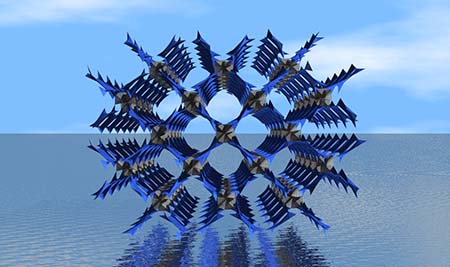
But a new material called NOTT-300, discovered at the University of Nottingham, could be set to revolutionise the world of carbon capture. Researchers found that when they combined aluminium nitrate with a carbon-based connector in water and ‘cooked’ it at 210°C for three days under pressure, the result was a porous material with an extremely high internal surface area and unique gas absorption properties.
The higher the internal surface area, the greater a material’s capacity to absorb gases. Take your lungs. Across both lungs you have around 300 million tiny hollow cavities called alveoli, which means, despite their relatively small size, your lungs have an internal surface area of around 160 square metres – enough to cover more than half a tennis court. The vast number of cavities wrapped up inside NOTT-300 means that a single gram has an internal surface area of 1800 m2 – enough to cover almost seven tennis courts. What’s more, it is stable up to 400°C and doesn’t dissolve in water. It is also a relatively low cost material to produce as its main ingredients – aluminium salt and a carbon-based connector – are cheap and abundant. Most importantly it was found that the material could selectively absorb pollutant gases such as CO2 and SO2 with other gases such as oxygen and nitrogen passing straight through.
The team are currently looking at ways to scale up the technology for potential use in commercial power stations. That task requires intimate knowledge of the material’s structure and how it reacts to different gases.
To investigate this, the material is exposed to various gases and then subjected to the process of neutron scattering. That’s where the maths comes in. Neutron scattering involves placing a material in the path of a focussed beam of neutrons (neutral subatomic particles that, along with protons, are found in the nuclei of almost every atom). As the neutrons bounce off the NOTT-300 structure, they are scattered off at different angles before being picked up by sensitive detectors.
The bigger the angle, the more tightly packed the atoms are within the structure. This is known as Bragg’s law, first formulated by father and son duo William Henry and William Lawrence Bragg, who both won the 1915 Nobel Prize for Physics for expressing the exact mathematical relationship between atomic spacing and scattering angle.
By using Bragg’s law to interpret the results of neutron scattering experiments, the NOTT- 300 researchers were able to determine that their new material absorbs 31% of its own weight in CO2. It is also able to soak up 55% of its weight in sulphur dioxide (SO2) – the chemical that when combined with water droplets in the atmosphere is responsible for acid rain. Currently two different methods are needed to remove CO2 and SO2 from power station flue gas – NOTT-300 can do both at the same time. Crucially, the neutron scattering experiments were able to show that NOTT-300 does not absorb any other gases, meaning they can’t clog up valuable space in the material that could have been used for gathering up these two environmentally harmful substances.
NOTT-300 holds a lot of promise. But even if it comes into use in commercial power stations, you still need a safe way to dispose of the CO2 once it’s been removed. Luckily, mathematics is helping here too.
Carbon sequestration – taking carbon dioxide and burying it in underground reservoirs – is seeing growing interest and investment both globally and in the UK. Prime sites for depositing the CO2 include natural saline aquifers – layers of porous rock filled with salt water. It is also possible to use old oil and gas reservoirs that the fossil fuels were pumped out of in the first place. They are attractive because their structures are reasonably well known from the initial prospecting.They also have a natural geological cap that once stopped the fossil fuels escaping – the same cap can help contain the CO2.
In order to maximise the safety and efficiency of carbon sequestration, it is important to understand how the gas spreads throughout the reservoirs and the risk of CO2 leaking back out again. This is where mathematical modelling is vital. At the University of Cambridge, work is ongoing to model the behaviour of CO2 in saline aquifers like those under the North Sea. Seismic surveys are conducted by towing a source (air gun) and receivers (microphones) behind a ship, with microphones sometimes reaching 10km or more from the stern. By listening to the reflected sound waves, geophysicists can work out the structure of the earth, including pockets of injected CO2. The mathematical model can then be honed to match these measurements. This modelling has led to an understanding of the rate at which CO2 may propagate in the subsurface, where it may spread and why it may eventually stop. Using this insight it is possible to design the best injection scenarios, including how and where to drill, at what rate to pump and when to stop. The ideal scenario is to maximise the amount of CO2 that is stably trapped (not absorbed) while minimising cost and risk.
As we press ahead with efforts to make our energy industry more green, mathematics is at the heart of new technologies that will both improve the way we absorb carbon dioxide in our power stations and the way in which we safely store it away.
Technical Supplement
Bragg’s Law
Bragg’s Law states that  , where
  is an integer,
  is the wavelength of the beam of neutrons,
  the spacing of the planes in the atomic structure, and
  the angle at which the neutrons are reflected.
The law was originally formulated for a beam of X-rays being scattered by interaction with the crystal lattice inside a solid. In the case of determining the structure of NOTT-300, neutron scattering is preferred due to the fact that neutrons can penetrate further into the material.
Carbon sequestration
Mathematical modelling of carbon dioxide inside underground reservoirs has shown the leakage rate is proportional to the inverse of the natural logarithm of time. A function has also been determined which models carbon dioxide flux as a function of time. This enables the time over which the flux dies away to be determined.
Acknowledgements
The IMA would like to thank Professor Martin Schröder and Dr Sihai Yang at the University of Nottingham and Dr. Jerome Neufeld at the University of Cambridge for their help in the preparation of this document.
Image credit: NOTT-300 © The University of Nottingham
Cleaning up the Energy Act: Carbon Capture and Sequestration (pdf)