Most people or institutions are grouped together in lots of different networks – for example in our personal lives we are part of networks consisting of friends, family and work colleagues. On an even bigger scale, countries are part of networks working to negotiate international trade agreements or to develop policies on climate change or air pollution.
What influences how we behave within these networks? For example, when people are asked to recycle, some behave in a way which benefits the whole community – “co-operators”– and some behave selfishly – “free-riders”. What makes people decide on a particular course of action?
Researchers at the universities of Southampton and Surrey have been investigating the underlying mathematical theories which influence how individuals placed within a particular type of network behave, using two branches of mathematics called network theory and game theory. They have been looking at how patterns of behaviour develop over time – if people begin by cooperating with each other will they eventually switch to becoming free- riders or vice versa? How will the total number of co-operators and free-riders in the entire population change over time?
This cutting-edge research could have wide reaching implications for policy makers in the future. The researchers were initially inspired by countries where there are networks of small- scale fishers, investigating how fish stocks can be preserved and finding out how selfish or free- riding behaviour can be avoided.
Initial Research
Previous research at other universities has found that people’s behaviour changes when they are placed within the structure of a network. The researchers at Southampton and Surrey have built on this by looking at interactions on one particular type of network model which is a good way of describing how many groups of individuals or institutions interact. One key feature of this network model is that there are large numbers of people who have a relatively modest number of connections and then smaller numbers of people who have a larger number of connections.
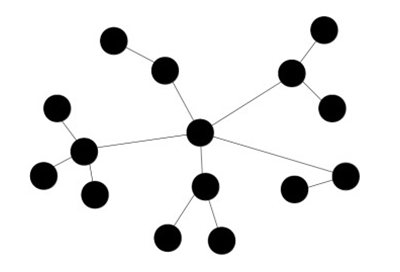
Previous mathematical research had shown that in the standard example of this type of network model, if you begin with enough well- connected people cooperating, then over time this cooperative behaviour will increase within the population (as long as the rewards for cooperation are above a critical threshold). The reason for this is that when a well- connected person becomes a co-operator they will be more resilient to the surrounding free-riders and can therefore help cooperation spread more easily. In the example of small-scale fishing, a fisherman who is very well connected and is also in favour of fishing quotas, is likely to spread their ideas about cooperation more easily than a fisherman who doesn’t have many connections.
New research
Researchers have now begun to use what are known as multi-layered networks, as in some cases they are a more accurate way to represent the real world. In the fishing example, each node would be a fisherman and each layer would be a different group of acquaintances, such as fishermen they meet at a market or fishermen they meet at a particular port. The researchers at the Universities of Surrey and Southampton have therefore begun to focus their research on these multi-layered networks. We all have multi-layered networks in our own lives – for example we have one network of family, and another consisting of work colleagues.
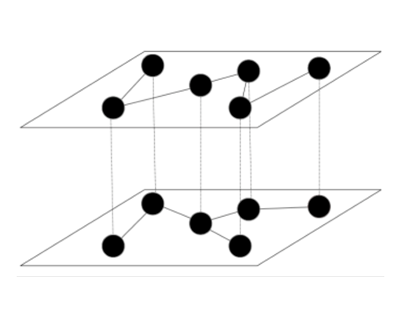
To put this into context by using a simplified example, a nation may be simultaneously considering their approach both to air quality, and also to water quality in their surrounding seas. Even though the nation might be surrounded by one network of other nations, it is effectively part of two different interlinked networks – one network of nations who are considering whether to cooperate on air quality and one network of nations who are deciding what to do with water quality. In reality the researchers usually use networks featuring individuals or companies which contain 100-1000 nodes.
The work of the researchers has used numerical simulations to study the effect of how frequently individuals choose to cooperate or defect on each layer. They found that if the members of the network change whether they cooperate or defect on every layer at the same time, this leads to lower amounts of cooperation than when they update on one layer at a time.
This is caused by the co-operators on one layer helping co-operators on another layer resist exploitation by free-riders.
In the previous example this means that overall a greater level of cooperation will be reached if nations only change their policies on air and water quality one at a time. This means that introducing policy which controls how frequently people, companies or nations choose whether to cooperate or free-ride can increase the cooperation in the system, and therefore reduce the exploitation of resources. While much of the current research is at an abstract level, it has huge potential for influencing behaviours in the future, particularly as resources become scarcer.
Technical Supplement
The research described in this article usually only applies to a special type of network which is called a “social network”. The title of this type of network can be confusing, as it can describe lots of different types of networks of individuals or institutions such as a network of nations as in the previous example. It doesn’t necessarily always refer to what we might immediately think of as a social network (for example Facebook and Twitter). The “social” part of social network just indicates that people are being connected rather than objects.
What are the mathematical properties of a “social network”?
Firstly, a network consists of vertices/nodes and edges that connect them. The number of edges connected to each vertex is called the degree. Social networks are networks where the nodes are people or institutions, and the edges are the connections between them. A common example which is used is the network of actors, where if two actors appear in a film together an edge is formed between them. There are a number of characteristics that social networks have in common. These include the “small-world” phenomenon, or “six degrees of separation”, where each person in the network is a small number of steps away from any other person.
In the example where we have a network of actors, if we had a particular actor who had acted with 10 other different actors in their career, then they would have a degree of 10. The probability of a node which we select at random having a certain degree is called the degree distribution, and this varies for different networks.
In a certain type of network, called scale-free, this probability distribution follows what is known as a power law, where  is the degree and
  is the probability of a node having that degree:
For social networks the value of will usually be between 2 and 3. Many real world social networks share this property meaning that the research described in this article has wide reaching applications.
References
James M Allen and Rebecca B Hoyle, Asynchronous updates can promote the evolution of cooperation on multiplex networks, Physica A: Statistical mechanics and its Applications, 471:607-619: http://dx.doi.org/10.1016/j.physa.2016.11.135
Experts
Professor Rebecca Hoyle, University of Southampton
James Allen, University of Surrey
The IMA would like to thank Professor Rebecca Hoyle and James Allen, for their help in the preparation of this document.
Social vs Selfish – How the Mathematics of Networks Influences Human Behaviour (pdf)