9 May 2012, 6:00pm
Statistical Studies of Coronal Dimming and Coronal Mass Ejection, Dr Danielle Bewsher (Jeremiah Horrocks Institute, University of Central Lancashire)
Abstract
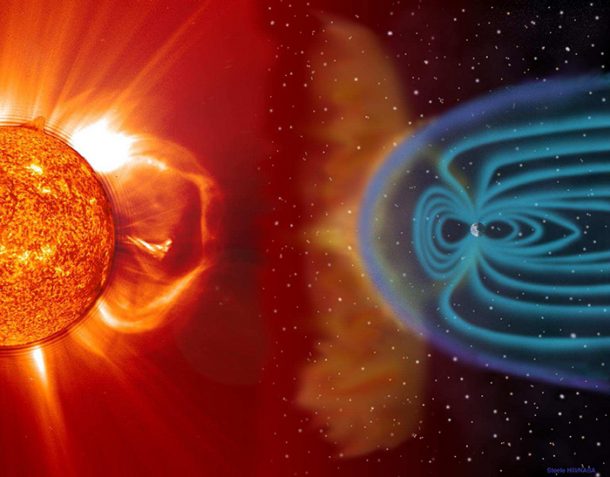
Compared to other stars, the Sun is relatively boring. However, the Sun is our local star and provides the energy that enables almost all life on Earth, and affects our everyday life, which makes it far from boring! Large quantities of energetic plasma from the solar atmosphere, called coronal mass ejections (CMEs), are regularly ejected into space. If this material is directed towards the Earth, then it can cause radiation hazards for astronauts, damage to spacecraft, induce currents in power grids and the aurora.
Because of the Sun’s effects on infrastructure that we rely on, one question posed by solar physicists is whether we can predict solar activity and in particular, the occurrence of CMEs.
Recently, I conducted a statistical study of coronal dimmings – an observable feature used to predict the occurrence of CMEs – and their relationship to CMEs. I will describe how mathematical techniques can be used to automatically identify these features in observational data and how probability models can be used to demonstrate the statistical relationship between dimmings and CMEs. I will also show observations and movies from the most recent space-based solar observatories.
Venue: Room E32, John Dalton Building, Oxford Road, Manchester Metropolitan University
No charge is made to attend meetings and non-members are welcome.