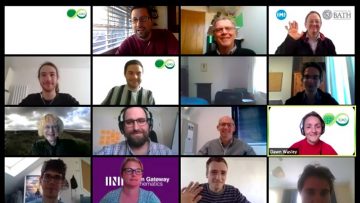
Mathematics 2021 Online ran for two half days in May, following on from a very successful IMA Mathematics 2020 Series which took place last summer in collaboration with the Newton Gateway to Mathematics. Many people will also fondly remember the annual one day conferences such as Mathematics 2018 which previously ran in person.
Most conferences focus on a single specialism or theme, whereas ‘Mathematics 2021 Online’ was deliberately designed to be different and cover a wide range of mathematical topics aimed at everyone with an interest in mathematics, including both academics and those who work in industry. For many people it provided a chance to step outside their normal field of research or work and to spend an enjoyable couple of mornings finding out about the wider mathematical landscape.
Day One
The first part of the IMA Mathematics 2021 Online conference took place on 6 May. The two talks were from IMA Gold Medallist Nick Higham, and David Abrahams and Jane Leeks from the Isaac Newton Institute for Mathematical Sciences (INI).
Gold Medallist Talk by Nick Higham
Communicating Applied Mathematics in 2021
In 2020 Professor Nick Higham (University of Manchester) was awarded the IMA Gold Medal, in recognition of his outstanding contribution to mathematics and its applications over a number of years. (Nominations for the IMA Gold Medal are considered every two years.) The IMA Mathematics 2021 Online series began with Professor Nick Higham’s Gold Medallist Talk: Communicating Applied Mathematics in 2021. In this talk Professor Higham explored how he has used his blog, as well as articles in magazines such as Mathematics Today to reach a much wider academic audience with his research and knowledge of applied mathematics. He also talked about his ‘What Is’ series of weekly blog posts which explain important topics in numerical analysis. There is a more in-depth write-up of Professor Higham’s Gold Medallist talk on this issue of Mathematics Today.
Future Developments and Directions in Mathematical Sciences Knowledge Exchange
This talk was given by Professor David Abrahams who is the director of the INI and Jane Leeks who is the Manager of the INI Newton Gateway to Mathematics.
The first part of the talk gave an update on the expanding work of the Newton Gateway which was rebranded in 2019, and was formerly known as the Turing Gateway. For anyone who is unfamiliar with the work of the Newton Gateway, it is the impact initiative of the INI and aims to: ‘bridge the gap between those engaged in frontier mathematical research and those working in more applied areas, by stimulating the interchange of knowledge and ideas’. Examples of current activities include Research Scoping/ Horizon Scanning Workshops, Study Groups and the establishment of the Virtual Forum for Knowledge Exchange in the Mathematical Sciences (V-KEMS).
In the second part of the talk Professor David Abrahams shared the news that the INI has been awarded an additional £10 million funding over the next five years arising out of the recommendations of the 2018 Bond Report: An Independent Review of Knowledge Exchange in the Mathematical Sciences. Professor Abrahams explained how INI plans to create a national Mathematical Sciences Connected Centres KE Network (CCN) which will support Knowledge Exchange across all UK mathematical sciences departments.
Hazel Lewis AMIMA
Day Two
The second part of the IMA Mathematics 2021 Online conference took place on 25 May with good attendance. The talks featured the works of the Virtual Forum for Knowledge Exchange in the Mathematical Sciences (V-KEMS), a platform created in March 2020 with the aim to identify virtual approaches to offer mathematical support to groups outside academia.
The day started with a brief introduction to V-KEMS by Matt Butchers, from the Knowledge Transfer Network, who also presented some of the activities organised by V-KEMS including several virtual study groups on challenges arising from the COVID-19 pandemic. Chris Budd and Alan Champneys then gave talks based on research from two V-KEMS meetings.
Reducing the Risk of Covid-19 Transmission on Trains
Professor Chris Budd, from the University of Bath, presented the results from the Virtual Study Group on Reducing the Risk of COVID-19 transmission on Trains. In this talk, Professor Budd described how the problem was divided into three challenges: the spread of the virus inside a train carriage; the infection risk during the entire journey, including going to the train station and entering and leaving the train; and the benefits of optimal train scheduling. The talk included a simulation on the crowd dynamics on the platform when the train arrives, and a very important take home message: queues that don’t respect social distance are high risk situations!
Modelling Solutions to the Impact of COVID-19 on Cardiovascular Waiting Lists
In the second talk of the day, Professor Alan Champneys, from the University of Bristol, discussed the work of a Virtual Study Group to study one of the consequences of the COVID-19 pandemic: the waiting lists for medical care associated with cardiovascular problems. In a talk that featured many references to Bob Dylan, whose 80th birthday was the day before the conference, Professor Champneys focused on the study of chronic heart failure, a loosely defined condition for which an early diagnosis is key to longer life expectancy. The talk featured several results using stochastic models, and a reflection on the ethical challenges of optimising the healthcare system.
The presentations are all available on the IMAmaths YouTube channel.
Eduard Campillo-Funollet AMIMA
University of Kent
Reproduced from Mathematics Today, August 2021
Download the article, IMA Mathematics 2021 Online (pdf)