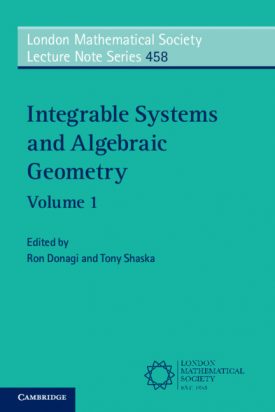
Ron Donagi and Tony Shaska (Eds)
CAMBRIDGE UNIVERSITY PRESS 2020, 420 PAGES
PRICE (PAPERBACK) £60.00 ISBN 978-1-108-71574-4
This book, and its companion Volume 2, have been produced and published to celebrate Emma Prevatio’s 65th birthday. This volume, as its title suggests, focuses on her achievements in Integrable Systems, which has been her main focus. However, she has used methods and ideas from other areas to advance that subject. The second volume is concerned with Algebraic Geometry where she has also made many major contributions. Emma Prevatio is one of the first women to research both her main areas of work.
Volume 1 contains sixteen articles relating to Integral Systems. The articles have been contributed by many people influenced by her over years. They are a mix of exposition, history and original research. Below is a brief description of some of the articles.
Article 1 – On a Class of Integral Operators – Fritz Gesztesy and Roger Nichols. These operators arise in the study of multi-dimensional Schrödinger and Dirac type operators. An example is given for massless Dirac type operators.
Article 2 – Explicit Symmetries of the Kepler Hamiltonian – Horst Knörrer. Quaternions are used to obtain explicit expressions for the global symmetries of the three dimensional Kepler problem.
Article 3 – A Note on the Commutator of Hamiltonian Vector Fields – Henryk Żołądek. Proofs are provided for the Jacobi identity for the Poisson bracket on a symplectic manifold.
Article 4 – Nodal Curves and a Class of Solutions of the Lax Equation for Shock Clustering and Burgers Turbulence – Luen-Chau Li. This article is an overview of the past several years of progress in the field of Statistics, although the equation, a matrix LAX equation, has applications in a number of other domains.
Article 5 – Solvable Dynamical Systems in the Plane with Polynomial Interactions – Francesco Calogero and Farrin Payandeh. This paper investigates algebraically solvable dynamical systems of consisting of two coupled ordinary differential equations. These are evolution equations equal to low degree polynomials in two dependent variables.
Article 6 – The Projection Method in Classical Mechanics – A.M. Perelomov. Describes the projection method of explicitly solving the equations of motion of systems of classical mechanics. Some specific solutions are given.
Article 7 – Pencils of Quadrics, Billiard Double-Reflection and Confocal Incircular Nets – Vladimir Dragović, Milena Radnović and Roger Fidèle Ranomenjanahary. Emily Prevatio has been extremely interested in Poncelet’s Theorem and integrable billiards over the past twenty years. These are two topics that have been crucial in the background of the development of billiards systems within quadrics.
Article 9 – The Periodic 6-Particle Kac-van Moerbeke System – Pol Vanhaecke. This set of equations is produced by discretizing the Korteweg De-Vries equation. Algebraic-geometric aspects of the Periodic 6-Particle Kac-van Moerbeke system are studied on this article.
Article 10 – Integrable Mappings from a Unified Perspective – Tova Brown and Nicholas M. Ercolani. Two discrete dynamical systems are studied. These systems are important for some problems in combinatorial probability.
Article 11 – On an Arnold-Liouville Type Theorem for the Focusing NLS and the Focusing mKdV Equations – T. Kappeler and P. Topalov. An infinite dimensional version of the Arnold-Liouville Theorem is produced for the focusing Nonlinear Schrödinger equation and the mKdV equation on a circle.
Article 14 – The Calogero-Francoise Integrable System: Algebraic Geometry, Higgs Fields, and the Inverse Problem – Steven Rayan, Thomas Stanley and Jacek Szmigielski. The Calogero-Francoise Integrable System is reviewed. Solutions are expressed in terms of twisted Higgs bundles.
Article 15 – Tropical Markov Dynamics and Cayley Cubic – K. Spalding and A.P. Veselov. This article covers the tropical version of Markov dynamics on the Cayley cubic. It is shown that the action is ergodic to the Lyapunov exponent.
Conclusion – This is a book that will mainly be of interest to people who are at least aware of Emma Prevatio. It gives a good indication of the many areas of mathematics influenced by her work. It is clearly aimed more at working mathematicians or post-graduate students.
John Bartlett CMath MIMA
Book review published directly onto IMA website