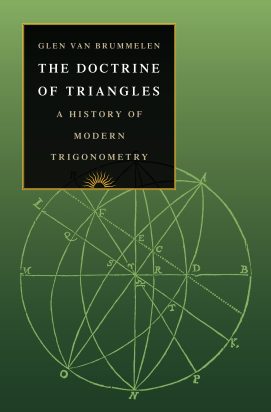
 Glen Van Brummelen
PRINCETON UNIVERSITY PRESS 2021, 392 PAGES
PRICE (HARDBACK) £25.00 ISBN 978-0-691-17941-4
This is the sequel to an earlier book by the author titled The Mathematics of the Heavens and the Earth. It begins from the mid‐sixteenth century onwards and contains five chapters, which include: European Trigonometry Comes of Age, Logarithms, Calculus, China and Europe After Euler.
Van Brummelen begins by commenting on the ‘polished package’ (p. 1) with which pupils are presented in school. He intends to tell the ‘tangled story’ (p. 1) behind this package: when these trigonometric ratios, expressions and identities first appeared in history, the mathematician involved and the impact that it had for future development of the subject and modern trigonometry.
He describes the essence of trigonometry originating through observation by ancient Greek astronomers, including Hipparchus of Rhodes, ‘who had constructed geometric models of the motions of the sun and moon’ (p. 1) involving ‘determining lengths in geometric diagrams from corresponding circular arcs and vice versa’ (p. 3).
The developing mathematical process behind trigonometric theory is a strong part of the book and is described diagrammatically throughout. Those who wish to follow through this insight will need to have at least an A level education in mathematics, to gain an appreciation of these descriptions. However, there are no colour plates, but brief biographical details of the mathematicians are given which assists the narrative flow.
The influence of calculus and logarithms is an important strand of the book concerned with ‘how trigonometry interacted with the new conceptions and applications provoked by these new ideas’ (p. xiv). The application of trigonometry is strongly emphasised, for example in seafaring, where ‘England took the lead in the integration of trigonometry with navigation’ (p. 53). John Napier’s first book on logarithms, published in 1614 and referred to today as the Descriptio (p. 63) revolutionised and simplified the trigonometric calculations necessary for navigation at sea. It enabled multiplications to be expressed through addition. Van Brummelen discusses the development of the Mercator sea navigation map, designed by Gerardus Mercator in 1569. Latitude and longitude are represented on the map and made single compass bearing navigation possible, along a straight line. Edward Wright in his 1599 book, Certaine Errors in Navigation (p. 102), improved the position of the latitude lines on the Mercator map, using the equivalent of the integral of the trigonometric ratio secant.
Van Brummelen then moves the focus on to the new technique of analysis, which minimises the geometric description necessary for trigonometry. In effect ‘trigonometry was becoming the study of particular kinds of functions’ (p. 304). Leonhard Euler founded modern analysis when he published the first of three books in 1748, titled Introductio in analysin infinitorum (p. 158). Joseph‐Louis Lagrange refined analysis further, in his words so that ‘perfection consists in using only the fewest possible principles’ (p. 247).
The section on China commences with the arrival of the Jesuits in the late sixteenth century. Van Brummelen is careful not to describe Chinese trigonometry culturally from a Western viewpoint or to focus in general on the history of trigonometry in the book using a modern interpretation.
The Doctrine of Triangles is an informative and valuable reference work.
Wallace A Ferguson CMath CSci MIMA
Chatham and Clarendon Grammar School, Ramsgate
Book review published directly onto IMA website