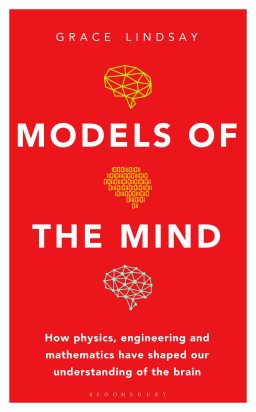
Grace Lindsay
BLOOMSBURY SIGMA 2021, 400 PAGES
PRICE (HARDBACK) £16.99 ISBN 978-1-4729-6642-1
The author of Models of the Mind, Grace Lindsay, is a computational neuroscientist. Aptly for a so-named professional, her popular science book describes the interplay between mathematics and biology in the study of the brain. Despite the alliterative title, it is the science of the brain that the book concentrates on, rather than the mind. This lively and readable text provides an introduction to modern neuroscience, as well as its history, and relates how mathematics has aided its progress.
Starting from the individual neuron, the chapters work through topics including memory, perception, movement control, and learning, while introducing mathematical ideas such as chaos, Shannon information, network theory, and Bayesian inference.
One theme is the mutual influence between artificial intelligence (AI) and neuroscience. For example, mathematicians will be familiar with the inspiration for artificial neural networks from properties of real neurons, but ideas have crossed over in the other direction. In the 1950s, neuroscientists found neural cells in frogs specialised for hierarchical pattern matching, in a form analogous to that first developed by computer scientists for artificial vision.
Many AI enthusiasts are motivated by the quest to create a conscious machine. However, AI research has progressed through creating systems with similar faculties to aspects of human cognition, such as perception and learning, in absence of a theory of consciousness. Through this book, it is clear that neuroscientists have made progress explaining many tangible and measurable properties of the brain, similarly without such a theory. At the end, however, Lindsay does briefly describe some controversial recent theories of consciousness, suggesting how unsatisfactory these are.
The mathematical concepts are mostly conveyed without equations, although an appendix does describe specific equations relevant to each chapter. In some hands this might make a book rather unavailing, but Lindsay manages to make her rich selection of concepts, biological and mathematical, interesting nonetheless. In one of my favourite chapters, she describes the route to successful theories of reinforcement learning. From Pavlov’s experiments in response conditioning, she leads us through Bellman’s dynamic programming for solving sequential decision processes (where the value of a state is defined recursively as reward plus the value of the next state) to DeepMind’s program for playing Atari games. Lindsay concludes that natural reinforcement learning is an aspect of neuroscience that has come close to fulfilling David Marr’s principles for explaining subsystems of the brain, which should be achieved at three levels. Firstly, computational: what is the system’s purpose? Secondly, algorithmic: how is this achieved? Thirdly, implementational: what specific parts (neurons, neurotransmitters, etc.) enact this?
Another theme is the tension between the messiness of the biology and the need in modelling for simplification. In 1982, John Hopfield developed a model of a network of neurons that could demonstrate ‘associative memory’. That is, when one memory component can provoke recollection of the whole memory. Hopfield’s model was based on a graph with weighted edges representing strength of neural connections. Each node represented a memory component, and the nodes were labelled with ‘-1’ or ‘1’ to denote the absence or presence of that component in a memory. The network would evolve over discrete time, with node labels being updated according to the weights. Initialised in a noisy or partial version of a memory, the network could stabilise to the representation of that memory. Not only was this model a simplified representation of real neural connections, it deliberately included the unrealistic assumption of symmetric neural connection strengths. However, it was a successful example of a model proving a principle: an associative memory could be represented by a network.
Another question of modelling is raised near the end of Lindsay’s book. To what extent should modelling proceed by representation of individual components of the brain (say from the neuron up), or from high level abstraction? Is the brain, the result of long evolution, too complex to be understood as a whole? On the other hand, would a hyper-detailed model be too complicated to be practical, or even have explanatory power? Lindsay concludes that neuroscience has learned much from incorporating principles from mathematics and physics, but future progress will require careful development and application of mathematics unique to the intricate biology of the brain. Simple enough might be very complicated.
Alasdair Hunter CMath CSci MIMA
Book review published directly onto IMA website