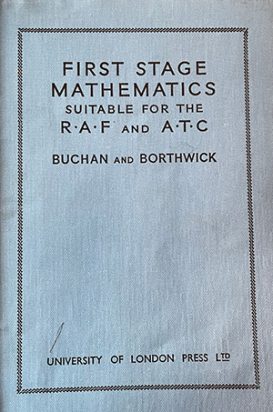
While browsing in a second-hand bookshop several years ago, I stumbled upon a slim booklet, published in 1941, entitled First Stage Mathematics Suitable for the R.A.F. and A.T.C. [1]. Containing just 95 pages, this book begins with simple arithmetic and moves on to such topics as elementary algebra (up to quadratic equations), basic Euclidean geometry, some trigonometry, and the use of log tables.
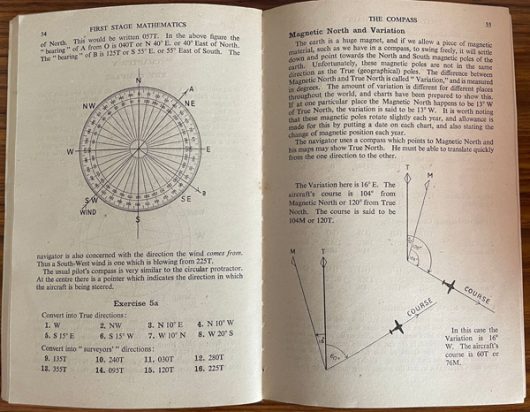
The content is often dressed up in a language that makes it especially relevant to budding aircrew – see Figure 1. The geometry, for instance, is geared very much towards map-making and the trigonometry to range-finding. According to its preface [1, p. 5], the purpose of the book was to refresh the mathematical knowledge of:
… young men who wish to join the R.A.F., but who feel that they have long forgotten their school Mathematics.
Hence the quite elementary level. But it wasn’t the content that caught my eye and sent me to the till with this little book – it was one remark at the end of the preface [1, p. 5]:
It is hoped that this book will give confidence to those who, in the past, have found Mathematics a terrifying subject.
Given that the booklet’s readers were being trained to go to war, the idea that they might be terrified by mathematics struck me as odd – even, dare I say it, laughable.
Yet, this remains the reality of how mathematics is often perceived several decades on. I need hardly recount any of this for the present readership: we’ve all had that encounter where someone wants to tell us how bad they were at maths at school and how frightening they find it still. The idea is fixed that they can’t do mathematics and that’s that. I’ve given lectures to non-mathematical audiences where the mathematics involved barely went beyond arithmetic, and yet, sadly, there were members of the audience who simply saw a monolithic MATHEMATICS and stopped engaging at that point.
Secure in our own mathematical understanding, we might view this attitude with bemusement, but if people have been turned away from mathematics so comprehensively that we first have to break down the fear barrier before we can even begin to communicate the ideas that we find interesting, then we are faced with a serious problem.
As far as I can tell, the problem is one of relatively modern origins, perhaps within the past 200 years or so, but there don’t yet appear to have been any comprehensive studies of the historical emergence of maths anxiety (some early steps are taken in [2]). The literature that has developed around this issue over the past several decades is a rather more practical one that places greater focus on the origins of maths anxiety in the individual – its effects on assessment and how we might counter it in an educational setting – than on the wider societal shifts that have made such attitudes commonplace (see, for example, [3]).
This is not to imply that prior to the twentieth century everyone loved mathematics, but rather that expressions of distaste for mathematics do not appear to have been quite so systemic. Of course, access to education is probably a factor here: not as many people were able to study mathematics and those who did were more likely to be studying it out of genuine interest for the subject. This is all highly speculative, however, and more historical research is needed.
Mathematics has always had its critics, whose hostility to the subject has sometimes been brought on by the perception of exclusivity that mathematical symbolism can provoke. We might cite, for example, the anonymous reviewer [4, p. 53] of a late-eighteenth-century mathematical textbook, who bemoaned:
… the tricks played with x’s and y’s, the hocus pocus of mathematicians.
This somewhat calls into question this person’s suitability as a reviewer of an algebra textbook. But the practical value of mathematics has rarely been questioned. Throughout history and around the globe, book-keepers, instrument-makers, navigators, surveyors and others have plied their various trades, quietly supported by mathematical tutors and textbook writers. Elsewhere in society, mathematics has been seen as a genteel accomplishment or a recreational activity. Within an educational setting, it was a vital part of producing a well-rounded individual, even if the mathematics itself wasn’t the main focus.
Although the practical users of and dabblers in mathematics have often been overlooked in the story of its development in favour of ‘research mathematicians’, their existence points to the long-standing pervasiveness of mathematics in many societies and this pervasiveness is of course still with us. Few people would question the utility of mathematics, but many would view it as something far from their immediate lives – as something for someone else to do.
The assertion that ‘things were better in the past’ rarely stands up to scrutiny, but I’d venture to suggest that we have an example here where it really does hold water: the attitude towards mathematics within wider (British) society was more favourable in centuries past. It is sad to live in an age where disdain for mathematics is the default point of view. But the outlook is not bleak. Valiant efforts are already being made in schools, where mathematics teachers seek to inspire their pupils with an interest in the subject and to nip maths anxiety in the bud.
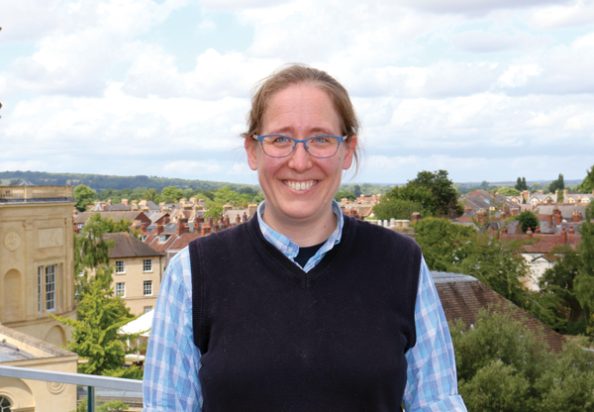
We can also pay tribute here to the great numbers of mathematical professionals who engage in outreach activities, thereby helping to demystify mathematics for the general public. The present issue of Mathematics Today features a write-up of this year’s How to Talk Maths in Public conference. This editorial is being written in June 2023, just a few weeks after the untimely death of Vicky Neale¹, one of our greatest recent communicators of mathematics, especially to school children. I’d like to pay tribute to her in particular. As Vicky showed, one way to counter a fear of mathematics is to demonstrate just how interesting it can be.
In conclusion, let’s come back to those World War II aircrew struggling with mathematics. Browsing through library catalogues and bibliographies, I found that the little booklet mentioned at the beginning of this editorial was far from being the only such book to appear in print. So far, I’ve come up with around a dozen similar titles, produced for trainees in the UK and in the USA, as well as further volumes for the armed forces more generally (for example, [5]).
When we look into the uses of mathematics during the Second World War, we usually only hear about the high-level mathematics employed at Bletchley Park, but we can have no doubt that mathematics of a more elementary kind also had its place. It may have taken a war for the readers of these booklets to seek to overcome their fear of mathematics, but it would be nice to think that they were then able to take an appreciation of the subject back with them into their civilian lives.
Christopher D. Hollings FIMA
University of Oxford
Acknowledgements
I am grateful to Snezana Lawrence FIMA and Sue Johnston-Wilder FIMA for references to the literature on maths anxiety and to Tony Mann FIMA for useful comments on a draft of this editorial.
Notes
- Further tributes to Vicky can be found on the Oxford University website.
References
- Buchan, A.F. and Borthwick, R. (1941) First Stage Mathematics Suitable for the R.A.F. and A.T.C., University of London Press.
- Carlson, B.A. (2022) Blowing off steam: Victorian narratives of frustration about mathematics, Math. Intell., vol. 44, pp. 269–272.
- Dowker, A., Sarkar, A. and Looi, C.Y. (2016) Mathematics anxiety: What have we learned in 60 years?, Front. Psychol., vol. 7, art. 508.
- Anon (1795) Review: The Elements of Algebra by James Wood, The Critical Review, or Annals of Literature, vol. 15, pp. 51–60.
- Oram, F.T. and Wesley, R. (1942) Mathematics Pocket Book for the Services, Evans Brothers, London.
Reproduced from Mathematics Today, December 2023
Download the article, Anxiety About Maths Anxiety (pdf)