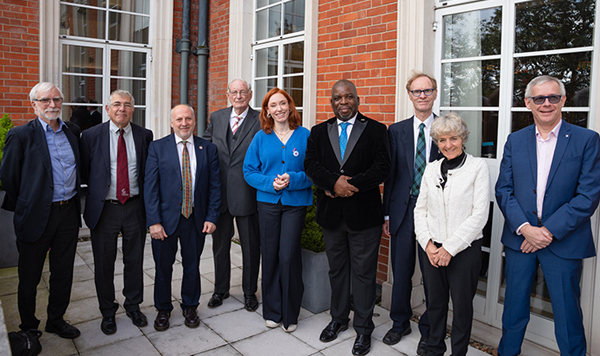
For many of us, a birthday, particularly a milestone birthday, is approached with some amount of trepidation, the surprise of how quickly time has passed and the inevitable introspection in which we wonder what we have – or have not – achieved since the last. For institutions, similar processes of corporate reflection attend anniversaries and are a healthy opportunity to contemplate past successes. For the Institute of Mathematics and its Applications, this year marks the 60th anniversary of its foundation. The occasion was marked by a successful anniversary event in London, attended by our current president, Hannah Fry HonFREng FIMA, and several of her predecessors.
In 1964, the IMA was founded by Sir James Lighthill FRS, the centenary of whose birth coincidentally also falls this year. At the time, the Institute sought to create a community of mathematicians broader in scope than the more academic London Mathematical Society. As such, the IMA has sought to be attentive to the interface between academic and industrial mathematics. With this comes an acute awareness of the utility of mathematics, not merely as an intellectual endeavour for its own sake, but as an important pillar of high-end manufacturing, financial management, and military research and development, among many other sectors.
Seeking to nurture this broader use of mathematical knowledge, the IMA has forged important connections with industry. One of these is the IMA Exponential mentoring programme, which connects senior and junior members, in order that the latter may learn from the former (and vice versa). Learning is a never-ending process and, with this borne in mind, the Institute has crafted a platform for Continuing Professional Development, which offers a framework within which employees can mature professionally and mathematically, developing a greater intellectual grounding and laying the foundations on which to take future steps in their careers.
In addition to maintaining these external connections, the IMA has sought to promote internal connections within the mathematical community. Prominently, this has included sponsoring a successful set of publications (including, of course, Mathematics Today) and facilitating a number of conferences, whereby mathematicians share their latest news and work with each other.
Nevertheless, as heartening as dwelling on historical achievements can be, it avails us little if we do not use this reflection in order to learn lessons from the past, which will profit us in the future. When we find ourselves at a junction, the path last taken can help us to choose the next.
Mathematics and mathematicians have evolved significantly in the past 60 years. No longer can be it argued, as held from the ages of Isaac Newton to Bertrand Russell, that advanced mathematics is primarily the occupation of an elite, the esoteric practice of dons passed on to their students, the preserve of the gilded world of the ancient universities. As economies have become increasingly knowledge-based, mathematics, one of the most ancient and foundational disciplines, has entered into many other fields. Increasingly many career paths now require high levels of mathematical skills. In turn, that has increased the demands on our educational system, at all levels, to meet these demands by producing students with the requisite knowledge and skills.
Naturally, exercising its role as an advocate for the mathematical sciences within the public sphere, the IMA has been a notable proponent of the increasing importance placed upon mathematical education. Welcome developments include attempts to encourage more school pupils to study for qualifications in mathematics, tailoring the curriculum such that it includes content more amenable to the needs of a modern economy, and the vocal support of the former Prime Minister, Rishi Sunak, for the mathematical sciences.
Few organisations – and the IMA is certainly not among them – can avoid considering one of the most promising, innovative and potentially vexing advances of the technological age, which is, of course, the creation and refinement of artificial intelligence (AI). Since OpenAI’s release of ChatGPT, feverous speculation has abounded as to the perils of AI. Much of the alarm is, as most mathematicians will recognise, hyperbolic: Skynet will not enslave humanity. Nevertheless, inanimate objects being nominally endowed with a property – namely, intelligence – that we have previously thought reserved for ourselves as human beings, distinguishes this advance from others of the Industrial Revolution, Space Age, or the early era of the Internet. Concern is legitimate. Undoubtedly, the risks are greater than merely students cheating on their assignments, which has become the danger most discussed among the academic circles that dominate the mathematical community.
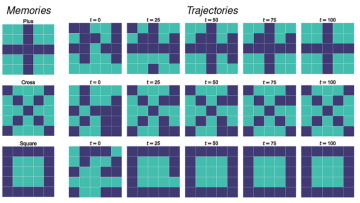
At its heart, however (if it can be thought to have such a thing), ChatGPT, like any other large language model, is a mathematical creation: the fusion of a snazzy language synthesis algorithm, a healthy dose of linear algebra and the analysis of a perhaps unhealthy amount of data.
While few may appreciate the significance of this fact, and fewer still fully understand it, mathematicians are uniquely well equipped to comprehend the operation, nurture the promise and manage the potential pitfalls of the latest fruit of the Information Age. For the mathematical community, therefore, the advent of artificial intelligence is an example – monumental, well publicised and wide-ranging, but still simply an example – of the importance for society of having mathematically competent workers dispersed through the world of business.
Although few, outside academia, bear the specific title ‘mathematician’, there are many mathematicians, by education and by occupation, scattered throughout different fields and employed by many companies, research facilities and educational institutions. Part of the role of the IMA in its 60 years has been to create some sense of community among them all and, as the realm of mathematics diversifies and broadens, that can only become more important.
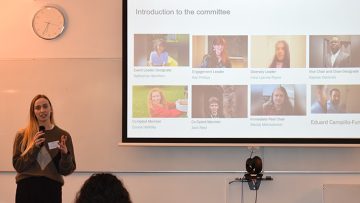
Many of those whose careers will shape, and will be shaped by, the opportunities and challenges that recent developments pose, are currently still in education, or in their first few years of work. In 2024, the IMA’s Early Career Mathematicians (ECM) Group marks its 20th year, completing the triptych of significant anniversaries for the IMA this year. At its inception, the purpose of what was initially called the Younger Mathematicians Group, founded by Amanda Padbury CMath MIMA and Dan Tilley CMath FIMA among others, was to provide an institutional voice within the IMA for a group otherwise underrepresented in the upper echelons of the Institute. Since that time, the ECM Group’s remit has grown, now sponsoring a wide variety of activities. If you are an ECM, why not consider joining the Committee?

Having broad networks and being well connected within one’s field is important for all mathematicians, but particularly so for junior mathematicians seeking to establish their careers. As a contribution to meeting this need, the ECM Group has hosted a number of conferences, in order to allow mathematicians both within academia and from industry to present their latest work, to establish relationships with their contemporaries and to learn of the latest exciting developments in their field.
Coronavirus created a major shock, necessitating a temporary move to remote working and facilitating an indefinite move to hybrid working for many. Adapting to that, the ECM Group began offering Virtual Maths Teas, which are online opportunities to connect with others across the country on a wide range of topics, including careers advice, good programming practices and how to grow mathematically when working in industry. Similarly, the Group has started to offer online seminars, in order that researchers can broadcast their work more widely.
Over 60 years, the IMA community has met with good fortune when we are prepared to meet new developments with tools from our existing mathematical armoury, to adapt our ways of working and techniques to new problems and to engage in the vibrant exchange of ideas. In light of the turmoil of recent years, which has encompassed political upheaval, pandemic disease and financial instability, we may be tempted to believe ourselves victims of that old curse, ‘May you live in interesting times.’ Undoubtedly, we do live in interesting times, in every sense of that word. However, every previous generation would be entitled to think the same, facing multifarious challenges precisely as we do now. Building upon the solid foundations of the past, relying upon our present knowledge and embracing the promise of the future, we are well placed to meet them.
Jack Reid MIMA
University of St Andrews
Reproduced from Mathematics Today, December 2024
Download the article, Celebrating the 20th Anniversary of the ECM Group (pdf)