What do you do to find places to visit when travelling? Consult a guidebook? Search Google Maps? Look at reviews on TripAdvisor?
Early in my career, when I used to travel a lot to visit universities around the UK, I would often look up the places I was visiting in the Mathematical Gazetteer of the British Isles. This is an alphabetical listing of place names, and each has some information about mathematical places of interest and the mathematicians who were born, died, worked or visited there.
These were collected and published by the late David Singmaster in the BSHM Newsletter of the British Society for the History of Mathematics. Singmaster explained that he had been collecting information ‘for some years’ already by the time of the first publication [1]. The series was published in 18 parts from 1995 to 2002, and these were expanded and placed on the web with additional entries between 1998 and 2003.
Some of the entries are more clearly places where there is something to visit. For example, the entry for Greenock notes that there is a statue of James Watt (1736–1819). Others are harder to pin down. For example, the entry for Whitby notes that Charles Dodgson (1832–1898), aka Lewis Carroll, spent a vacation there in 1854, but there are no specific places to visit.
Some are more clearly mathematical than others. For example, the entry for Doncaster notes that William Herschel (1738–1822) played violin and oboe at the town hall in February 1762. Hershel was 23 at the time, and this was before he took up an interest in astronomy that led to him being appointed Court Astronomer to George III.
In 2010, my mathematician friend Samuel Hansen came to visit me in Nottingham for a little working holiday. Nottingham has a decent link to the history of mathematics through George Green (1793–1841). Green was the son of a miller in Sneinton, now a suburb of Nottingham. He was also a self-taught mathematical genius. He is the Green of Green’s theorem and Green functions. His father’s windmill, in which Green worked and which he later owned, was restored in the 1980s and is open today as a working mill and science centre (see Figure 1).
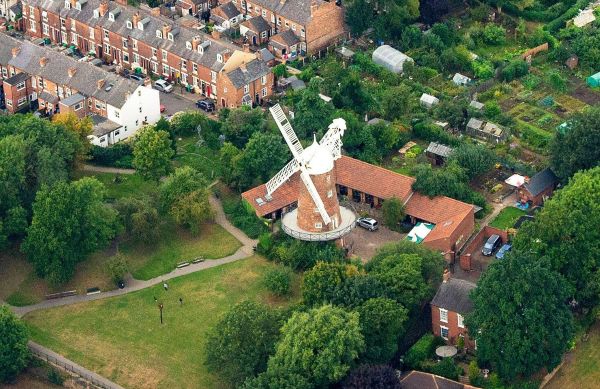
The Gazetteer entry for Nottingham has a long passage on Green, with details such as his gravesite at the nearby church. Although the house in which he died no longer stands, it was through the Nottingham entry that I learned that those on the opposite side of the road have been preserved because William Booth (1829–1912), founder of the Salvation Army, was born in one of them. The lives of Booth and Green overlapped from 1829 to 1841, so a visitor to the William Booth Birthplace Museum can get a picture of the world in which Green lived.
The Gazetteer contains much information that I had not known about my home town, which led to a series of excursions for my visiting mathematician. I learned that Ada Lovelace is buried in the Byron family tomb in the parish church of Hucknall, conveniently situated at the end of the modern tram line. I learned that Einstein lectured at the University College, now the University of Nottingham, in 1930, and that the blackboard he used was varnished and is preserved in the School of Physics and Astronomy.
One of the more perplexing entries about Nottingham explains that Burroughs first began overseas production of adding machines and calculators ‘at its premises in Bell Street at Kirkby Street’ in 1898, which was still in use in the 1950s. William Seward Burroughs (1855–1898) was an inventor from Rochester, New York. His company made mechanical adding and calculating machines. In the 20th century, it moved into computers before merging with Sperry UNIVAC in 1986 to form Unisys.
But what of the factory in Nottingham? ‘Bell Street at Kirkby Street’ is not a standard form of address, and I could not find either street on a modern map. I wrote to David Singmaster, and he provided a scan of the pages from Total to Date – The Evolution of the Adding Machine: The Story of Burroughs by Bryan Morgan. I understand that he had a considerable library from which many of the facts of the Gazetteer were drawn.
Singmaster’s clue showed a plan of a factory that covered the area between Bell Street and Kirkby Street, fronting both, hence the strange address, and adjacent to Arkwright Street. This clue was enough to unravel the mystery. Arkwright Street was the historic link between Nottingham railway station and Trent Bridge. The whole area was redeveloped in the 1970s. I visited the local studies section of the public library and consulted an old map, realising that the position of a nearby church was enough for me to identify the location of the factory, which is now within the site of a primary school.
The Gazetteer, then, is a treasure trove of information about local connections to the history of mathematics in the British Isles. It is currently housed by the MacTutor History of Mathematics project at the University of St Andrews, which has added an interactive map [2]. Not everywhere has an entry, and not every entry is as full as the one for Nottingham. I also wonder how much of the information is out of date after more than two decades, but I imagine an intrepid holidaymaker could investigate and find out.
Peter Rowlett CMath FIMA
Sheffield Hallam University
References
- Singmaster, D. (1995) #1 Aberdeen to Ashford, BSHM Newsletter, vol. 10, no. 1.
- MacTutor, Mathematical Gazetteer of the British Isles
Reproduced from Mathematics Today, June 2026
Download the article, Mathematical Gazetteer of the British Isles (pdf)