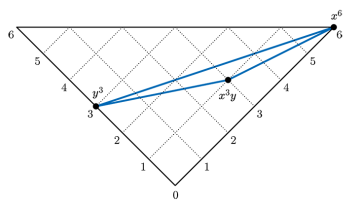
The points  and
and  are on the curve
  such that
  is a right angle. What points and will give the smallest possible area for the triangle ?
Reveal Solution
 Writing the coordinates of the points and as
  and
and  gives the line
  gradient
  .
.
The line  has gradient:
  .
.
Solving  gives
gives  and hence
  for the coordinates of .
By dropping perpendiculars to the x-axis, and labelling these points  and
and  , the area of the triangle can be found by subtracting the area of two triangles from a trapezium:

Solving with calculus:

 when
when  (or
(or  ). This gives and at (1,1) and (-1,1).
Solving without calculus:
 which has a minimum value when
  i.e. when (or ).
This gives and at (1,1) and (-1,1).