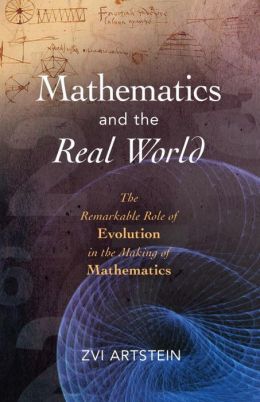
 Zvi Artstein
PROMETHEUS BOOKS 2014, 426 pages
PRICE (HARDBACK) £25.00 ISBN 978-1-61614-091–5
Artstein considers ‘the mathematics of nature, the nature of mathematics, and their interrelationship’, through historical review, current research and the link between mathematics, the physical world and the social world around us. The book is split into ten chapters, from the evolution of early man to current cutting edge technological advancement through mathematics. The chapters can be read in any order, without detracting from the common thread that runs through each. He has a very accessible style of writing, with asides that demonstrate the depth of his insight and research.
Artstein discusses mathematics that gives competitive advantage to early man; counting and recognition of geometric form. He takes time to introduce the concept of these as innate human attributes, from research into the abilities of the very young. He considers the building of evolutionary advantage, ‘Mutation and selection of genes are the basis of the modern understanding of the process of evolution of plant and animal species’. He gives a fascinating insight into the development of logic and proof in ancient Greek mathematics, maintaining his view that this results in mathematics that would not give an early evolutionary advantage, the need for rigour and precision not ‘innate in human nature’. It is too early to tell according to his analysis how evolved logic has become in the evolutionary process still current.
He discusses the academic freedom in Greek city states, tolerant of discussion and different viewpoints, that assists the rise of the new axiomatically defined mathematics. This is in contrast to the approach in earlier societies, notably Babylonian and Egyptian, where ‘An approximate result that would suffice for all practical purposes was sufficient. Mathematics was a practical tool and not an intrinsically theoretical subject’.
The section on the 19th century development of James Clerk Maxwell’s theory of electromagnetism is a strong element of the book where, ‘physics whose components could not be perceived directly but whose effect on other physical quantities could be measured’ requires a modern experimental approach deriving relations expressed in differential equations. This is in contrast to the ancient Greek study of nature, where scientific progress had to be logically developed to the exclusion of performing experiments, where ‘optical illusions’ may prevent the correct development of theory. The author examines nature and mathematics in the round, where ‘Nature tries to converge to the ideal solution that mathematics found, but it is not achievable’.
The section on the development of statistics as an academic subject from the work of Pascal in the 17th century onwards is framed in the evolutionary context of randomness with the human driver of gambling, and is very strong and untypical in a general book of this type.
Artstein considers contemporary times and what the future holds, discussing mathematical optimisation and artificial intelligence. He introduces genetic algorithms, which improve on optimisation, where features that contribute more to success are enhanced through the computing process, chiming with his early introduction of mutation and selection in describing how evolutionary progress occurs.
The book is plainly illustrated, although this does not detract from its effect. Very readable, engaging and offering a different perspective of the development of mathematics.
Wallace A Ferguson CMath CSci MIMA
Book review first published in Mathematics Today December 2016