Essential Math Skills for Engineers
Clayton R. Paul WILEY 2009, 231 PAGES PRICE (PAPERBACK) £33.50 ISBN 978-0-470-40502-4
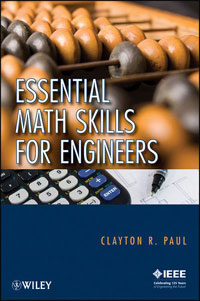 Mathematics is at the heart of engineering design. So states the author, Clayton R. Paul, a professor of electrical and computer engineering at Mercer University, in Macon, Georgia. I expect readers of this magazine are likely to agree, though I’ve known a few engineers who wouldn’t!
Professor Paul states that the purpose of his book is to “enumerate and discuss only those mathematical skills that engineers use most often” (his italics). By and large he manages this, though I doubt that many engineers find much use for Cramer’s rule, to which the book devotes five pages (compared with only two pages for Gaussian elimination)! Also, the absence of any statistics is, perhaps, surprising these days.
The main chapter headings are: What Do Engineers Do?; Miscellaneous Math Skills; Solution of Simultaneous, Linear, Algebraic Equations; Solution of Linear, Constant-Coefficient, Ordinary Differential Equations; Solution of Linear, Constant-Coefficient, Difference Equations; Solution of Linear, Constant-Coefficient, Partial Differential Equations; The Fourier Series and Fourier Transform; The Laplace Transform; Mathematics of Vectors.
In UK terms the treatment ranges from A-level standard to University level.
In answering the question, “What do engineers do?” Professor Paul supplies the following succinct summary: “Engineers develop and analyse mathematical models of physical systems for the purpose of designing those physical systems to perform a specific task.”
The book has a slightly old-fashioned air to it. Outside of the first chapter there is little or no attempt to discuss the topics in any engineering context; the emphasis is firmly on the mathematics (the first chapter includes six, brief, generalised examples to illustrate that the equations governing engineering systems fall into just a few categories). Numerical methods are treated only briefly in the chapters on miscellaneous math skills and ordinary and partial differential equations.
There is one, possibly trivial, peculiarity of the book I can’t help commenting on! There are several illustrative graphs purporting to show sine and cosine curves. However, in all cases they are clearly not sine and cosine curves; they are sequences of semicircles, alternately placed above and below the x-axis! Given the number of computational tools available these days that can plot proper trigonometric curves, this is surprising.
The discussions of each mathematical topic included are clear, though terse. The book is probably better seen as a repository of basic solution methods than as a text for first-time learners.
Mathematics is at the heart of engineering design. So states the author, Clayton R. Paul, a professor of electrical and computer engineering at Mercer University, in Macon, Georgia. I expect readers of this magazine are likely to agree, though I’ve known a few engineers who wouldn’t!
Professor Paul states that the purpose of his book is to “enumerate and discuss only those mathematical skills that engineers use most often” (his italics). By and large he manages this, though I doubt that many engineers find much use for Cramer’s rule, to which the book devotes five pages (compared with only two pages for Gaussian elimination)! Also, the absence of any statistics is, perhaps, surprising these days.
The main chapter headings are: What Do Engineers Do?; Miscellaneous Math Skills; Solution of Simultaneous, Linear, Algebraic Equations; Solution of Linear, Constant-Coefficient, Ordinary Differential Equations; Solution of Linear, Constant-Coefficient, Difference Equations; Solution of Linear, Constant-Coefficient, Partial Differential Equations; The Fourier Series and Fourier Transform; The Laplace Transform; Mathematics of Vectors.
In UK terms the treatment ranges from A-level standard to University level.
In answering the question, “What do engineers do?” Professor Paul supplies the following succinct summary: “Engineers develop and analyse mathematical models of physical systems for the purpose of designing those physical systems to perform a specific task.”
The book has a slightly old-fashioned air to it. Outside of the first chapter there is little or no attempt to discuss the topics in any engineering context; the emphasis is firmly on the mathematics (the first chapter includes six, brief, generalised examples to illustrate that the equations governing engineering systems fall into just a few categories). Numerical methods are treated only briefly in the chapters on miscellaneous math skills and ordinary and partial differential equations.
There is one, possibly trivial, peculiarity of the book I can’t help commenting on! There are several illustrative graphs purporting to show sine and cosine curves. However, in all cases they are clearly not sine and cosine curves; they are sequences of semicircles, alternately placed above and below the x-axis! Given the number of computational tools available these days that can plot proper trigonometric curves, this is surprising.
The discussions of each mathematical topic included are clear, though terse. The book is probably better seen as a repository of basic solution methods than as a text for first-time learners.