Fractals: A Very Short Introduction
Kenneth Falconer OXFORD UNIVERSITY PRESS 2013, 126 PAGES PRICE (PAPERBACK) £7.99 ISBN 978-0-199-67598-2
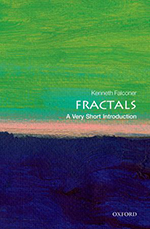 126 pages at A6, it is both short and small, but within it is contained a multitude of detail, explanation, background and relevance.
The book is very well written and is accessible to the interested middle-schooler, and definitely to those with some basic knowledge of geometric series and post GCSE mathematics. Whatever ‘special’ maths that is required, is carefully and succinctly explained; such as the basics behind complex numbers, squaring complex numbers, and a simple overview of the log laws.
The author first explains the concept behind a fractal, then how to construct the classics of the Koch Curve and Sierpinski Triangle (and a few modifications of them), using this as a template for future consideration. He also stressed the idea of itineraries and iterative processes. Discussion of self-similarity leads us through templates and self-affine fractals, and paves the way for a most interesting and informative chapter on fractal dimension.
The chapters on the Julia and Mandelbrot sets are simply and clearly written, and are incredibly interesting and illuminating; even for someone who already believes they ‘understand’ what these are.
Finally, the book discusses fractals in real life, including random walks, options pricing and the Black-Scholes model, amongst others.
I found this a most enjoyable, ‘short’ read, and it definitely did cause me to stop and think, at times, about itineraries, dimension and the relationship between the Julia and Mandelbrot sets.