
NIST Handbook of Mathematical Functions
Edited by Frank W. J. Olver, Daniel W. Lozier, Ronald F. Boisvert and Charles W. Clark CAMBRIDGE UNIVERSITY PRESS 2010, 968 PAGES PRICE (HARDBACK) £65.00, ISBN 978-0-521-19225-5 PRICE (PAPERBACK) £35.00, ISBN 978-0-521-14063-8
 How do you improve on perfection? The Handbook of Mathematical Functions edited by Abramowitz and Stegun (A&S) and produced for NIST (then known as the National Bureau of Standards) in 1964 has been the most highly cited of NIST’s publications. Indeed it was one of the standard references at my workplace and I personally found it invaluable.
To improve on this handbook, it was necessary to take into account the new work on special functions and the considerable advances in computing.
How do you improve on perfection? The Handbook of Mathematical Functions edited by Abramowitz and Stegun (A&S) and produced for NIST (then known as the National Bureau of Standards) in 1964 has been the most highly cited of NIST’s publications. Indeed it was one of the standard references at my workplace and I personally found it invaluable.
To improve on this handbook, it was necessary to take into account the new work on special functions and the considerable advances in computing.
- There is more information on special functions already covered in A&S. For example the section on the Riemann Zeta function has been greatly expanded from the single page in A&S to six pages including sections describing integral representations, infinite sums, asymptotic approximations and zeros. It is also illustrated with six plots.
- Twelve new chapters cover additional special functions. For example there are chapters on the functions of number theory, Lamé functions and integrals with coalescing saddles. The latter considers cupsoid and umbilical catastrophes and the associated canonical integrals and diffraction catastrophes.
- A CD-ROM copy is included with the book. Light blue text enables the user to reference the particular page, sub-section, formula, figure, etc. Also a parallel website, known as the DLMF (Digital Library of Mathematical Functions), has been created at http://dlmf.nist.gov/ The handbook and its CD-ROM provide context related links to this site.
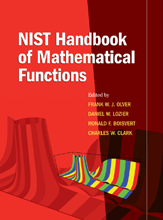
- The functions are illustrated by various graphics. A particular way of representing the modulus and phase of a function of a complex variable is to plot the modulus as the height and the phase with a different colour for each sector with e.g. blue representing 0–90° – an example is shown on the book’s front cover.
- The main group of tables at end of the chapter in A&S are not included in the NIST Handbook. Instead the considerable body of published tables is detailed at the end of the chapter by reference to the bibliography. By accessing the bibliography in the DLMF website the user can go to a reference through an external link.
- Likewise software can be accessed via the DLMF. As well as links to particular software, the DLMF includes a software index showing which software packages implement which special functions and a repository with significant holdings in the area of special functions. For example, source code for a large variety of special functions can be accessed from the NIST GAMS (Guide to Available Mathematical Software). Note that NIST does not endorse any software listed in the DLMF.