Relationships between pentagonal and triangular numbers
[vc_row][vc_column][vc_column_text]
2016 is a triangular number.
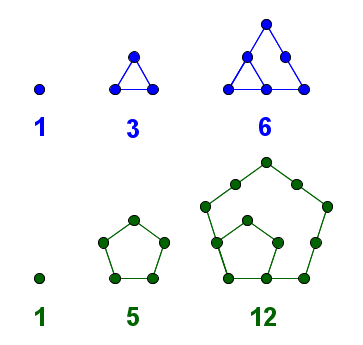
The first three triangular numbers are: 1, 3, 6. The first three pentagonal numbers are: 1, 5, 12.
The pentagonal numbers 1, 5 and 12 are all one third of a triangular number.
Are all pentagonal numbers one third of a triangular number?[latexpage][/vc_column_text][/vc_column][/vc_row][vc_row][vc_column][lvca_accordion][lvca_panel panel_title="Reveal Solution"]
Algebra solution
The formula of the $n$th pentagonal number:
$p_n=\frac{3n^2-n}{2}.$
\begin{align*}
3\left(\frac{3n^2-n}{2}\right)&=\frac{9n^2-3n}{2}\
&=\frac{9n^2-6n+1-3n+6n-1}{2}\
&=\frac{(3n-1)^2+(3n-1)}{2}.
\end{align*}
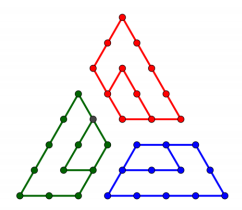
i.e. the $(3n-1)$th triangular number.
Problem Page Coordinator: Stephen Lee CMath MIMA – Mathematics in Education and Industry
Acknowledgement: The IMA are indebted to MEI for sourcing and supplying Mathematics Today with these well-known puzzles.
First published in Mathematics Today December 2016

 2016 is a triangular number.
The first three triangular numbers are: 1, 3, 6. The first three pentagonal numbers are: 1, 5, 12.
The pentagonal numbers 1, 5 and 12 are all one third of a triangular number.
Are all pentagonal numbers one third of a triangular number?[latexpage][/vc_column_text][/vc_column][/vc_row][vc_row][vc_column][lvca_accordion][lvca_panel panel_title="Reveal Solution"]
2016 is a triangular number.
The first three triangular numbers are: 1, 3, 6. The first three pentagonal numbers are: 1, 5, 12.
The pentagonal numbers 1, 5 and 12 are all one third of a triangular number.
Are all pentagonal numbers one third of a triangular number?[latexpage][/vc_column_text][/vc_column][/vc_row][vc_row][vc_column][lvca_accordion][lvca_panel panel_title="Reveal Solution"]
 [/lvca_panel][/lvca_accordion][/vc_column][/vc_row][vc_row][vc_column][vc_column_text]