Rolling-ball Clocks, Fountain Pens and Mathematical Collaboration
Even though I’ve been a member of the Mathematics Today Editorial Board for some years, I still have vivid memories of the first board meeting I attended. Coincidentally, this was also my first visit to De Morgan House in Russell Square. Being somewhat nervous, I arrived in London well before the meeting was due to start. So, with some time to kill I found myself in the British Museum, which is just around the corner from our meeting venue.
Nowadays, there’s lots of comment about what your favourite colour, place, song, dog breed or whatever says about you. I’m sure there’s something similar, although possibly more erudite, about what your favourite exhibit in the British Museum says about you. In the hope that I’m not sharing more than I should, or revealing some deep inner character flaw, I’ll tell you my favourite.
Despite spending most of my career working with computers and embedded electronics I have a penchant for mechanical things. Especially ones where you can see some of their inner workings and even a novice like me can appreciate some of the magic that makes them tick. So, it’s probably no surprise that I became absorbed by a rolling-ball clock.
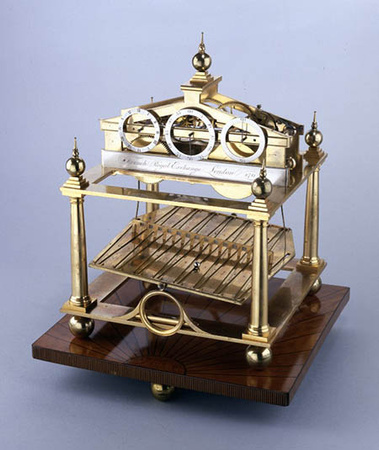
If you’re not familiar with the concept, rather than using a pendulum, the clock is regulated by a ball that rolls along a path inscribed on a tilted plane. When the end of the path is reached, the angle of tilt changes and the ball reverses its path. Despite its simplicity, I watched this simple process for five minutes or more.
For various reasons, rolling-ball clocks never really caught on. The plane the ball travels on means they’re quite large, more suitable for a coffee table than a mantelpiece. More importantly, they’re not especially good timekeepers. They are, however, wonderfully calming to watch.
That feeling of calm began to dissipate as, approaching my first board meeting, I climbed the stairs in De Morgan House, looking for our Institute’s room. A series of portraits on the wall seemed to convey messages to me: that important things happened here; that I was privileged to be a part of them; and, most of all, that I bore a responsibility to ensure things continued on to future generations. Fortunately, the other board members were very welcoming so it didn’t take long before my equilibrium was restored. That said, I do believe the messages of importance, privilege and responsibility are relevant for the work of the IMA and, more specifically, Mathematics Today.
Similar to my first board meeting, it was with some trepidation that I picked up the pen to write my first editorial. During my time supporting Mathematics Today I have had the great pleasure of working with several different editors. They have all brought their own gifts to the role, including setting strategic direction, encouraging contributions and effective chairing of meetings. Despite their differences, they have also had some things in common, chiefly a passion for our subject and the way that it is communicated. Individually and collectively they have been truly excellent. They have left some very big shoes to fill.
My mention of picking up a pen was not metaphorical. I wrote the very first draft of this piece out in longhand. I even used a fountain pen. That pen’s not special in the sense that it cost lots of money, although depending on your perspective it wasn’t cheap: it cost a few tens of pounds, rather than a few tens of pence. It’s also not special in the sense that I use it quite frequently, on an almost daily basis, now I come to think about it. But it is special in the sense that it was a present from a close relative. It’s also special in that I’ve been using it for quite a few years, so we’ve been through some good times together and we’ve also been through some tough times.
One of the reasons I’ve stuck with using a pen is that I find it gives me time and space to think. Using a keyboard, my fingers often move more quickly than my thoughts. Sometimes, that’s good. Especially when I’m trying to write a report on a subject that I know quite well. At other times, it results in a jumble of disorganised thoughts. Obviously, when using a keyboard and computer, it’s easy to move things around, but creating some form of coherent narrative still feels like a battle.
Maybe the difficulty of changing handwritten text encourages me to slow my thinking down sufficiently for at least semi-coherent thoughts to be produced. Or maybe it’s the nature of the physical act itself. I tend to attack the keyboard with a vengeance, striking each key with a definite purpose (although, given the noise this causes, I’m trying to moderate this behaviour so that I’m a better citizen in the modern world of open plan offices!). Using the pen is a much quieter, more fluid affair.
I find reading articles, especially those on the printed page rather than on a screen, is another way of finding time and space to think. Sometimes an article may directly help me with a problem I’m struggling with. More often, an article I’ve previously read feels as if it would be helpful and I drag half-remembered concepts from the depths of my memory (or, in some cases, look up the text). Occasionally, the act of reading seems to prompt something in my subconscious, entirely unconnected with the article at hand, but directly relevant to my problem. I’ve had all of these experiences when reading Mathematics Today

 Despite spending most of my career working with computers and embedded electronics I have a penchant for mechanical things. Especially ones where you can see some of their inner workings and even a novice like me can appreciate some of the magic that makes them tick. So, it’s probably no surprise that I became absorbed by a rolling-ball clock.
If you’re not familiar with the concept, rather than using a pendulum, the clock is regulated by a ball that rolls along a path inscribed on a tilted plane. When the end of the path is reached, the angle of tilt changes and the ball reverses its path. Despite its simplicity, I watched this simple process for five minutes or more.
For various reasons, rolling-ball clocks never really caught on. The plane the ball travels on means they’re quite large, more suitable for a coffee table than a mantelpiece. More importantly, they’re not especially good timekeepers. They are, however, wonderfully calming to watch.
That feeling of calm began to dissipate as, approaching my first board meeting, I climbed the stairs in De Morgan House, looking for our Institute’s room. A series of portraits on the wall seemed to convey messages to me: that important things happened here; that I was privileged to be a part of them; and, most of all, that I bore a responsibility to ensure things continued on to future generations. Fortunately, the other board members were very welcoming so it didn’t take long before my equilibrium was restored. That said, I do believe the messages of importance, privilege and responsibility are relevant for the work of the IMA and, more specifically, Mathematics Today.
Similar to my first board meeting, it was with some trepidation that I picked up the pen to write my first editorial. During my time supporting Mathematics Today I have had the great pleasure of working with several different editors. They have all brought their own gifts to the role, including setting strategic direction, encouraging contributions and effective chairing of meetings. Despite their differences, they have also had some things in common, chiefly a passion for our subject and the way that it is communicated. Individually and collectively they have been truly excellent. They have left some very big shoes to fill.
My mention of picking up a pen was not metaphorical. I wrote the very first draft of this piece out in longhand. I even used a fountain pen. That pen’s not special in the sense that it cost lots of money, although depending on your perspective it wasn’t cheap: it cost a few tens of pounds, rather than a few tens of pence. It’s also not special in the sense that I use it quite frequently, on an almost daily basis, now I come to think about it. But it is special in the sense that it was a present from a close relative. It’s also special in that I’ve been using it for quite a few years, so we’ve been through some good times together and we’ve also been through some tough times.
One of the reasons I’ve stuck with using a pen is that I find it gives me time and space to think. Using a keyboard, my fingers often move more quickly than my thoughts. Sometimes, that’s good. Especially when I’m trying to write a report on a subject that I know quite well. At other times, it results in a jumble of disorganised thoughts. Obviously, when using a keyboard and computer, it’s easy to move things around, but creating some form of coherent narrative still feels like a battle.
Maybe the difficulty of changing handwritten text encourages me to slow my thinking down sufficiently for at least semi-coherent thoughts to be produced. Or maybe it’s the nature of the physical act itself. I tend to attack the keyboard with a vengeance, striking each key with a definite purpose (although, given the noise this causes, I’m trying to moderate this behaviour so that I’m a better citizen in the modern world of open plan offices!). Using the pen is a much quieter, more fluid affair.
I find reading articles, especially those on the printed page rather than on a screen, is another way of finding time and space to think. Sometimes an article may directly help me with a problem I’m struggling with. More often, an article I’ve previously read feels as if it would be helpful and I drag half-remembered concepts from the depths of my memory (or, in some cases, look up the text). Occasionally, the act of reading seems to prompt something in my subconscious, entirely unconnected with the article at hand, but directly relevant to my problem. I’ve had all of these experiences when reading Mathematics Today
Despite spending most of my career working with computers and embedded electronics I have a penchant for mechanical things. Especially ones where you can see some of their inner workings and even a novice like me can appreciate some of the magic that makes them tick. So, it’s probably no surprise that I became absorbed by a rolling-ball clock.
If you’re not familiar with the concept, rather than using a pendulum, the clock is regulated by a ball that rolls along a path inscribed on a tilted plane. When the end of the path is reached, the angle of tilt changes and the ball reverses its path. Despite its simplicity, I watched this simple process for five minutes or more.
For various reasons, rolling-ball clocks never really caught on. The plane the ball travels on means they’re quite large, more suitable for a coffee table than a mantelpiece. More importantly, they’re not especially good timekeepers. They are, however, wonderfully calming to watch.
That feeling of calm began to dissipate as, approaching my first board meeting, I climbed the stairs in De Morgan House, looking for our Institute’s room. A series of portraits on the wall seemed to convey messages to me: that important things happened here; that I was privileged to be a part of them; and, most of all, that I bore a responsibility to ensure things continued on to future generations. Fortunately, the other board members were very welcoming so it didn’t take long before my equilibrium was restored. That said, I do believe the messages of importance, privilege and responsibility are relevant for the work of the IMA and, more specifically, Mathematics Today.
Similar to my first board meeting, it was with some trepidation that I picked up the pen to write my first editorial. During my time supporting Mathematics Today I have had the great pleasure of working with several different editors. They have all brought their own gifts to the role, including setting strategic direction, encouraging contributions and effective chairing of meetings. Despite their differences, they have also had some things in common, chiefly a passion for our subject and the way that it is communicated. Individually and collectively they have been truly excellent. They have left some very big shoes to fill.
My mention of picking up a pen was not metaphorical. I wrote the very first draft of this piece out in longhand. I even used a fountain pen. That pen’s not special in the sense that it cost lots of money, although depending on your perspective it wasn’t cheap: it cost a few tens of pounds, rather than a few tens of pence. It’s also not special in the sense that I use it quite frequently, on an almost daily basis, now I come to think about it. But it is special in the sense that it was a present from a close relative. It’s also special in that I’ve been using it for quite a few years, so we’ve been through some good times together and we’ve also been through some tough times.
One of the reasons I’ve stuck with using a pen is that I find it gives me time and space to think. Using a keyboard, my fingers often move more quickly than my thoughts. Sometimes, that’s good. Especially when I’m trying to write a report on a subject that I know quite well. At other times, it results in a jumble of disorganised thoughts. Obviously, when using a keyboard and computer, it’s easy to move things around, but creating some form of coherent narrative still feels like a battle.
Maybe the difficulty of changing handwritten text encourages me to slow my thinking down sufficiently for at least semi-coherent thoughts to be produced. Or maybe it’s the nature of the physical act itself. I tend to attack the keyboard with a vengeance, striking each key with a definite purpose (although, given the noise this causes, I’m trying to moderate this behaviour so that I’m a better citizen in the modern world of open plan offices!). Using the pen is a much quieter, more fluid affair.
I find reading articles, especially those on the printed page rather than on a screen, is another way of finding time and space to think. Sometimes an article may directly help me with a problem I’m struggling with. More often, an article I’ve previously read feels as if it would be helpful and I drag half-remembered concepts from the depths of my memory (or, in some cases, look up the text). Occasionally, the act of reading seems to prompt something in my subconscious, entirely unconnected with the article at hand, but directly relevant to my problem. I’ve had all of these experiences when reading Mathematics Today