[vc_row][vc_column][vc_column_text]
What would the shaded area of pattern 3 be?[/vc_column_text][/vc_column][/vc_row][vc_row][vc_column][lvca_accordion][lvca_panel panel_title="Reveal Solution"]The first shaded area is the area of the large semicircle minus the area of the two small semicircles (i.e. a circle).
Area = $\frac{\pi \times 2^2}{2}- \pi \times 1^2 = (2 - 1) \pi = \pi$
The second shaded area can be found by a similar calculation for the large section of the shaded area. The rest of the shaded area would then be 4 sets of the previous result.
Large shaded area = $\frac{\pi \times 8^2}{2} - \pi \times 4^2 = (32 - 16) \pi = 16\pi$
Total shaded area $16\pi + 4 \pi = 20 \pi$
Writing these as powers of 2 gives:
First result is $ (2^1 - 2^0 )\pi $
Second result is $ \big( ( 2^5 - 2^4 ) + 2^2 ( 2^1 - 2^0 ) \big)\pi = ( 2^5 - 2^4 +2^3 -2^2 ) \pi $
Extending these results the third pattern would have a shaded area of $ (2^9 - 2^8 + 2^7 - 2^6 + 2^5 - 2^4)\pi = 336\pi $[/lvca_panel][/lvca_accordion][vc_column_text]
Problem Page Coordinator: Stephen Lee CMath MIMA – Mathematics in Education and Industry[latexpage]
Acknowledgement: The IMA are indebted to MEI for sourcing and supplying Mathematics Today with these well-known puzzles.
First published in Mathematics Today (December 2015)

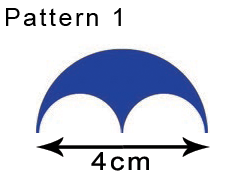
 What would the shaded area of pattern 3 be?[/vc_column_text][/vc_column][/vc_row][vc_row][vc_column][lvca_accordion][lvca_panel panel_title="Reveal Solution"]The first shaded area is the area of the large semicircle minus the area of the two small semicircles (i.e. a circle).
Area = $\frac{\pi \times 2^2}{2}- \pi \times 1^2 = (2 - 1) \pi = \pi$
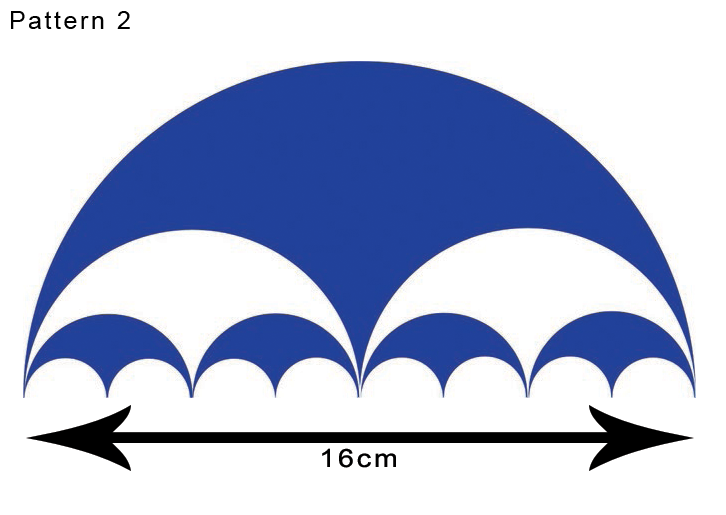
The second shaded area can be found by a similar calculation for the large section of the shaded area. The rest of the shaded area would then be 4 sets of the previous result.
Large shaded area = $\frac{\pi \times 8^2}{2} - \pi \times 4^2 = (32 - 16) \pi = 16\pi$
Total shaded area $16\pi + 4 \pi = 20 \pi$
Writing these as powers of 2 gives:
First result is $ (2^1 - 2^0 )\pi $
Second result is $ \big( ( 2^5 - 2^4 ) + 2^2 ( 2^1 - 2^0 ) \big)\pi = ( 2^5 - 2^4 +2^3 -2^2 ) \pi $
Extending these results the third pattern would have a shaded area of $ (2^9 - 2^8 + 2^7 - 2^6 + 2^5 - 2^4)\pi = 336\pi $[/lvca_panel][/lvca_accordion][vc_column_text]
What would the shaded area of pattern 3 be?[/vc_column_text][/vc_column][/vc_row][vc_row][vc_column][lvca_accordion][lvca_panel panel_title="Reveal Solution"]The first shaded area is the area of the large semicircle minus the area of the two small semicircles (i.e. a circle).
Area = $\frac{\pi \times 2^2}{2}- \pi \times 1^2 = (2 - 1) \pi = \pi$
The second shaded area can be found by a similar calculation for the large section of the shaded area. The rest of the shaded area would then be 4 sets of the previous result.
Large shaded area = $\frac{\pi \times 8^2}{2} - \pi \times 4^2 = (32 - 16) \pi = 16\pi$
Total shaded area $16\pi + 4 \pi = 20 \pi$
Writing these as powers of 2 gives:
First result is $ (2^1 - 2^0 )\pi $
Second result is $ \big( ( 2^5 - 2^4 ) + 2^2 ( 2^1 - 2^0 ) \big)\pi = ( 2^5 - 2^4 +2^3 -2^2 ) \pi $
Extending these results the third pattern would have a shaded area of $ (2^9 - 2^8 + 2^7 - 2^6 + 2^5 - 2^4)\pi = 336\pi $[/lvca_panel][/lvca_accordion][vc_column_text]