Sir Erik Christopher Zeeman, the Mathematician Who Did Everything
Introduction
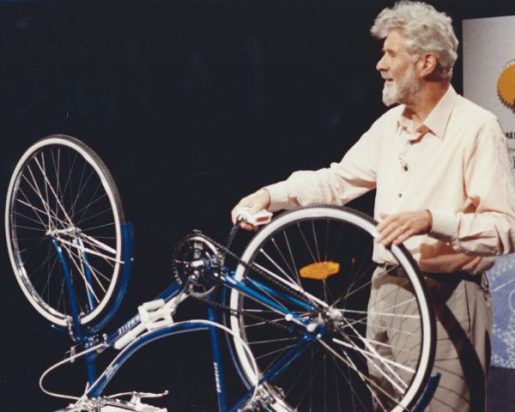
This year marks the centenary of the birth of Sir Erik Christopher Zeeman, one of the most influential British mathematicians of his era. Arguably, his greatest achievement was the founding of the University of Warwick's mathematics department, today one of the most successful in the UK after only 60 years' existence. But he also gave talks to schoolchildren, delivered the first ever BBC Christmas Lectures on mathematics, started the Royal Institution's (Ri) Mathematics Masterclasses (see photo), made fundamental advances in topology, promoted René Thom's theory of catastrophes, and applied those ideas to the physical, biological and social sciences. He had a commanding presence and great charisma, was generally genial and modest in demeanour, but was also an impressive operator when it came to administrative matters.
Christopher was born in Yokohama, Japan, on 4 February 1925. His father Christian Zeeman was Danish, and his mother Christine (née Bushell) was English. Christian was an entrepreneur in the Siberia–Japan salmon trade; Christine was a governess. She moved to England in 1926 to run a B&B in London, while her husband shuttled between Japan and England. Three years later, Christian disappeared while passing through Honolulu, a mystery that remains unresolved. So Christopher never knew his father.
His mother initiated him into the deeper mystery of mathematics by explaining how to use x to find an unknown quantity. ‘I was astounded,’ he said, ‘and remember it vividly to this day’ [1, p. 524].
Initially educated at Christ's Hospital boarding school, Horsham, he began studying for a degree at Christ's College, Cambridge as an RAF cadet. He interrupted his studies for three years to serve as a flying officer in the RAF, becoming a bomber navigator and then a navigation instructor. The Hiroshima and Nagasaki atomic bombings put an end to these activities and he returned to Cambridge, becoming senior wrangler (top marks) in 1948 and passing Part III of the Tripos in 1951.
His PhD was supervised by Shaun Wylie, who mostly left his students to find their own problems but provided help in solving them. The PhD was awarded in 1954, by which time Christopher had been elected a Fellow of Gonville and Caius College. In 1954, he visited the universities of Chicago and Princeton, returning to Cambridge as a university lecturer in 1955.
Spheres
Christopher's love of geometric thinking became apparent from the very start. It led him to work initially in topology, where he was equally adept at the other side of the coin: the intricate symbolism of algebraic topology. His main research was in higher-dimensional piecewise linear (PL) topology. Here the topological space is constructed by joining together simple pieces, like triangulating a map but using higher-dimensional analogues of triangles.
A basic area of topology is knot theory, which is about embedding a closed loop in three-dimensional space. At the time, very little was known about analogous issues in higher dimensions, where the loop is replaced by a multidimensional sphere. Christopher proved the remarkable and unexpected result that a two-dimensional sphere in a five-dimensional space can always be unknotted. He had spent seven years trying to find a knotted sphere, then found a 20-page proof that this is impossible. Having solved the problem, he suddenly realised how to simplify the proof into half a page [2].
Mathematicians are often classified into theory-builders and problem-solvers, but Christopher was both. He developed an entire coherent theory of PL topology, mostly in the form of duplicated notes, leading him to work on the Poincaré conjecture, at the time one of the greatest unsolved problems in mathematics. Originally posed as a question by Henri Poincaré in 1904, this problem concerns a characterisation of the three-dimensional analogue of the two-dimensional surface of a sphere.
Initial progress involved generalising the problem in higher dimensions. In 1961, Stephen Smale proved the Poincaré conjecture for smooth topologies in dimension five or higher. John Stallings proved it for PL topologies in seven or more dimensions. Christopher improved this to five or more dimensions [3], and Stallings independently did the same. In 1982, Michael Freedman found a proof for dimension four. But Poincaré's original question in three dimensions remained unresolved until the epic breakthrough by Grigori Perelman in 2002 based on the earlier ideas of Richard Hamilton.
Founding mathematics at Warwick
Although Christopher never lost his interest in research, this was inevitably constrained by the heavy administrative duties he undertook in creating a research centre and mathematics department at the new University of Warwick. At that time, there were very few international research centres in the world, the main two being the Institut des Hautes Études Scientifiques (IHES) in France and the Instituto Nacional de Matemática Pura e Aplicada (IMPA) in Brazil. Christopher initially hoped to found such a centre at Cambridge, but the idea aroused little interest there, so in 1963, he decamped to Warwick. Many years later, Cambridge finally woke up and the Isaac Newton Institute was born.
When first offered the founding professorship at Warwick, Christopher turned it down. He slept badly, telling his wife Rosemary that he felt he had made the wrong decision. He promptly wrote a second letter to Vice-Chancellor Jack Butterworth at Warwick, asking whether he could change his mind, and Butterworth tore the original letter up. Unknown to Christopher, Rosemary had phoned Butterworth as soon as Christopher left the house, asking him to wait 24 hours.
The first task was to appoint staff, initially six. He decided to make them all topologists, a decision that raised many eyebrows, but it proved a master stroke. The intention was to create a strong research group from day one. That meant specialising. Later appointments, first to algebra and then analysis, broadened the coverage.
Today, Warwick has over 2600 academic staff and around 30 000 students. Its mathematics department has over 1000 undergraduate and 100 graduate students, and it holds the largest portfolio of EPSRC research grants of any mathematics department at £28 million. Its research covers almost every area of modern mathematics, pure and applied, and the Mathematical Sciences Building – opened in 2018 – focuses on interdisciplinary areas with mathematics as its core. Christopher's early focus on specialisation has paid off handsomely.
How these initial appointments were made was the subject of a tale that was thought to be apocryphal until much later, when Christopher confirmed it, writing [1, p. 529]:
I wrote to David Epstein, Rolf Schwarzenberger, Colin Rourke, Brian Sanderson and Luke Hodgkin asking them all to join me at Warwick, but they all said no. So I wrote to them all again saying ‘But the other four say yes’ and then they all said yes. Of course there was a certain amount of burning up of telephone wires in between.
The Mathematics Institute acquired tangible form when the university stumped up £8000 to buy a large house on Gibbet Hill crossroads. In 1966, a grant of £88 000 from the Nuffield Foundation, obtained by Christopher and Sandy Green, paid for an extensive library, six houses for visiting mathematicians, and the salaries of a manager, a secretary and visiting professors. This was the Mathematics Research Centre, the first of its kind in the UK. It ran annual symposia with lots of visitors and a relaxed programme of seminars, the aim being to give visitors time to talk and work together.
I arrived at Warwick in 1967. By then mathematics had taken over the university's original library on Gibbet Hill campus. At first, the central area where the bookshelves had been was open, and the graduate students – who occupied offices round the periphery on two floors – played badminton there in the evenings. But soon the building was converted into a proper Mathematics Institute. Christopher involved himself in every detail, and he insisted on a large common room next to the department library. The badminton court became two lecture rooms for undergraduate lectures, seminars and colloquia, and in 1970, the full-time staff moved into the newly converted building. A massive expansion was now under way.
The attitude early on was always positive. Creativity and innovation were prioritised, encouraging a ‘can do’ culture. Lecturers were free to develop new courses and other initiatives with minimal interference from the administration. The contrast with today's regime in UK universities is striking.
Christopher tended to make clear ‘black-and-white’ distinctions. He once told me his view that mathematicians divided into two main types. One type concentrated on a specific area of mathematics and absorbed new viewpoints as that area developed. The other concentrated on a specific viewpoint and changed area when the associated methods led in new directions. Christopher was a clear example of the second type: he considered himself primarily a geometer, and his research exploited geometric thinking in whichever area of mathematics could currently benefit from it, be it algebraic topology or evolutionary game theory.
Geometry here does not refer to the traditional geometry of Euclid but to any way of thinking based on visual representations of complex ideas in spaces that go far beyond Euclid's rather literal representations of humanity's simplistic mental models of physical space. It embraces topics such as topology, where spaces are deformable and standard geometric concepts such as length and area have no meaning; it extends to conceptual spaces of four, five, six or more dimensions, and even up to and including infinity; it includes general concepts such as symmetry and continuity.
Catastrophes
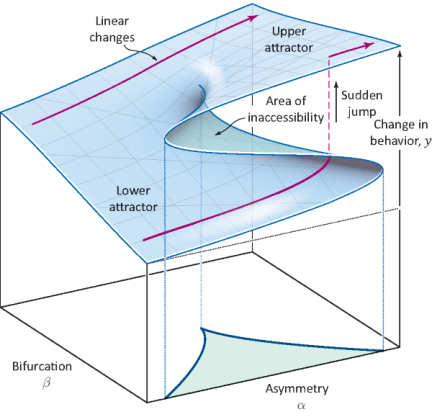
In the late 1960s and throughout the 1970s and beyond, the quest for geometric thinking led Christopher into a new way of thinking about dynamic processes in models of the natural world, with potential applications to a broad variety of sciences. This new viewpoint was the brainchild of the French topologist René Thom, who developed it as a way to think about morphogenesis – the study of developing form, especially in living creatures. Key events in morphogenesis occur when form or behaviour change discontinuously, that is, suddenly and dramatically rather than gradually.
In the late 1960s, the Warwick mathematics department was abuzz with rumours of Thom's remarkable and provocative ideas. David Fowler, manager of the Mathematics Research Centre, was translating Thom's book Stabilité Structurelle et Morphogénèse (Structural Stability and Morphogenesis) [4]. The book is very broad, somewhat philosophical in tone, extremely general in its mathematical stance, often vague and obscure, but its core ideas are deep and penetrating. The classical modelling method in applied mathematics is to write down specific equations aimed at capturing known physics or chemistry, which are then solved, exactly (which is rare), by making approximations or numerically. In contrast, Thom suggested analysing the topological nature of possible models, a qualitative approach pioneered by Poincaré and taken up much later by Vladimir Arnold and Stephen Smale.
The classical approach has had considerable success in the physical sciences, where equations that represent nature with great accuracy are often available. But biology is another matter, because accurate realistic equations are seldom available. When a model has a dozen or more parameters, known only to within a factor of 10 or 100, and when its behaviour is sensitive to changes in those parameters, it is difficult to draw sensible conclusions. Thom suggested a first step to overcome such difficulties: model the qualitative behaviour of the system using structurally stable models. These, by definition, retain the same qualitative behaviour if the underlying equations are slightly perturbed.
Thom used the French word catastrophe to refer to the aforementioned discontinuities in form. His book mentioned one special case of his much broader approach: singularities of families of real-valued maps, which he called the catastrophes élémentaires (elementary catastrophes). I suspect that it was their beautiful and enigmatic geometry that appealed to Christopher; certainly, he emphasised this in his lectures. Thom preferred to promote his ideas on a general philosophical level; Christopher's approach was more specific and more practical. He perceived significant potential for the application of the elementary catastrophes to scientific problems. The more general catastrophes envisaged by Thom could come later. His research at that period, collected in [5], includes developmental and evolutionary biology, economics, sociology and ship stability. He also produced a rigorous proof of Thom's classification of the elementary catastrophes, extracted from the deep work of John Mather.
The topic attracted attention from the mass media, initially positive, and Christopher gave numerous public lectures about what was quickly dubbed catastrophe theory. In the early 1970s, this kind of public attention was unusual for mathematics, and it led to a backlash in which several prominent mathematicians (mostly American) declared that the subject was neither novel nor useful. Statements that Christopher had made when trying to simplify the topic for non-mathematical audiences were analysed as if they were technical definitions in professional journals and, not surprisingly, found wanting. The media, characteristically preferring controversy to scientific content, whipped up the argument. Christopher chose to stay out of the controversy, probably not wishing to fan the flames, but this gave the impression that the critics had won.
The truth is more nuanced. Even at the time, there were numerous applications to the physical sciences and promise in other areas [6]. Today, catastrophe theory is alive and well, often under an assumed name – singularity theory or bifurcation theory. If you search on the phrase catastrophe theory, you will find a relatively sparse scattering of papers, although these cover a wide range of areas, among them ecology, evolution and cosmology. If you follow the underlying ideas and where they have led, it becomes clear that the outcome of Zeeman's pioneering work has been much more extensive and far more influential. See, for example, [7, 8] and the beautiful memoir by David Rand [1]. Several of Christopher's applications have turned out to be correct. For example, the clock and wavefront model of the formation of somites in development [9] has been confirmed by the identification of the biomolecules involved [10].
Public engagement
From the earliest days at Warwick, Christopher was active in, and an enthusiastic supporter of, public engagement (or outreach). He gave a talk on BBC radio about topology and appeared in a documentary about catastrophe theory.
In 1978, he was the first mathematician to present the Royal Institution Christmas Lectures on BBC television (to be pedantic, one of Geoffrey Ingram Taylor's Christmas Lectures was televised in 1936, but not the entire series, and although Taylor was a mathematician, his lectures were on ships). In those days, there were six 1-hour lectures; Christopher's included gyroscopes and boomerangs, perspective and, of course, catastrophe theory.
The success of Christopher's lectures opened the floodgates, creating a demand for more such lectures among young people, their parents and their teachers. Sir George Porter, Director of the Royal Institution, agreed to sponsor a follow-up series of Mathematics Masterclasses, initially organised by John Crank. The aim was to stimulate and encourage children in the art and practice of mathematics. The first masterclasses were held in London in 1981 and proved so popular that they quickly spread to other parts of the United Kingdom. They continue to this day.
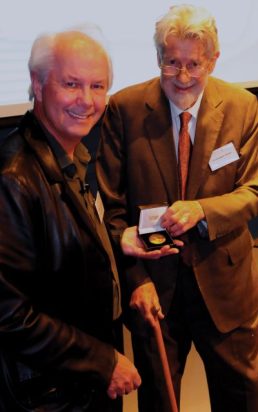
To celebrate Christopher's outreach work, especially his popular Christmas Lectures, the IMA and London Mathematical Society named a medal after him. The Medal (see photo) acknowledges the contributions of mathematicians engaging with the public and demonstrates that such activities are a part of a mathematician’s roles and responsibilities.
Christopher Zeeman was one of the most prominent, active and influential British mathematicians of the past 60 years. He left a legacy of major discoveries in topology, promoted the new methods of catastrophe theory and pioneered their applications. He involved himself in mathematics at every level, from primary school through outreach to advanced research. He was an impressive and forceful administrator, but simultaneously a kind and helpful person. In this centenary year, everyone who knew and worked with him will remember him with admiration and affection.
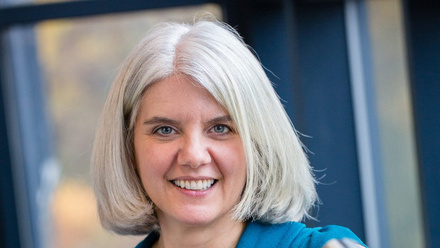
Ian Stewart FRS FIMA
University of Warwick
References
Rand, D.A. (2022) Sir Erik Christopher Zeeman. 4 February 1925–13 February 2016, Biogr. Mems. Fell. R. Soc., vol. 73, pp. 521–547.
Zeeman, E.C. (1960) Unknotting spheres in five dimensions, Bull. Amer. Math. Soc., vol. 66, p. 198.
Zeeman, E.C. (1962) The Poincaré conjecture for n ≥ 5, in Topology of 3-Manifolds and Related Topics, eds Fort Jr, M.K., Prentice-Hall, Englewood Cliffs, NJ, pp. 198–204.
Thom, R. (1975) Structural Stability and Morphogenesis, Benjamin, Reading, MA.
Poston, T. and Stewart, I. (1978) Catastrophe Theory and Its Applications, Pitman, London.
Golubitsky, M. and Schaeffer, D.G. (1985) Singularities and Groups in Bifurcation Theory: Volume I, Springer, New York.
Golubitsky, M., Stewart, I. and Schaeffer, D.G. (1988) Singularities and Groups in Bifurcation Theory: Volume II, Springer, New York.
Cooke, J. and Zeeman, E.C. (1976) A clock and wavefront model for control of the number of repeated structures during animal morphogenesis, J. Theor. Biol., vol. 58, no. 2, pp. 455–476.
Sonnen, K.F. et al. (2018) Modulation of phase shift between Wnt and Notch signaling oscillations controls mesoderm segmentation, Cell, vol. 172, no. 5, pp. 1079–1090.

 Christopher was born in Yokohama, Japan, on 4 February 1925. His father Christian Zeeman was Danish, and his mother Christine (née Bushell) was English. Christian was an entrepreneur in the Siberia–Japan salmon trade; Christine was a governess. She moved to England in 1926 to run a B&B in London, while her husband shuttled between Japan and England. Three years later, Christian disappeared while passing through Honolulu, a mystery that remains unresolved. So Christopher never knew his father.
His mother initiated him into the deeper mystery of mathematics by explaining how to use x to find an unknown quantity. ‘I was astounded,’ he said, ‘and remember it vividly to this day’ [1, p. 524].
Initially educated at Christ's Hospital boarding school, Horsham, he began studying for a degree at Christ's College, Cambridge as an RAF cadet. He interrupted his studies for three years to serve as a flying officer in the RAF, becoming a bomber navigator and then a navigation instructor. The Hiroshima and Nagasaki atomic bombings put an end to these activities and he returned to Cambridge, becoming senior wrangler (top marks) in 1948 and passing Part III of the Tripos in 1951.
His PhD was supervised by Shaun Wylie, who mostly left his students to find their own problems but provided help in solving them. The PhD was awarded in 1954, by which time Christopher had been elected a Fellow of Gonville and Caius College. In 1954, he visited the universities of Chicago and Princeton, returning to Cambridge as a university lecturer in 1955.
Christopher was born in Yokohama, Japan, on 4 February 1925. His father Christian Zeeman was Danish, and his mother Christine (née Bushell) was English. Christian was an entrepreneur in the Siberia–Japan salmon trade; Christine was a governess. She moved to England in 1926 to run a B&B in London, while her husband shuttled between Japan and England. Three years later, Christian disappeared while passing through Honolulu, a mystery that remains unresolved. So Christopher never knew his father.
His mother initiated him into the deeper mystery of mathematics by explaining how to use x to find an unknown quantity. ‘I was astounded,’ he said, ‘and remember it vividly to this day’ [1, p. 524].
Initially educated at Christ's Hospital boarding school, Horsham, he began studying for a degree at Christ's College, Cambridge as an RAF cadet. He interrupted his studies for three years to serve as a flying officer in the RAF, becoming a bomber navigator and then a navigation instructor. The Hiroshima and Nagasaki atomic bombings put an end to these activities and he returned to Cambridge, becoming senior wrangler (top marks) in 1948 and passing Part III of the Tripos in 1951.
His PhD was supervised by Shaun Wylie, who mostly left his students to find their own problems but provided help in solving them. The PhD was awarded in 1954, by which time Christopher had been elected a Fellow of Gonville and Caius College. In 1954, he visited the universities of Chicago and Princeton, returning to Cambridge as a university lecturer in 1955.
 The topic attracted attention from the mass media, initially positive, and Christopher gave numerous public lectures about what was quickly dubbed catastrophe theory. In the early 1970s, this kind of public attention was unusual for mathematics, and it led to a backlash in which several prominent mathematicians (mostly American) declared that the subject was neither novel nor useful. Statements that Christopher had made when trying to simplify the topic for non-mathematical audiences were analysed as if they were technical definitions in professional journals and, not surprisingly, found wanting. The media, characteristically preferring controversy to scientific content, whipped up the argument. Christopher chose to stay out of the controversy, probably not wishing to fan the flames, but this gave the impression that the critics had won.
The truth is more nuanced. Even at the time, there were numerous applications to the physical sciences and promise in other areas [6]. Today, catastrophe theory is alive and well, often under an assumed name – singularity theory or bifurcation theory. If you search on the phrase catastrophe theory, you will find a relatively sparse scattering of papers, although these cover a wide range of areas, among them ecology, evolution and cosmology. If you follow the underlying ideas and where they have led, it becomes clear that the outcome of Zeeman's pioneering work has been much more extensive and far more influential. See, for example, [7, 8] and the beautiful memoir by David Rand [1]. Several of Christopher's applications have turned out to be correct. For example, the clock and wavefront model of the formation of somites in development [9] has been confirmed by the identification of the biomolecules involved [10].
The topic attracted attention from the mass media, initially positive, and Christopher gave numerous public lectures about what was quickly dubbed catastrophe theory. In the early 1970s, this kind of public attention was unusual for mathematics, and it led to a backlash in which several prominent mathematicians (mostly American) declared that the subject was neither novel nor useful. Statements that Christopher had made when trying to simplify the topic for non-mathematical audiences were analysed as if they were technical definitions in professional journals and, not surprisingly, found wanting. The media, characteristically preferring controversy to scientific content, whipped up the argument. Christopher chose to stay out of the controversy, probably not wishing to fan the flames, but this gave the impression that the critics had won.
The truth is more nuanced. Even at the time, there were numerous applications to the physical sciences and promise in other areas [6]. Today, catastrophe theory is alive and well, often under an assumed name – singularity theory or bifurcation theory. If you search on the phrase catastrophe theory, you will find a relatively sparse scattering of papers, although these cover a wide range of areas, among them ecology, evolution and cosmology. If you follow the underlying ideas and where they have led, it becomes clear that the outcome of Zeeman's pioneering work has been much more extensive and far more influential. See, for example, [7, 8] and the beautiful memoir by David Rand [1]. Several of Christopher's applications have turned out to be correct. For example, the clock and wavefront model of the formation of somites in development [9] has been confirmed by the identification of the biomolecules involved [10].
 Christopher Zeeman was one of the most prominent, active and influential British mathematicians of the past 60 years. He left a legacy of major discoveries in topology, promoted the new methods of catastrophe theory and pioneered their applications. He involved himself in mathematics at every level, from primary school through outreach to advanced research. He was an impressive and forceful administrator, but simultaneously a kind and helpful person. In this centenary year, everyone who knew and worked with him will remember him with admiration and affection.