[vc_row][vc_column][vc_column_text]
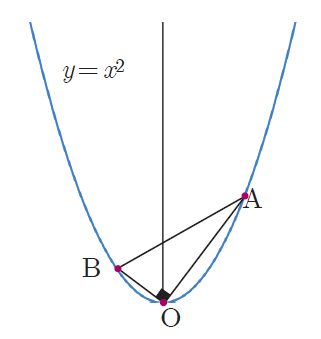
The points $A$ and $B$ are on the curve $y=x^2$ such that $AOB$ is a right angle. What points $A$ and $B$ will give the smallest possible area for the triangle $AOB$? [latexpage][/vc_column_text][/vc_column][/vc_row][vc_row][vc_column][lvca_accordion][lvca_panel panel_title="Reveal Solution"]
Writing the coordinates of the points $A$ and $B$ as $(a, a^2)$ and $(b, b^2)$ gives the line $OA$ gradient $a$.
The line $OB$ has gradient: $-\frac{1}{a}$.
Solving $b^2=-\frac{1}{a}b$ gives $b=-\frac{1}{a}$ and hence $(-\frac{1}{a}, \frac{1}{a^2})$ for the coordinates of $B$.
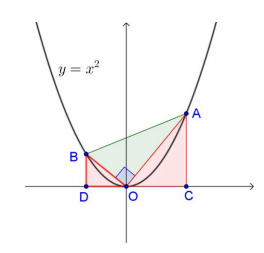
By dropping perpendiculars to the x-axis, and labelling these points $C$ and $D$, the area of the triangle $AOB$ can be found by subtracting the area of two triangles from a trapezium:
\begin{align*}
\emph{AOB}&=\emph{CABD}-\emph{OAC}-\emph{OBD}\
&=\frac{(a^2+1/a^2)(a+1/a)}{2}-\frac{a^3}{2}-\frac{1/a^3}{2}\
&=\frac{a^3+a+1/a+1/a^3-a^3-1/a^3}{2}\
&=\frac{a+1/a}{2}.
\end{align*}
Solving with calculus:
$A=\frac{a+1/a}{2}, \quad \frac{\textrm{d}A}{\textrm{d}a}=\frac{1=1/a^2}{2}.$
$\frac{\textrm{d}A}{\textrm{d}a}=0$ when $a=1$ (or $a=-1$). This gives $A$ and $B$ at (1,1) and (-1,1).
Solving without calculus:
$\frac{a+1/a}{2}=\frac{(\sqrt{a}-1/\sqrt{a})^2+2}{2}$ which has a minimum value when $\sqrt{a}-1/\sqrt{a}=0,$ i.e. when $a=1$ (or $a=-1$).
This gives $A$ and $B$ at (1,1) and (-1,1).[/lvca_panel][/lvca_accordion][/vc_column][/vc_row][vc_row][vc_column][vc_column_text]
Problem Page Coordinator: Stephen Lee CMath MIMA – Mathematics in Education and Industry
Acknowledgement: The IMA are indebted to MEI for sourcing and supplying Mathematics Today with these well-known puzzles.
First published in Mathematics Today December 2016

 The points $A$ and $B$ are on the curve $y=x^2$ such that $AOB$ is a right angle. What points $A$ and $B$ will give the smallest possible area for the triangle $AOB$? [latexpage][/vc_column_text][/vc_column][/vc_row][vc_row][vc_column][lvca_accordion][lvca_panel panel_title="Reveal Solution"]
 Writing the coordinates of the points $A$ and $B$ as $(a, a^2)$ and $(b, b^2)$ gives the line $OA$ gradient $a$.
The line $OB$ has gradient: $-\frac{1}{a}$.
Solving $b^2=-\frac{1}{a}b$ gives $b=-\frac{1}{a}$ and hence $(-\frac{1}{a}, \frac{1}{a^2})$ for the coordinates of $B$.
By dropping perpendiculars to the x-axis, and labelling these points $C$ and $D$, the area of the triangle $AOB$ can be found by subtracting the area of two triangles from a trapezium:
\begin{align*}
\emph{AOB}&=\emph{CABD}-\emph{OAC}-\emph{OBD}\
&=\frac{(a^2+1/a^2)(a+1/a)}{2}-\frac{a^3}{2}-\frac{1/a^3}{2}\
&=\frac{a^3+a+1/a+1/a^3-a^3-1/a^3}{2}\
&=\frac{a+1/a}{2}.
\end{align*}
Solving with calculus:
$A=\frac{a+1/a}{2}, \quad \frac{\textrm{d}A}{\textrm{d}a}=\frac{1=1/a^2}{2}.$
$\frac{\textrm{d}A}{\textrm{d}a}=0$ when $a=1$ (or $a=-1$). This gives $A$ and $B$ at (1,1) and (-1,1).
Solving without calculus:
$\frac{a+1/a}{2}=\frac{(\sqrt{a}-1/\sqrt{a})^2+2}{2}$ which has a minimum value when $\sqrt{a}-1/\sqrt{a}=0,$ i.e. when $a=1$ (or $a=-1$).
This gives $A$ and $B$ at (1,1) and (-1,1).[/lvca_panel][/lvca_accordion][/vc_column][/vc_row][vc_row][vc_column][vc_column_text]
Writing the coordinates of the points $A$ and $B$ as $(a, a^2)$ and $(b, b^2)$ gives the line $OA$ gradient $a$.
The line $OB$ has gradient: $-\frac{1}{a}$.
Solving $b^2=-\frac{1}{a}b$ gives $b=-\frac{1}{a}$ and hence $(-\frac{1}{a}, \frac{1}{a^2})$ for the coordinates of $B$.
By dropping perpendiculars to the x-axis, and labelling these points $C$ and $D$, the area of the triangle $AOB$ can be found by subtracting the area of two triangles from a trapezium:
\begin{align*}
\emph{AOB}&=\emph{CABD}-\emph{OAC}-\emph{OBD}\
&=\frac{(a^2+1/a^2)(a+1/a)}{2}-\frac{a^3}{2}-\frac{1/a^3}{2}\
&=\frac{a^3+a+1/a+1/a^3-a^3-1/a^3}{2}\
&=\frac{a+1/a}{2}.
\end{align*}
Solving with calculus:
$A=\frac{a+1/a}{2}, \quad \frac{\textrm{d}A}{\textrm{d}a}=\frac{1=1/a^2}{2}.$
$\frac{\textrm{d}A}{\textrm{d}a}=0$ when $a=1$ (or $a=-1$). This gives $A$ and $B$ at (1,1) and (-1,1).
Solving without calculus:
$\frac{a+1/a}{2}=\frac{(\sqrt{a}-1/\sqrt{a})^2+2}{2}$ which has a minimum value when $\sqrt{a}-1/\sqrt{a}=0,$ i.e. when $a=1$ (or $a=-1$).
This gives $A$ and $B$ at (1,1) and (-1,1).[/lvca_panel][/lvca_accordion][/vc_column][/vc_row][vc_row][vc_column][vc_column_text]