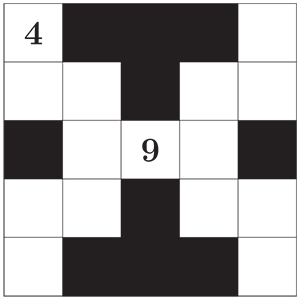
[vc_row][vc_column][vc_column_text]I want to complete the cross figure shown here. I would like all eleven answers to be prime numbers and none to have a leading zero. Also I don’t want any digit to appear more than once in any row or column or on either of the two long diagonals.
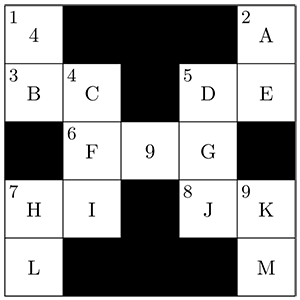
Given the starting values shown, how many different ways could I complete the grid?[/vc_column_text][/vc_column][/vc_row][vc_row][vc_column][lvca_accordion][lvca_panel panel_title="Reveal Solution"][latexpage]We use $1d$ for "1 down", etc., and introduce notation as shown here:
Evidently $\{{\sf C},{\sf J},{\sf M}\}=\{1,3,7\}$ and we rule out 5 of the possible six permutations as follows:
If $({\sf C},{\sf J},{\sf M})=(1,3,7)$ or $({\sf C},{\sf J},{\sf M})=(1,7,3)$ or $({\sf C},{\sf J},{\sf M})=(7,3,1)$ then it quickly follows that $6a=691$ and ${\sf D}=6$. This implies that ${\sf E}\in\{1,7\}$ and this clashes with either $3a$ or $9d$ and these cases fail.
If $({\sf C},{\sf J},{\sf M})=(3,7,1)$ then ${\sf I=1}$ and there is no way to choose ${\sf F}$.
If $({\sf C},{\sf J},{\sf M})=(7,1,3)$ then ${\sf F}=4$ and ${\sf G}\in\{1,9\}$ which are numbers that neighbour ${\sf G}$.
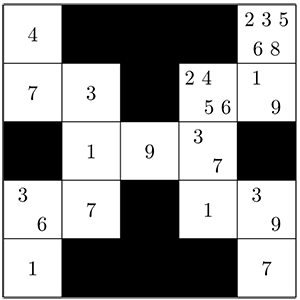
We are left with $({\sf C},{\sf J},{\sf M})=(3,1,7)$ and the grid has been narrowed down to the summary on the right here:
To finish the job we look at cases according to $5d$. There are 4 possibilities:
If $5d=271$ then every square is uniquely defined except ${\sf A}\in\{5,8\}$.
So there are two possible grids here.
If $5d=431$ then ${\sf E}=1$ and we can now consider two subcases according to $9d$
If $9d=37$ then $2d=61$ and $7d=67$. The grid is unique in this case.
If $9d=97$ then $2d\in\{31,61\}$ and $7d\in\{31,61\}$. Four different grids here.
If $5d=571$ then the grid is unique except ${\sf A}\in\{2,8\}$.
If $5d=631$ then the grid is uniquely defined except for ${\sf H}\in\{3,6\}$.
There are eleven ways to complete the grid.
[/lvca_panel][/lvca_accordion][vc_column_text]
Problem Page Coordinator: Stephen Lee CMath MIMA – Mathematics in Education and Industry
Acknowledgement: The IMA are indebted to Peter Chamberlin FIMA (University of Reading) for creating and supplying Mathematics Today with this puzzle.
First published in Mathematics Today (December 2015)

 Given the starting values shown, how many different ways could I complete the grid?[/vc_column_text][/vc_column][/vc_row][vc_row][vc_column][lvca_accordion][lvca_panel panel_title="Reveal Solution"][latexpage]We use $1d$ for "1 down", etc., and introduce notation as shown here:
 Evidently $\{{\sf C},{\sf J},{\sf M}\}=\{1,3,7\}$ and we rule out 5 of the possible six permutations as follows:
 To finish the job we look at cases according to $5d$. There are 4 possibilities: