Reflecting on four years of writing these West Country musings and inspired by a favourite round of a long-running TV quiz show, Alan Champneys tries to answer the question: ‘What happened next?’ That is, what is the next chapter in some of the stories that have been featured so far?
I am a huge fan of both sport and quiz shows on television. Combining the two, since childhood one of my favourite programmes has been the BBC’s A Question of Sport. Most eagerly awaited each week was the round where some perfectly innocuous sporting action would unfold, only for the footage to freeze and the contestants asked: ‘What happened next?’ Bizarre goalkeeping errors in football provided a rich vein of material, as did comedy run-outs in cricket. But, in a sense, to the connoisseur, the innocuous back pass or the forward prod into the unguarded cover region become natural portents of disaster. The best ones involve the truly unexpected: the catastrophic failure of an everyday piece of equipment, the violent consequences of an unlucky ball bounce or, my personal favourite, the irresponsible behaviour of a member of the animal kingdom.
I have been writing these Westward Ho!’s for almost four years, and I believe this will be the 20th. So I thought it might be a good time to pause and reflect. Each piece is a stream of consciousness about whatever happens to interest me at the time. I write in a bit of a rush, and errors inevitably enter – I thank those readers who have written in with corrections. To me there is a live element; as I start writing, I never know quite where it is going to end up. It is as if the publication deadline acts as a freeze frame on the narrative. For most of the stories, there has been a natural ending point. For others though, it is as if the action has continued and what happened next has taken an unexpected turn.
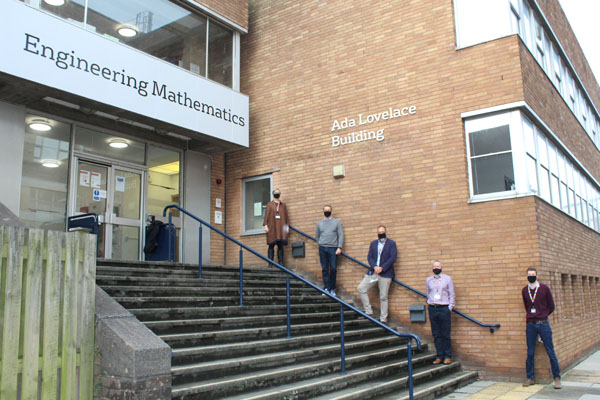
The piece ‘Pride and Prejudice’ [1] from August 2020 seemed to resonate with the rightful focus in our community on under-represented communities. As I was writing, my department at the University of Bristol was in the process of moving to a different building, the newly refurbished former Maths building on University Walk. The university now has a policy that buildings should no longer be named after the function they contain. The Engineering Maths Department was given the chance to propose names for its new home. A committee was formed to draw up a short list, which was then put to a vote of all staff and students.
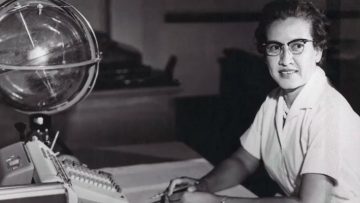
In a tight contest, the name chosen was the Ada Lovelace Building. The other two names on the short list were Bristol-based 19th century engineer and inventor Sarah Guppy and Katherine Johnson, the NASA mathematician featured in the book and film Hidden Figures. But why did we choose an all-female short list?
If I am being honest, while going along with the need for greater diversity in our profession, it is only recently that I have had my own perceptions challenged. I know few people in our community who are overtly racist, sexist or elitist. But, it is the little things that matter.
As an early career academic, I recall my imposter syndrome being exacerbated by the corridor in our faculty building, which prominently displayed monochrome smiling photographs of former professors. Given that all were white males, presumably men of privilege, how much more would such imagery have made women feel that they do not belong? Or, for that matter, those from the BAME, LGBTQ+ or working class communities?
It would seem there is no single ‘silver bullet’ for achieving true gender balance, the widespread acceptance of ethnic, sexual and neural diversity, or the correction of elitist mentalities. It is not a question of quick actions. Lasting change will doubtless require a sustained cultural shift, and for us all to think about our unconscious biases and the subliminal messages we transmit.
Why is this important? There are those, including some of our elected politicians, who have started a backlash against modern ‘woke’ values. I make no comment on politics, but from an IMA perspective, even if one took a hard-nosed attitude, clearly in the current data-rich, ‘post-truth’ world, society needs more mathematical scientists, at all levels. In my view, to face the challenges ahead, we simply cannot afford to ignore the potential talent of 50% or more of the next generation.
Despite broadening the discussion to wider forms of prejudice, I do not want to forget the remarkable life of Ada Lovelace and other pioneering women.
Just as I was writing this, I got a nice email from Ursula Martin, from the University of Oxford, who, you may recall from [1], has published, along with colleagues, historical research that unpicks Ada’s mathematical contributions. Perhaps, other historians of mathematics will be drawn to Ada’s work, which Ursula helpfully informs me is now available as an archive held by the Clay Institute [2].
The history of mathematics and mechanics has played a role in many of these Westward Ho!’s. In the piece on the bridges of Bristol [3] from December 2019, I introduced a modern-day variant of the famous bridges of Königsberg problem, the solution to which, as ‘everybody knows’, led Leonhard Euler to introduce discrete topology, otherwise known as graph theory. Except, it seems, this is not quite true.
In March, just before the lockdown, I was honoured to be invited to give one of the Oxford University Mathematics Department’s monthly outreach lectures. Robin Wilson, the Open University affiliated historian of mathematics, had left an envelope for me with a reprint by him and Brian Hopkins [4] that relates to the bridges of Königsberg. I am sorry to say that despite glancing at the contents, I was pre-occupied with my hastily prepared lecture on the topic of misunderstandings about the instability of London’s Millennium Bridge (a topic that will doubtless form the subject of a future Westward Ho!). The paper remained unread, in my (makeshift) home office in my (redundant) work bag, until the late summer. Only then did I notice Robin’s note to accompany the paper, which had some nice words of explanation.
In work that won them the 2005 George Pólya Award from the Mathematical Association of America, Hopkins and Wilson carefully analysed Euler’s solution to the bridge problem. In his 1736 paper, Euler states three results [4, pp. 205–206]:
- If there are more than two areas to which an odd number of bridges lead, then such a journey [that crosses each bridge precisely once] is impossible.
- If however, the number of bridges is odd for exactly two areas, then the journey is possible if it starts in either of those two areas.
- If, finally, there are is no area to which an odd number of bridges lead, then the required journey can be accomplished starting from any area.
In [4], it is argued that Euler provided a rigorous proof only to the first of these. Crucially, Hopkins and Wilson show that Euler uses a counting argument, a so-called handshake lemma, and there is no reference to links, vertices nor anything we would now recognise as relating to graph theory. In fact, they found that it was not until the 19th century that the bridges problem was posed in terms of graph theory. It was not until 1871 that the first full proofs of all three statements were published, and only in 1892 did the first Königsberg graph appear.
It seems that interesting comments on Westward Ho!’s from Oxford-based mathematicians have become a bit of a theme. Following my musings in October 2018 [5] on the causes of lift on an aircraft wing, I received an email from my good friend John Ockendon. The message contained a scan of some pages from the textbook that he co-authored with Hilary Ockendon on viscous flow [6]. The next time we met, in his inimitable style, he sarcastically berated me for deliberately leading Mathematics Today readers astray. Why was I not telling members of our august society that there is a simple solution to the question of what causes flight? I promised that when I wrote some kind of follow-up, I would pay due deference to what is in the book. So, here goes.
The argument in [6, pp. 39–40] is along the lines of the Kutta–Joukowski theorem that I quote in [5]. Taking a planar section, and ignoring the viscous boundary layer, one can use complex potential theory to solve for the inviscid flow around any shape of wing. Vector calculus applied to a contour in the far field then enables us to calculate the induced circulation  and hence, via the Joukowski formula, the lift force per unit length:
![\[L = -\rho U \Gamma,\]](https://ima.org.uk/wp/wp-content/ql-cache/quicklatex.com-768e5534bd2ba09f4f70b222e3e63817_l3.svg "Rendered by QuickLaTeX.com")
where  is the airspeed and
  the air density.
In [6], the Ockendons then point to a problem with using this formula alone: the value of the circulation is arbitrary and depends on the nature of the equivalent vortex induced by the wing. This equivalent vortex depends, in the potential-flow solution, on the location and angle of the flow separation point at the back of the wing. Here, they argue, one has to use viscous theory. This theory gives the so-called Kutta boundary condition: the flow must separate at the sharp trailing edge of the aerofoil. In turn, this fixes the potential flow solution, which provides a unique value of and hence the lift  for the cross section in question.
Ockendon and Ockendon [6, p. 40] close this section of their book by saying that
although the lift is zero when [viscosity]
(by D’Alembert) it is
as
. … this lift is due to viscosity but not dependent on the size of viscosity. It is a remarkable illustration of the nonuniform convergence of the solution of the Navier–Stokes equations as
that a boundary layer of thickness
cm is crucial for an airliner to cross the Atlantic!
I like this explanation; it represents a neat mathematical argument. It enables a simplified method for calculating the lift for an aerofoil that has a thin trailing edge. But it does not explain everything, for example, how aerofoils without sharp edges can also generate lift, as evidenced by stunt planes that can fly upside down. I stand by the point I was trying to make in [5] that there is no simple explanation of what causes lift, rather than that there is no mathematical theory to calculate it. Sorry, John.
To me, fluid–structure interactions are subtle and it can be hard to separate cause and effect. Also, all theories are approximate and involve underlying assumptions and approximations. In fairness, perhaps John has a point; as applied mathematicians, we should leave questions of causality to metaphysics and limit ourselves to calculations that lead to quantitative predictions. In that regard, the theory in the Ockendons’ book is just what we need.
The title of the December 2017 article [7] was loosely inspired by a line from the Christmas play performed by the Weston Mummers on Boxing Day at the Packhorse Inn, Southstoke. I wrote that the pub was due to open again in 2018 after a massive community effort to repurchase it from developers. So, for the first time in many years, Boxing Day 2018 was once again going to see the Weston Mummers perform.
Unfortunately, in the intervening years since the pub closed, there had been some retirements from the Weston Mummers. Several new cast members were required. In particular, the actor playing the compère of the play, the Old Fool, had moved away from the area. And so, with some reluctance, I agreed to step in myself. I am not sure I did any justice to the piece, but fortunately there was plenty of Christmas cheer.
For rather dull reasons I will not go into, there was no repeat performance in 2019, and we all know what happened in 2020. At the time of writing, it is not clear whether the Weston Mummers are in permanent abeyance. I do still have the Old Fool costume, though.
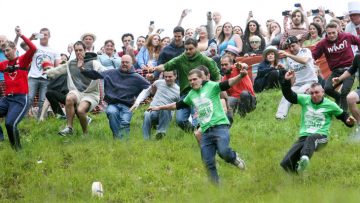
The most unexpected turn of events arising from a Westward Ho! article came from the very first one, on cheese rolling [8]. This, you may recall, was a brief discussion on rigid body mechanics inspired by the Gloucestershire Whitsun bank holiday tradition of chasing a cheese down a very steep slope.
In April 2019, I received an email:
Good Evening Alan,
I’m a producer for a documentary series which explores unique
competitions around the world, the cultures surrounding them, and the competitors who dedicate their lives to winning it.We’ll be covering the Cooper’s Hill Cheese Rolling and Wake this year for one of the episodes – and while we plan to follow a few runners on their journey to the competition, our main reason for contacting you concerns the hill itself and the science involved in the objects and people falling down it!
I came across the article you wrote for Mathematics Today back in 2017, this is exactly the type of expert analysis we are looking for.
Please let me know if this is something you think you could help us with?
Well, what could I say? The TV company in question is a small to medium-sized outfit based in Los Angeles and run by two expat Brits, Martin Desmond Roe and Nick Frew. The company is called Dirty Robber, the etymology of which I do not know, but Nick has Captain Jack style facial hair, and Martin habitually wears a Buccaneer-style jacket and boots. They seem to specialise in high-definition films, often involving sport, such as extended Nike commercials. This would be their first fully independently produced TV series.
So, that was how my wife and I got to watch the 2019 cheese rolling from a ringside seat. We arrived early, but it was already clear something special was afoot. A police roadblock was in place, and the main A46 running alongside the hill was closed to traffic. With roadside parking suspended, various pubs and businesses along the Shurdington Road were making a fortune charging for ‘secure’ parking spots. A continuous stream of people armed with selfie-sticks, boots, picnics and good cheer were ascending the various footpaths leading to the base of the hill.
For us fifty-somethings, this was quite a trek. For the ‘hill’ of Cooper’s Hill is actually a cleared strip in the upper half of one of the many wooded escarpments in the Cotswolds. The course itself is seriously steep. The kind of steep that you would probably only want to walk down backwards, preferably on all fours.
It is also rough. The vegetation is more scrub than grass. The course is quite short, probably less than 100 m in distance. The incline is particularly irregular; it is precipice-like at the top, and while the overall slope gradually flattens out, there are surprise bumps and borrows. Fortunately, this was a dry year.
I cannot recall ever seeing so many people crammed into such a small region of the countryside; they were at the bottom of the slope and under the trees on both sides. What looked like a melee of folk were in the distance above us at the top of the hill. Seemingly at great expense, Dirty Robber had hired the lone house that sits at the bottom of the slope, with the owners making themselves scarce for the entire weekend. There were camera operators on the roof, in the trees, and at the top and the bottom of the hill. More cameras were attached to zip wires temporarily erected to follow the race leaders as they made their descent.
Words cannot do justice to what happened next as the various races unfolded.
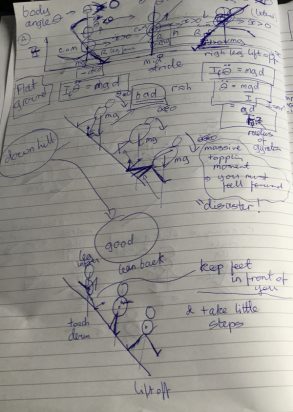
Cut to the next day; some of the crew drove the 30 miles or so to Bristol so that they could film an expert explaining the mechanics behind the challenge. So there I was, bedecked in a boffin-style mock tweed jacket and tie, in a venerable wood-panelled lecture theatre, with an audience composed of students we had hauled out of the cafe downstairs. I used good old-fashioned ‘chalk and talk’ to try to explain the mechanics involved.
I had covered the blackboard with  ,
,  ,
,  ,
,  ,
,  ,
,  , etc. Accompanying the symbols were little stick figures with arrows, slopes, etc. and various statements like ‘conservation of energy’, ‘angular momentum’ and ‘Coulomb friction’. I tried to explain the mathematics underlying some general tactical principles: lean back; take small, rapid steps; if you must fall, fall backwards; avoid tumbling; and bend the knees for more control.
Then they had me watch footage of the race and attempt to provide amusing commentary on how the various competitors approach the problem. To be fair, presumably, most of the runners possessed neither a working knowledge of Lagrangian mechanics nor the speed of thought to perform the necessary computations in real time.
I have been eagerly awaiting the documentary to appear. After signing some kind of non-disclosure agreement, I can now reveal that it became available for streaming on Netflix in November 2020. The series is called We are the Champions and the Cooper’s Hill Cheese Rolling comprises the opening episode. Other shows concern a South Carolina chilli-eating contest, the world yo-yo championships, a Californian frog jumping competition inspired by a Mark Twain short story, a New Orleans fantasy hair contest and the European open dog dancing championships.
The finished result is just lovely; witty yet treating the competitors with affection, and beautifully shot. Narrated by American TV A-lister Rainn Wilson, the central narrative of the cheese rolling episode follows the fortunes of Flo Early (see photo above), who was going for a record-beating fourth win in the women’s race that year. I do not want to give you a spoiler of what happens next, but, if you do have a Netflix subscription, look at the mechanics of how the various competitors attempt to run as fast as they can while remaining upright.
I started this Westward Ho! series four years ago with some humility, inspired by Paul Glendinning’s long-running ‘View from the Pennines’. Despite repeated deadline stress, looking back, I have enjoyed the experience immensely. I am especially proud of some of the unexpected juxtapositions that have emerged in the stories I have uncovered. But we all know what pride comes before ….
An affectionate half-hour tribute to the traditions and personalities of the Cooper’s Hill Cheese Rolling naturally left no room for mathematics and mechanics. My involvement was cut completely from the final edit. Oh, and the only cheese rolled on Whitsun bank holiday Monday in 2020 was a socially distanced Babybel.
Alan Champneys CMath FIMA
University of Bristol
References
- Champneys, A.R. (2020) Westward Ho! Pride and prejudice, Math. Today, vol. 56, no. 4, pp. 136–139.
- Lovelace, A. (2020) Mathematical papers, Clay Institute.
- Champneys, A.R. (2019) Westward Ho! 45 bridges of Bristol, Math. Today, vol. 55, no. 6, pp. 242–245.
- Hopkins, B.P. and Wilson, R.J. (2004) The truth about Königsberg, Coll. Math. J., vol. 35, pp. 198–207.
- Champneys, A.R. (2018) Westward Ho! How the Deverill do they do that?, Math. Today, vol. 54, no. 5, pp. 202–205.
- Ockendon, H. and Ockendon, J.R. (1995) Viscous Flow, Cambridge University Press.
- Champneys, A.R. (2017) Westward Ho! Mummers and papas – the cure for all ills, Math. Today, vol. 53, no. 6, pp. 268–271.
- Champneys, A.R. (2017) Westward Ho! Cheese rolling, Math. Today, vol. 53, no. 2, pp. 62–65.
Reproduced from Mathematics Today, February 2021
Download the article, Westward Ho! What Happened Next? (pdf)