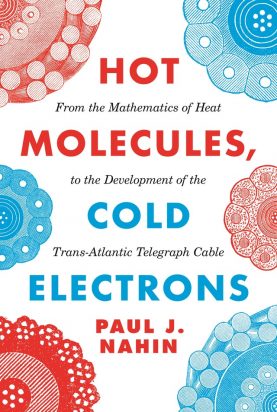
 Paul J. Nahin
PRINCETON UNIVERSITY PRESS 2020, 232 PAGES
PRICE (HARDBACK) £20.00 ISBN 978-0-691-19172-0
This is a further book in the extensive popular science and mathematics catalogue of Professor Paul J. Nahin, Professor Emeritus of Electrical Engineering at the University of New Hampshire. Here, in Hot Molecules, Cold Electrons, Nahin explores the basis and extended application of the Heat Equation stipulated by Jean-Baptiste Joseph Fourier. This second order, partial differential equation (PDE), defines the flow of heat energy in a material. By extension this equation has uses and implications in a variety of fields, including electronic communications.
The author draws on his expertise in maths and science, to give interesting examples with well sourced built up explanations. In addition, he is very careful to provide excellently referenced notes with additional explanations of the mathematics involved. There is also a very comprehensive index as well as some example coding in MATLAB.
In the course of the book, Nahin moves from a first principles description of the problems that Fourier examined through to practical applications in early transatlantic telephone cables. A re-cap for the rusty: Fourier showed how energy, in particular heat can diffuse through matter in a process of conduction. It would be hard to describe the heat equation in a few lines, nor would I try. The maths in the book does this far more effectively, as does helpfully Euler’s formula, eix = cos (x) + i sin (x), in providing identities to link in with harmonic series in providing solutions for the heat equation.
By the middle of the book we have learnt about the basis, derivation and solutions to the heat equation. Those who remembered the horror of ‘assumed solutions to PDEs’, from university days will be relieved to see that Paul Nahin steps carefully here and explains fully how to use such solutions and derives the associated constants for exponential solutions in a methodical manner. By the end of Chapter 4 the heat equation is successfully solved. Chapters 5 and 6 look at its practical application in telegraphy. Here Nahin works through careful explanation, linking the heat equation and its development to produce finally, the wave equation. Several surprising physical facts limiting early forms of telegraphic communication are also discussed.
Reading as a physicist, dare I say it a lay mathematician, I was lost in places with the amount of mathematic formulae though I could still understand the underlying principles being explained. This was certainly a really nice way to look at the work of Fourier and this could have been very useful in my own physics learning. The mathematics that Paul Nahin describes as ‘Freshman calculus’, seem a little daunting in my eyes, though an undergraduate Degree in Physics allows me to recognise the partial derivatives used and do the basics of the manipulations detailed, even if the language is not one I am fully fluent in.
The book is well paced overall. Despite mathematical complexity in my own eyes, it is still an accessible read. With an open mind and acceptance of the well worked examples and as a technical reference to this subject, it is well laid out and well-constructed in derivations. The knowledge while not always absorbed by this reader should flow, like Fourier’s heat as described, into the minds of most undergraduate level readers. I suspect that this will be a long-term classic and a book to be returned to when some explanation of a Fourier topic is needed or to be reflected upon. A book to be at hand on the bookshelf, to form a useful reference to help in any future work on partial derivatives, Fourier, harmonic series, PDE analysis and the like. This is a nicely presented book with an attractive dust cover to the hardback. All in, very good value for the content and depth of information covered.
Kenny Green AMIMA
Book review published directly onto IMA website