Nets Hawk Katz
YALE UNIVERSITY PRESS 2021, 264 PAGES
PRICE (PAPERBACK) £20.00 ISBN 978-0-300-24279-9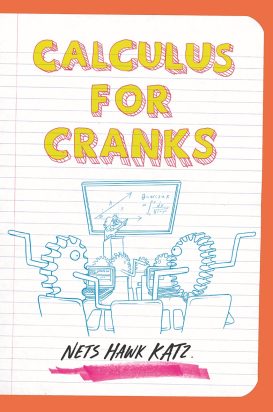
Nets Hawk Katz wrote Calculus for Cranks using his course notes from the Math1a course at the California Institute of Technology (Caltech). He’s very clear who is the intended audience for this book: the ‘cranks’ of Caltech, but it will have a wider audience than that.
I need to start in a similar manner to Katz by defining a ‘crank’. As he notes, the term can have negative connotations, referring to people who think they know what they’re doing in mathematics but don’t. Katz prefers his alternative definition, being those students who’ve joined his course and are rediscovering mathematics for the subject that it really is. He prefers to define ‘cranks’ as those who would do mathematics correctly when the world told them they shouldn’t.
With that, Katz immediately took me back almost two decades to the start of my undergraduate studies. I remember starting the first courses of my degree, being told that all of the maths we had learned at A-Level was wrong and that my professors would help my classmates and I understand all those things on a far deeper level, but it all had to start back at the very beginning. That memory, along with the way Katz’ book touches on many things a first-year undergraduate maths student would, tells me that Katz’ audience is in fact new mathematics students everywhere and not just those on his Math1a course in Pasadena.
How far back does Katz go in getting his students to re-learn the mathematics they’ve been taught before joining his course? Put it this way – Katz wrote a calculus textbook of 264 pages and defines the derivative – the subjects that A-Level students are taught when they start to learn the calculus – on page 92. Up until that point the reader is (re)taught several topics in chapters 1 (entitled ‘Induction and the real numbers’), 2 (‘Sequences and series’) and 3 (‘Functions and derivatives’). In my opinion this is a very useful and constructive way to teach the subject.
Each of Katz’ seven chapters has some problems for the reader to test their learning of the material covered, and within each chapter Katz has also added some section-specific exercises. The book is not published with solutions to these problems and exercises, nor could I find any published online, which is a shame.
The textbook covers a lot of topics in such a short book. Following chapter 3 the reader learns integration (chapter 4); convexity (chapter 5); trigonometry, complex numbers and power series (chapter 6); and they finish with complex analysis in chapter 7. Helpfully, Katz includes a ‘how to use this book’ section in the appendix (which I find is often overlooked in textbooks but its inclusion is always useful for the reader), as well as a list of other textbooks that he would recommend when the reader is finished with this one.
Overall I really enjoyed this textbook as it weaved through several of my undergraduate courses (Mathematical Methods 1, Analysis 1, Foundations of Mathematics to name just three) as well as supplementing that with some other subjects. I said that the audience of this book is likely to be any first-year undergraduate maths student and this textbook is likely to help the student to bring several ideas from different courses together. Katz’ style is easy-going and straightforward, moving on to the next point when he’s said just enough to make his previous.
Dominic Thorrington MIMA
Haute Autorité de Santé
The views and opinions expressed are those of the author and do not necessarily reflect those of Haute Autorité de Santé.
Book review published directly onto IMA website