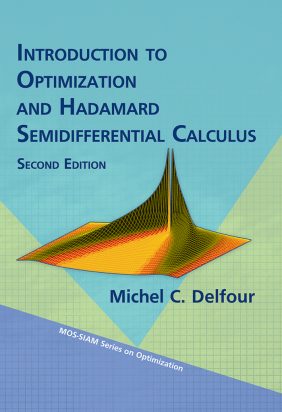
Michel C. Delfour
SIAM 2019, 423 PAGES
PRICE (HARDBACK) £87.00 ISBN 978-1-61197-595-6
This book, which consists of five long chapters, is aimed at advanced undergraduates. For this reason, the exposition is limited to variables in finite-dimensional spaces, avoiding the complexities of functional analysis.
The chapters are as follows: Chapter 1 – Introduction. This contains sections on maxima and minima, calculus of variations, a description of the other chapters and background material for the book. The book has two objectives: to find the weakest conditions for the existence of a point that achieves the extremum point of a function and secondly to characterise the points achieving that extremum. This is achieved via differentiation. Depending on the function involved this can mean applying increasingly weak definitions of differentiability, from semidifferentials to upper or lower semidifferentials.
Chapter 2 – Existence, Convexities, and Convexification. It is clear from the Weierstrass theorem that two properties are required for infimum and supremum, these are compactness and continuity of a function defined in a domain. For the purposes of the book, continuity can be relaxed to lower semicontinuity. Compactness can also be replaced by Ekeland’s principle. Thus, the chapter sections are: Weierstrass Existence Theorem; Extreme of Functions with Extended values; Lower and Upper Semicontinuities; Existence of Minimizers; Ekeland’s Variational Principle; Convexity, Quasiconvexity, Strict Convexity and Uniqueness; Convexification and Fenchel–Legendre Transform. Ekeland’s Principle is usually used in infinite dimensional function spaces but a finite-dimensional version is provided here.
Chapter 3 – Semidifferentiability, Differentiability, Continuity, and Convexities. This visits historical definitions of differentiability in order to identify a suitable approach to differentiating functions that are not normally considered differentiable. This is necessary as optimization can lead to the need to use functions that are not classically considered differentiable. The sections of the chapter are as follows: Real-Valued Functions of a Real Variable; Real Values Functions of Several Real Variables; Convex and Semiconvex Functions; Semidifferential of a Parametrized Extremum; Summary of Semidifferentiability and Differentiability.
Chapter 4 – Optimality Conditions. This chapter presents several general optimality conditions to characterise local and global minima of semidifferentiable or differentiable objective functions. The following sections are in the chapter: Unconstrained Differentiable Optimization; Optimality Conditions for U Convex; Admissible Directions and Tangent Cones to U; Orthogonality, Transposition, and Dual Cones; Necessary Optimality Conditions for U Arbitrary; Affine Equality and Inequality Constraints; Quadratic Programming; Glimpse of Optimality via Subdifferentials.
Chapter 5 – Differentiable and Semidifferentiable Constrained Optimization. Here we are concerned with constraints that are not affine. If the constraint qualification property applies then the saddle point equations of the Lagrangian are still satisfied. The sections of the chapter are Equality Constraints: Lagrange; Equality Constraints: Karush, John, and Kuhn–Tucker; Mixed Equality and Inequality Constraints: Mangasarian–Fromovitz. So, the sections of the chapter introduce the recommended approach for increasingly complicated constraints.
The remainder of the book consists of a number of appendices: Inverse Function Theorem, Answers to Exercises, and Hadamard Semidifferential: Functions Defined on Arbitrary Sets. The book states that it is aimed at undergraduates. I would suggest the truth is more that it is aimed at, at least, senior undergraduates. The material is quite demanding for undergraduates, although I certainly concede the point that the analysis is limited to finite-dimensional vector spaces so as to avoid the need for Functional Analysis. I found it to be an interesting book. I decided to review it due to a strong interest in all kinds of calculus.
John Bartlett CMath MIMA
Book review published directly onto IMA website